
A marketing platform is the operating control center that connects your customer data, outreach channels, creative assets, approval workflows, and performance measurement into one coordinated process. Think of it less as "software" and more as the system that decides what happens next after a customer takes any action. When someone visits your pricing page, a platform can trigger a follow-up email, update their contact record, and queue a review request — all without you touching a thing.
Three things a marketing platform does at its core:
- Centralizes your contacts, content, and campaign assets so nothing lives in a silo
- Automates triggers and follow-up sequences based on real customer signals
- Connects performance data back to specific actions so you know what's actually working
Table of Contents
- What does a marketing platform actually include?
- Why marketing platforms matter for small businesses and solo professionals
- How do you choose the right marketing platform?
- Your practical 30/60/90 implementation roadmap
- What does a marketing platform look like in practice?
- Security and privacy considerations when using a marketing platform
- Key Takeaways
- The part most guides skip about marketing platforms
- What Rooted Up does for Tennessee professionals who want this working
- Useful sources and further reading
What does a marketing platform actually include?
A marketing platform is built from six interlocking components. Understanding each one helps you evaluate whether a platform fits your business or just adds complexity.

| Component | What it does for your business |
|---|---|
| CRM / contact data model | Stores every customer interaction in one record; drives personalization |
| Channel layer (email, SMS, social, web) | Delivers messages across touchpoints from a single interface |
| Automation / trigger engine | Fires sequences when a contact takes a defined action |
| Asset & approval workflows | Manages content creation, brand review, and publishing sign-off |
| Analytics / attribution | Ties revenue and conversions back to specific campaigns |
| Integrations / API layer | Connects your booking tool, CRM, ad accounts, and other apps |
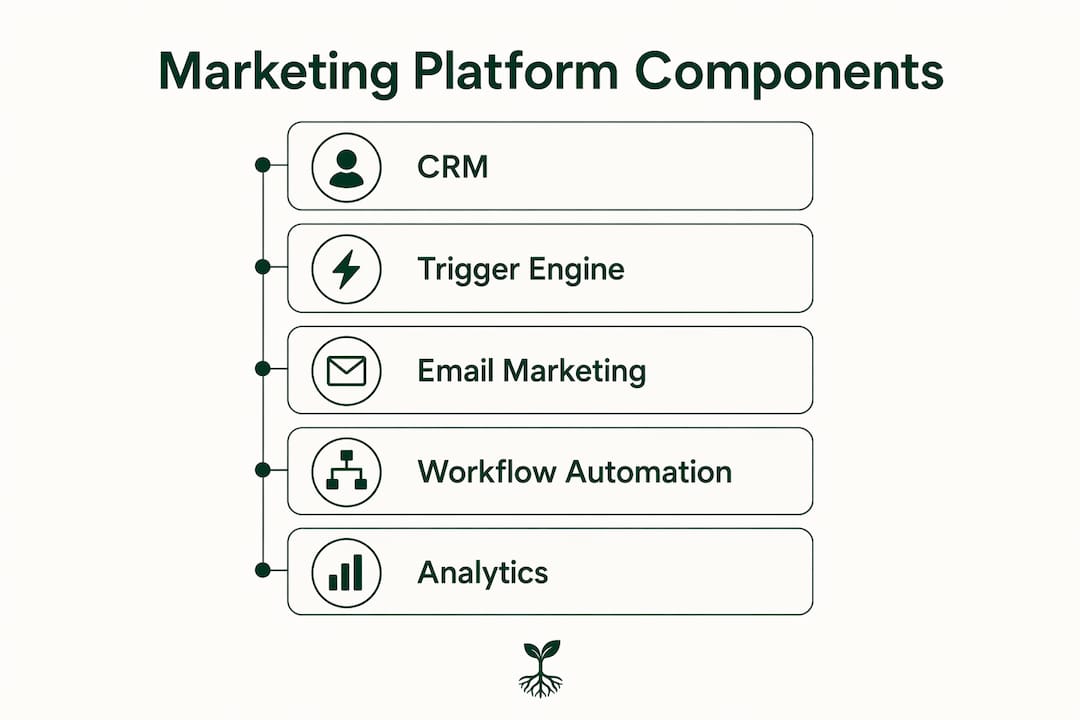
The trigger engine is where the real leverage lives. A prospect visits your pricing page → the platform tags them, sends a nurture email, and notifies you. A client submits a review → a thank-you workflow fires, and the platform updates their reputation score. One customer signal, multiple coordinated actions, zero manual handoffs.
The central trade-off in platform selection is consolidation versus channel depth. All-in-one platforms bundle CRM, email, SMS, funnels, and automation under a single data model, which keeps your records consistent and your overhead low. Best-of-breed stacks let you go deeper on a specific channel — say, SMS deliverability or advanced ad attribution — but they require more integration work and more places for data to break.
Pro Tip: Before you evaluate any platform, map the one workflow that costs you the most time each week. That workflow should be the first thing you test in any trial — not the prettiest dashboard feature.
Why marketing platforms matter for small businesses and solo professionals
The biggest misconception is that a marketing platform is just email software with extra steps. It isn't. The correct mental model is a control center: one place where a customer signal in any channel can trigger a coordinated response across every other channel.
For solo professionals, the constraint isn't ideas or even budget. It's approval bandwidth — the hours spent manually following up, posting, and chasing responses. A platform removes that ceiling.
64% of solopreneurs use generative AI for marketing, and AI is estimated to handle 10–40% of a solo operator's workday. That shift makes one-person marketing teams genuinely viable — but only when the platform underneath connects those AI outputs to real customer data and consistent follow-up.
Two concrete shifts a platform creates for a solo professional:
- A new inquiry comes in at 9 PM on a Tuesday. Without a platform, it sits until morning. With one, an automated welcome sequence fires immediately, books a discovery call, and tags the contact for follow-up — before you've looked at your phone.
- You publish a blog post once. The platform distributes it to your email list, schedules social posts, and triggers a retargeting audience update. One action, five outputs.
Scaling beyond a single marketer is less about adding acquisition tools and more about choosing platforms that reduce approval and review overhead. Consistency beats episodic bursts of activity every time.
How do you choose the right marketing platform?
Start with your data model. If a platform can't unify your contacts into a single record that every channel reads from, you'll end up with duplicate contacts, broken automations, and attribution gaps. That's the first red flag to screen for.
Prioritized selection checklist:
- Does it maintain a single contact record across all channels?
- Can you build an end-to-end automation without writing code?
- Does it cover the specific channels your clients actually use?
- Is the reporting tied to revenue, or just vanity metrics like opens?
- What does migration look like — can you import existing contacts cleanly?
- Is pricing transparent, or does it scale unpredictably with contact volume?
- What does onboarding support look like after day one?
Demo questions worth asking: Ask the vendor to show you a live automation that starts with a contact action and ends with a measurable output. Ask what happens to your data if you cancel. Ask for documentation on their API — sparse docs are a reliable signal of a brittle integration layer.
Red flags: no unified contact model, opaque pricing that jumps at contact thresholds, integrations that break when a third-party app updates, and onboarding that's just a video library with no live support.
Choosing an all-in-one platform often reduces overhead and simplifies data consistency — attractive for small teams unless a specific channel requires specialist depth. For most solo professionals in Tennessee, the consolidation benefit outweighs the channel-depth trade-off.
Pro Tip: During a free trial, build one complete flow from lead capture to follow-up email to conversion tag. If you can't complete that loop in the trial period, the platform is too complex for your current team size.
Your practical 30/60/90 implementation roadmap
| Window | Focus | Key deliverables |
|---|---|---|
| Days 1–30 | Setup and data | Import contacts, map fields, connect integrations, set brand voice guardrails |
| Days 31–60 | Automation | Build 2–3 core sequences (welcome, follow-up, review request); test triggers |
| Days 61–90 | Optimization | Review KPIs, refine underperforming sequences, add one new channel or workflow |
Onboarding checklist before you launch:
- Audit existing contacts and remove duplicates before importing
- Map every data field to the platform's contact model
- Set brand voice guidelines in any AI-assisted content tools
- Keep a human in the approval loop for the first 30 days of any new automation
- Back up your legacy data before migrating anything
KPIs to track in the first 90 days:
- Email open rate and click-through rate (baseline, then week-over-week trend)
- Lead-to-appointment time (how many days from first contact to booked call)
- Inquiry-to-booking conversion rate
- Review volume and average rating (for local businesses)
- Cost per acquired client
- Time saved on manual follow-up (estimate in hours per week)
For AI-driven workflow automation, apply it to the highest-friction, repetitive tasks first — content drafts, scheduling, basic reporting — and free your time for decisions that require judgment.
What does a marketing platform look like in practice?
Local service business — lead qualification and booking: A Tennessee-based consultant embeds a contact form on their site. Every submission triggers a qualification sequence: one email with a case study, one SMS with a calendar link, one internal notification. Leads who book within 48 hours are tagged as high-intent. Expected outcome: inquiry-to-booking rate improves within the first 60 days, and manual follow-up drops to near zero.
Solo consultant — nurture sequence: A new contact downloads a free resource. The platform starts a five-email sequence over three weeks, each email tied to a specific pain point. Contacts who open three or more emails get flagged for a personal outreach. The sales cycle shortens because the platform does the warming before the human conversation starts.
Local microbrand — reputation and content workflow: Every completed service triggers a review request. Positive reviews feed into a social proof library. AI prospecting tools can layer on top to identify new local leads while the platform handles existing client follow-up. The compounding effect: more reviews improve local search rankings, which drives more inquiries, which the platform qualifies automatically.
A practical solo marketing stack focuses on compounding channels — organic search, consistent email, and automated distribution — rather than chasing every new channel. The platform makes that consistency possible without burning out the person running it.
Security and privacy considerations when using a marketing platform
Every marketing platform stores contact data, behavioral signals, and sometimes payment-adjacent information. That creates real obligations. At minimum, confirm that any platform you use is compliant with the CAN-SPAM Act for email and the Telephone Consumer Protection Act (TCPA) for SMS — both apply to U.S. businesses regardless of size.
Look for platforms that offer role-based access controls so not every team member or contractor can export your full contact list. Data encryption at rest and in transit is a baseline expectation, not a premium feature. Ask specifically where your data is stored and what the vendor's breach notification policy is.
For Tennessee-based businesses collecting customer data through web forms or booking tools, review your privacy policy to confirm it accurately describes how you use that data. If you use AI-assisted personalization, disclose it where required. The FTC has increased scrutiny of automated marketing practices, so keeping your consent records clean — who opted in, when, and how — protects you if questions arise.
Key Takeaways
A marketing platform functions as a control center that connects data, channels, and automation so one customer signal can trigger coordinated follow-up across every touchpoint without manual work.
| Point | Details |
|---|---|
| Control center, not just software | A platform connects CRM data, channels, automation, and analytics into one coordinated system. |
| Automation is the real leverage | Trigger-based sequences handle follow-up, review requests, and nurture without manual intervention. |
| Biggest selection red flag | No unified contact model means broken automations and attribution gaps — screen for this first. |
| First implementation step | Import clean contact data and build one end-to-end automation before adding complexity. |
| Rooted Up for Tennessee professionals | Rooted Up's monthly plans cover Google Business Profile, review automation, SEO content, and AI workflow setup — the core platform functions, done for you. |
The part most guides skip about marketing platforms
Most articles about marketing platforms spend their energy on feature lists. What they underestimate is the approval bandwidth problem — the invisible ceiling that stops solo professionals from growing even when they have the right tools.
The platform isn't the hard part. The hard part is that most small business owners set up an automation, get nervous about what it's sending, and quietly turn it off after two weeks. Then they're back to doing everything manually, just with a more expensive subscription.
The fix isn't more features. It's starting with one automation you trust completely — a welcome email, a review request, a booking confirmation — and letting it run long enough to see results. Consistency over 90 days outperforms a sophisticated but fragile 12-automation stack every time.
What Rooted Up does differently is stay in the loop during that trust-building phase. The advisory sessions and monthly check-ins aren't upsells — they're the mechanism that keeps automations running instead of getting quietly disabled. That's the implementation detail most platform vendors don't mention because they sell software, not outcomes.
What Rooted Up does for Tennessee professionals who want this working
Solo professionals and small business owners in Tennessee don't need a bigger tool stack. They need the platform functions — consistent content, automated follow-up, local search visibility, and reputation management — running reliably every month.

Rooted Up's monthly subscription plans cover exactly that: Google Business Profile management, review automation, monthly SEO blog posts, newsletters, AI workflow audits, and custom AI integrations for the administrative tasks that eat your week. No agency retainer, no six-month contract, no guessing which features you actually need.
The practical next step is a free discovery call where Rooted Up maps your current workflow gaps to the specific automations that would close them. See what's included and book a call directly from the services page.
Useful sources and further reading
- What Is a Marketing Platform? A Complete Guide — JoinBrands — definition and control-center framing
- How to Choose an All-in-One Marketing Platform — Rework Resources — consolidation vs. best-of-breed trade-offs
- AI for Small Business Marketing — Factors.ai — where to apply AI automation first
- One-Person Marketing Team Tools — Intempt — scaling limits and approval bandwidth
- New Business Formation Report — Gusto — solopreneur AI adoption figures
- AI Marketing Stack for Solopreneurs — ShelbyAI — compounding channel strategy and automation priorities