
Use a short, automated welcome series of 3 to 5 emails, and send the first one within minutes of signup. That immediate first message captures a reader at their most curious, which is why Alex Berman's B2B newsletter research treats it as the highest open and click event you'll ever get from that subscriber. Everything below covers timing, templates, triggers, and how to measure whether the sequence is actually working.
TL;DR:
- A welcome series typically consists of 3 to 5 automated emails sent over one to two weeks, each with a specific purpose like delivering value or addressing objections.
- The first email should be sent immediately after signup to capitalize on the subscriber's peak attention and confirm the promised offer or content.
- Behavior triggers such as clicking links or making purchases can improve sequence relevance, but time delays suffice for small lists or less engaged audiences.
- Measuring success involves tracking series completion, click rates, and conversion data, ideally through holdout tests comparing subscribers who receive the sequence against those who do not.
- For solo creators, starting with a compact three-email sequence that delivers, proves, and asks is more practical than a full five-email series, with automation and testing prioritized before expansion.
Table of Contents
- What Is a Newsletter Welcome Series, and Why Does It Matter?
- The 5-Email Welcome Sequence: Timing, Jobs, and Exit Rules
- Welcome Email Templates: Subject Lines and Copy You Can Adapt
- Should You Use Behavior Triggers or Time-Based Delays?
- How to Measure If Your Welcome Series Is Working
- Setting Up and Launching Your Welcome Series: A Pre-Flight Checklist
- What Solo Creators Should Actually Prioritize First
- How Rooted Up Builds and Manages Your Welcome Series
- Sources
- FAQ
What Is a Newsletter Welcome Series, and Why Does It Matter?
A welcome email is one message. A newsletter welcome series is a scheduled run of several automated emails, each with a different job, sent over roughly one to two weeks after someone joins your list. The distinction matters because a single email can only do one thing: confirm the signup. A series can deliver value, build trust, answer objections, and ask for a next step, in that order.
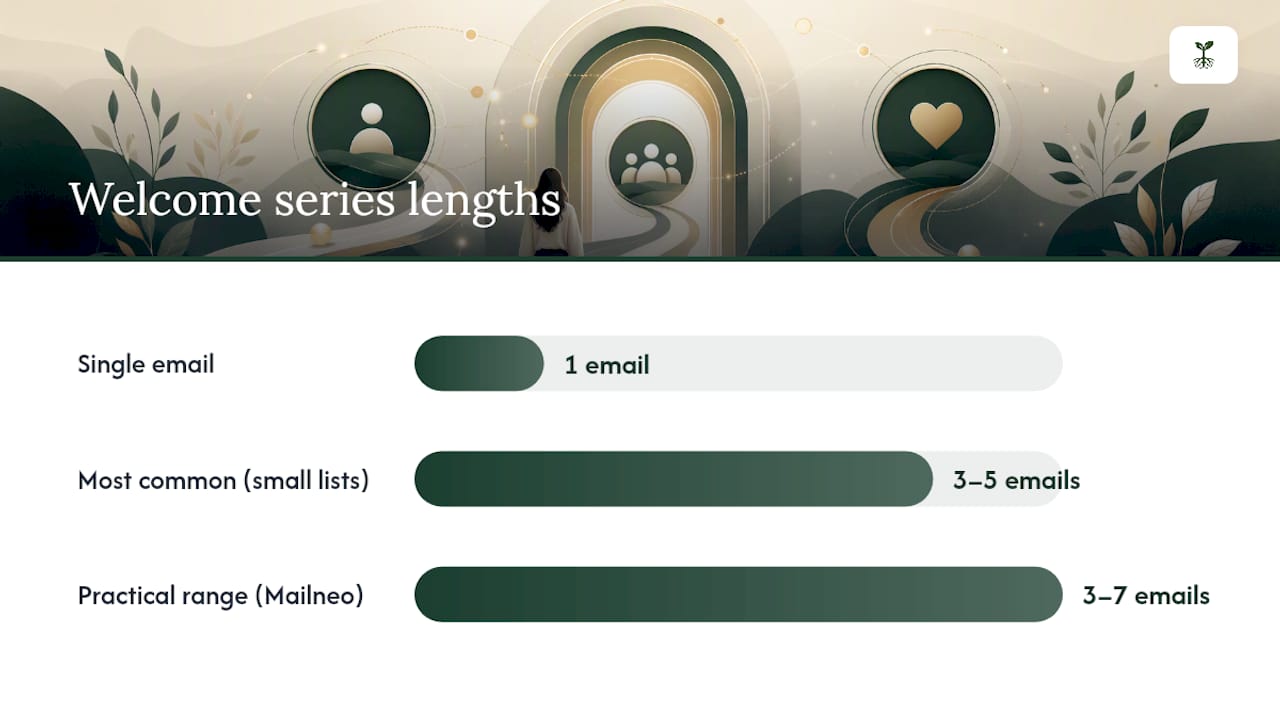
The "welcome window" is the short stretch right after signup when a subscriber is paying the closest attention they ever will. Wait a day to send that first email and you lose most of that attention. Mailneo's research on welcome sequences puts the practical range at 3 to 7 emails, with 3 to 5 being the most common structure for small lists.
When is one email enough? Stick to a single message for purely transactional flows, like a receipt confirmation or a password reset. Reach for a full series when the goal is relationship building:
- You're introducing a paid newsletter for small business audiences and need to justify the subscription.
- You want subscribers to recognize your voice before you ever pitch anything.
- You're running an onboarding email sequence tied to a product trial or service signup.
The 5-Email Welcome Sequence: Timing, Jobs, and Exit Rules
Each email in the sequence needs exactly one job. Stacking two goals into one message (say, delivering value and pitching a sale) dilutes both. Here's the sequence order that holds up across most small business newsletters:
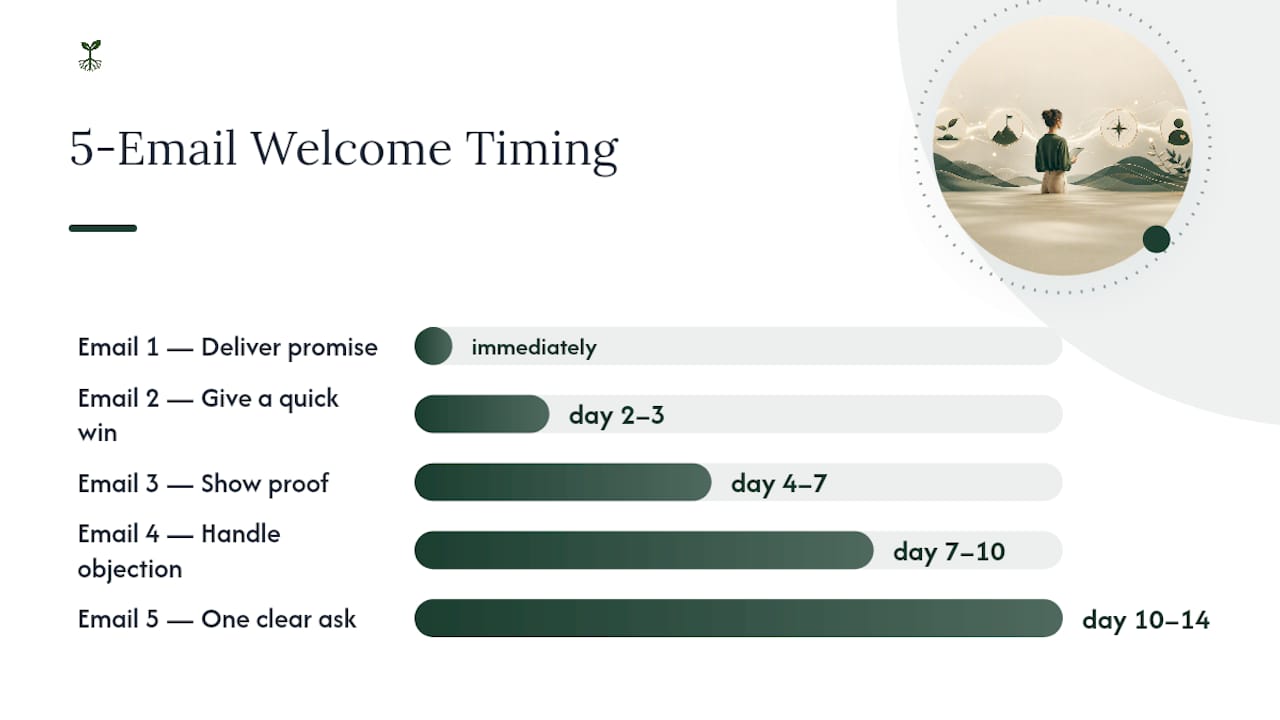
- Email 1, sent immediately: Deliver whatever you promised at signup (a lead magnet, a discount code, access to content) and set expectations for what's coming. Delays here measurably hurt open rates, according to Berman's newsletter data.
- Email 2, day 2 to 3: Share one useful insight or a quick win. No pitch. This is where you earn the right to be in someone's inbox.
- Email 3, day 4 to 7: Show proof. A case study, a client result, or a specific number works better than a general claim about your credibility.
- Email 4, day 7 to 10: Handle the objection you know is coming. Answer the FAQ nobody asked out loud yet.
- Email 5, day 10 to 14: Make one clear ask. A trial, a purchase, a reply. Not three asks. One.
Exit rules matter as much as the timing. If a subscriber replies, purchases, or completes an activation step (like confirming a preference or clicking a key link), skip the remaining pitch emails. Sending a sales email to someone who already bought reads as sloppy, and Mailgun's welcome email guidelines recommend building that branch logic in from the start rather than patching it later.
Timing details count too. Match sends to the subscriber's signup time zone when your platform supports it, and for B2B newsletters, skip weekend sends entirely. A Saturday morning email to a business inbox usually just sits there until Monday, buried under everything else.
Welcome Email Templates: Subject Lines and Copy You Can Adapt
Your first email carries the most weight, so it deserves a subject line that states the payoff plainly rather than teasing it. Below are starting templates for each slot in the sequence.
- Email 1 subject: "Here's your [item], plus what to expect" — preheader: "One quick thing before you dig in."
- Email 2 subject: "The one thing most people miss about [topic]"
- Email 3 subject: "How [example] got [specific result]"
- Email 4 subject: "Quick answer to something you're probably wondering"
- Email 5 subject: "Ready when you are"
For body copy, write two versions: one conversational, one more formal, and pick based on your brand voice.
Conversational opener: "Hey, thanks for signing up. Here's the [item] I promised, no strings attached."
Formal opener: "Thank you for subscribing. Attached is the [item] you requested, along with a brief overview of what to expect from future emails."
Each CTA should support exactly one action: "Read the guide," "Reply and tell me," "See the case study," "Book a time." Avoid stacking a secondary link "just in case," since a second option splits attention and usually lowers clicks on the primary one. Browsing a gallery like Really Good Emails is a fast way to see how other brands frame layout and tone before you write your own.
Pro Tip: Draft email 1 last, after you've written the rest of the sequence. You'll have a clearer sense of what you're actually promising once you know what follows it.
Should You Use Behavior Triggers or Time-Based Delays?
Time-based delays work fine for a small list. Behavior triggers work better once conversion is the goal, because they respond to what the subscriber actually does instead of assuming everyone moves at the same pace. Mailgun's guidance on welcome flows is direct on this point: trigger the next email only if the subscriber hasn't completed the target action yet, not on a fixed clock.
Practical triggers to build around:
- Opened or clicked a specific link (send the next email sooner, since they're engaged).
- Completed an onboarding step, like setting a preference or confirming an account.
- Made a purchase (this should cancel any remaining pitch emails automatically).
When you don't have behavior data, whether the platform doesn't track it or the subscriber hasn't acted, fall back to the time-based schedule from the sequence above. Behavioral branching adds real setup complexity, so it only pays off once your list reaches a few thousand active subscribers, or when activation ties directly to revenue. Below that threshold, a clean time-based sequence gets you most of the benefit for a fraction of the build time.
How to Measure If Your Welcome Series Is Working
Track series completion rate, clicks per email, conversion per recipient, and unsubscribe rate by position in the sequence. If email 4 is losing people, that's the one to rewrite first.
The cleanest way to prove the series is driving revenue rather than just activity is a holdout test. Route roughly 10% of new subscribers into a control group that gets no series for 30 days, then compare their outcomes against the group that did. Mailneo's sequence research recommends this exact structure for attributing lift.
For A/B testing, focus your effort on two things: the email 1 subject line, since it decides whether anyone reads further, and the CTA on the offer email, since that's the one carrying the ask. Run these tests sequentially rather than all at once, so you know which change actually moved the number. Early opens and clicks also function as trust signals to mailbox providers, which tends to help deliverability on every email you send afterward, not just the welcome series.
Setting Up and Launching Your Welcome Series: A Pre-Flight Checklist
- Choose the right trigger: confirmed opt-in, not raw signup, so you're not welcoming addresses that never verified.
- Segment by signup source (lead magnet, event, referral) so email 1 can reference how they actually found you with practical list-growth strategies.
- Set suppression rules that block regular campaign sends until the series finishes, and exclude recent purchasers or existing customers from a new-subscriber flow they've already outgrown, a step Tented's guidance on welcome series flags as commonly overlooked.
- Run render tests across major email clients, click every link, and confirm exit conditions actually fire.
- Launch your holdout group at the same time as the series itself, not after.
Pro Tip: Put a recurring reminder on your calendar every 3 to 6 months to review series metrics and rewrite whichever email has the weakest numbers. A welcome series isn't a set-it-and-forget-it asset.
What Solo Creators Should Actually Prioritize First
If you're running this alone, skip the 5-email version at launch. Build a tight 3-email series first: deliver, prove, ask. Add branching later, once you can point to a specific pattern in the data worth automating around.
Outsourcing the automation setup and letting AI handle first-draft copy preserves quality without eating your week. Measure before you expand. A longer sequence you haven't tested is just more surface area for something to go quietly wrong.
— Jason
How Rooted Up Builds and Manages Your Welcome Series
Some services offer an alternative to hiring an agency or building your own automation stack for a newsletter welcome series by providing one monthly plan that covers the setup, AI-assisted drafting, and ongoing operations, rather than billing separately for each piece or leaving you to build it solo. That matters most for the solo professionals and small teams this guide is written for, since the actual bottleneck is rarely knowing the sequence structure. It's finding the hours to build it, QA it, and keep rewriting the weak email every few months.
Rooted Up's Foundation and Growth plans include newsletter setup and monthly operations alongside Google Business Profile management and review automation, so your welcome series isn't a standalone project competing for attention with everything else on your plate. If you want the sequence built, tested, and handed off with reporting attached rather than assembled piecemeal, review the plans on the Rooted Up site or ask about a Foundations Sprint if you need the setup done as a single project first.
Sources
- How to Set Up an Email Welcome Sequence (With Examples) — Mailneo
- B2B newsletter best practices that drive revenue — Alex Berman
- Welcome email best practices — Mailgun
- Welcome email examples & designs — Really Good Emails
FAQ
How Many Emails Should Be in a Welcome Series?
Three to five emails is the practical range for most small business newsletters, though Mailneo's research notes sequences can run up to seven for more complex onboarding. Each email needs its own job: deliver, engage, prove, address objections, and ask.
Are Newsletters Still Relevant in 2026?
Yes. Email remains one of the few channels where you own the relationship instead of renting attention from a social algorithm, and a well-built welcome series is what turns a cold signup into an engaged reader. The businesses seeing the strongest results treat the first two weeks after signup as the highest-leverage window they have.
Can You Provide Examples of Email Welcome Series?
A typical five-email version runs: an immediate delivery email, a value-only tip a few days later, a proof or case study email, an objection-handling email, and a single clear ask around day 10 to 14. For visual and subject-line inspiration, browsing a curated collection like Really Good Emails is faster than starting from a blank page.
What Is a Good Welcome Message for a Newsletter?
A good welcome message delivers on the exact thing you promised at signup and tells the reader what to expect next, without asking for anything yet. Keep it short, send it within minutes of signup, and save any sales ask for a later email in the sequence.