
NAP consistency means your business name, address, and phone number appear identically across every online listing that mentions you. If a searcher or Google finds three different phone numbers for the same business, treat that as a problem to fix today. Pick one canonical version of your NAP, publish it on your website and Google Business Profile first, then use that exact version everywhere else.
TL;DR:
- Ensuring your NAP is consistent across all listings improves local search visibility, ranking in the local pack, and prevents lost customer calls.
- Major inconsistencies include mismatched phone numbers, incorrect suite or address details, and duplicate or outdated listings, especially from aggregators.
- Regular audits should focus on your website, Google Profile, and key directories, with updates verified every four to twelve weeks.
- Use a standardized format for addresses and phone numbers in structured data to prevent machine-readable errors and improve search engine understanding.
- Ongoing monitoring and maintenance are essential to prevent drifting and ensure your local presence remains accurate and authoritative.
Table of Contents
- What Counts as a Real NAP Inconsistency
- Why This Actually Affects Your Rankings and Your Phone
- How to Run a NAP Audit Step by Step
- Fixing the Five Problems That Show Up Most Often
- Tools, Automation, and When to Bring In Help
- Getting the Technical Details Right
- How Often You Should Check Your Listings
- Why Solo Professionals Can't Afford to Treat This as a One-Time Fix
- Keep Your Listings Clean Without Adding It to Your To-Do List
- Sources
What Counts as a Real NAP Inconsistency
Not every mismatch is worth losing sleep over. Search engines are reasonably good at recognizing that "St" and "Street" refer to the same address. What they can't reconcile is a business showing up with two different phone numbers or a missing suite number that puts you in a different unit entirely.
Your website should function as the single source of truth, sometimes called NAP+W when you include the URL as a fourth data point. Every other listing should mirror what's on your site, not the other way around. That matters because directories pull data from your site far more than the reverse, and Moz's guidance on NAP explains that search engines lean on this cross-referencing to confirm a business is real, active, and located where it claims to be.
There's also a machine-readable layer most owners never check. Your visible phone number might read (615) 555-0142, but the code behind it should use a tel:+16155550142 format so phones and voice assistants can dial it directly. The same logic applies to LocalBusiness schema markup, which we'll cover in more detail later.
Harmless variation:
- "St" vs. "Street," "Ave" vs. "Avenue"
- Minor capitalization differences
- Optional "Suite" vs. "Ste" abbreviation
Real problems:
- A tracking number listed instead of your primary line on Google Business Profile
- A missing or wrong suite number that sends customers to the wrong door
- An old address still live on a directory after you've moved
Document your canonical NAP in a shared file. Every future listing, press mention, or partnership page should copy from it.
Why This Actually Affects Your Rankings and Your Phone
Search engines don't inherently know that "Smith Dental" on Yelp and "Smith Dental Associates, PLLC" on a chamber of commerce site are the same practice. They infer it by cross-referencing name, address, and phone across sources. When those details line up, Google can confidently connect your reviews, backlinks, and map listing into one entity profile. When they don't, you fragment your own trust signals across multiple half-formed identities.
By the numbers: A 2026 audit from Backlynk found that 73% of businesses had NAP inconsistencies somewhere across 41 platforms checked, and businesses with fully consistent NAP appeared in the local pack noticeably more often than those with mismatches.
The customer-facing cost is just as real. A missed call because the wrong number is still live on an old directory listing is a lost customer, full stop, and it never shows up in your analytics because the call never reached you. A wrong suite number sends a walk-in to the wrong floor, and most people won't call to ask for directions. They'll just try the next business on the map.
BrightLocal's research on local ranking factors ties consistent citations and an optimized Google Business Profile directly to stronger local pack visibility. NAP consistency isn't the entire ranking algorithm, but it directly supports what Google calls "prominence," one of the three pillars of local ranking alongside relevance and distance. A handful of the practical issues that erode it:
- Duplicate listings splitting your reviews across two profiles
- A tracking number showing up where your real number should be
- Aggregator data that never got updated after a move
How to Run a NAP Audit Step by Step
This is the exact sequence Rooted Up uses when onboarding a new client, and it works whether you do it yourself over a weekend or hand it to an assistant.
- Set your canonical NAP first. Before you search for anything, write down the exact name, address (with suite number), and phone number you want to appear everywhere. Match this to what's legally registered with the state and what's printed on your signage.
- Check the big three authoritative sources. Your website's footer and contact page, your Google Business Profile, and then Apple Maps Connect and Bing Places. These four feed a huge portion of downstream discovery, so any error here multiplies.
- Search the major directories and aggregators. Yelp, BBB, Foursquare, and data aggregators like Data Axle and Neustar/Localeze all warehouse business data that other sites pull from automatically. A single wrong entry at an aggregator can quietly re-infect a dozen smaller directories months later.
- Log everything in a spreadsheet. Track the source name, the NAP currently listed there, what specifically is wrong, the fix you're applying, the date, and a status column. This turns a chaotic search into a project you can actually finish.
- Prioritize your fixes. Start with Google Business Profile and your website, since those carry the most weight and feed other sources. Move to the four major aggregators next, then major directories, then niche or industry-specific listings.
- Verify propagation. Recheck your fixed listings after four to twelve weeks. Aggregator-fed directories update on their own schedule, and some corrections take longer to trickle down than you'd expect.
Pro Tip: Do a quick manual gut check before touching any tool: Google your business name plus "phone number" in an incognito browser. Whatever comes up in the top results is what most customers will trust, whether it's accurate or not.
A simple site:yelp.com "your business name" search or similar queries against major directories will surface stale listings fast, no paid tool required for a small, single-location business.
Fixing the Five Problems That Show Up Most Often
Certain NAP problems repeat across almost every business Rooted Up has audited. Here's how to handle each one.
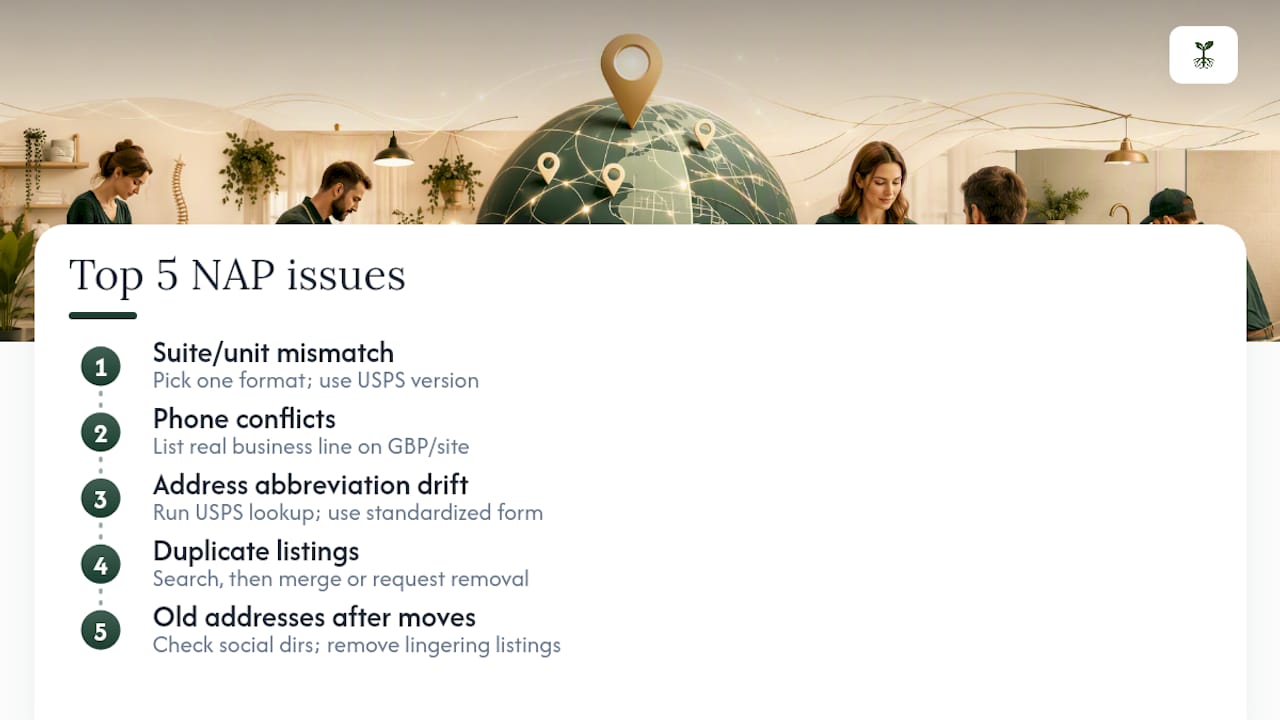
Suite and unit number mismatches. Pick one format (Suite 210 vs. Ste. 210 vs. #210) and use it identically on your website and Google Business Profile. When in doubt, match the USPS-standardized format for your exact address, since some directories validate against postal databases automatically.
Phone number conflicts. Your primary listed number on GBP and your website should be your real business line, not a call-tracking number. If you use dynamic number insertion (DNI) for marketing attribution, keep the tracking number visible only on the specific landing pages tracking that campaign, never on your homepage or GBP.
Address abbreviation drift. "123 Main St" and "123 Main Street" rarely cause real damage, but run your address through USPS's address lookup once to confirm the standardized version, then use that everywhere going forward.
Duplicate listings. These usually happen after a rebrand, an ownership change, or an old franchise listing that never got removed. Search your business name plus your city to spot duplicates, then merge or request removal directly through each platform's support process. For persistent duplicates on Google, you may need to escalate through Google Business Profile support directly.
Old addresses lingering after a move. Google's own support forums confirm this is a common pain point, particularly for service-area businesses that hide their exact address. Old addresses tend to linger on social profiles and smaller directories long after the official move, so check those specifically rather than assuming your GBP update handled everything.
Tools, Automation, and When to Bring In Help
A citation-scanning tool can crawl dozens of directories in minutes and flag every mismatch it finds, using AI-assisted local discovery and automation to speed the process far beyond any manual search. What most tools can't do is push a correction to every directory automatically. Many require manual claim-and-edit on the directory side, especially for aggregators with their own verification process.
Manual audits work fine for a single-location business checking its listings once a quarter. A managed subscription makes more sense once you're dealing with multiple locations, frequent address or phone changes, or a competitive market where a rival's clean listings are outranking yours.
When evaluating a tool or vendor, look for:
- Coverage of Apple Maps and Bing Places, not just Google
- Documented speed of propagation to major aggregators
- Support for correcting duplicate listings, not just flagging them
- Transparent reporting you can actually read without a training session
If a DIY audit turns up more than a handful of serious mismatches, the hours it takes to chase each one down by hand usually justify paying for a cleanup service instead.
Getting the Technical Details Right
Your canonical NAP needs to live in the code, not just the copy. Place it in your website footer, your contact page, any location pages, and inside your LocalBusiness JSON-LD schema, since that's what search engines parse directly rather than guessing from visible text.
Format your phone number as tel:+16155550142 in the code (E.164 format) so it's clickable and machine-readable, while the visible version on the page can stay friendly, like (615) 555-0142.
- Confirm your Google Business Profile's primary phone number matches your website and your schema exactly
- Keep tracking or DNI numbers on-site only, never inside your GBP listing
- Run your site through a structured data validator after any change
- Re-scan a few weeks later to catch anything a template update might have overwritten
How Often You Should Check Your Listings
NAP maintenance isn't a one-time project. Set a recurring calendar reminder:
- Monthly: Quick glance at your Google Business Profile for accuracy
- Quarterly: Full citation audit across directories and aggregators
- Within 30 days of any change: Address move, new phone line, or name change triggers an immediate re-audit, not a "get to it eventually"
Set up a branded search alert so you catch new listings automatically, and give propagation four to twelve weeks before assuming a fix failed. If mismatches keep reappearing despite your efforts, that's the signal to escalate to a paid cleanup rather than repeating the same manual search every quarter.
Why Solo Professionals Can't Afford to Treat This as a One-Time Fix
Most solo professionals fix their NAP once after launch and never look again. That's the mistake. Listings drift, aggregators re-import stale data, and a single old directory entry can undo months of consistent signals. Rooted Up builds the canonical NAP into onboarding, then monitors it continuously so clients never have to think about it again.
— Jason
Keep Your Listings Clean Without Adding It to Your To-Do List
Rooted Up handles the entire NAP audit and correction cycle as part of its monthly plans, so solo professionals get the same consistency a big-budget agency delivers without hiring one full-time. That means Google Business Profile management, schema fixes, and citation cleanup happen quarterly by default, not whenever you finally find the time.

Beyond citations, the same plans cover review automation and ongoing GBP optimization, so your local presence stays accurate and active instead of slowly drifting out of sync. If your listings haven't been checked since you launched, that's worth fixing before your next slow month, not after it. Take a look at Rooted Up's service plans to see what a managed cleanup and maintenance schedule actually looks like.
Sources
Consult Google Business Profile directly, BrightLocal's ranking research, and Backlynk's citation audit tool for deeper technical detail.