
The quickest path to a working marketing roadmap is a theme-based quarterly template, built in Google Sheets or PowerPoint, with three fields customized first: objective, owner, and milestone. Editable versions exist free in Excel, PowerPoint, Google Sheets, Slides, Canva, and Airtable. If you need to prove impact to leadership instead of rallying a team around a narrative, swap to a goal-based view. Either way, the customization takes under an hour once you know which fields matter.
TL;DR:
- Theme-based roadmaps are ideal for town halls and storytelling, organizing initiatives by quarterly themes like retention or new markets.
- Goal-based templates best serve executive reviews by mapping initiatives directly to measurable outcomes such as increasing inbound requests by a specific percentage.
- Maintaining multiple views, such as goal-based and theme-based, helps different stakeholders stay focused, but a single, updated source of truth reduces confusion.
- Effective roadmaps should include clear objectives, assigned owners, milestones with dates, status indicators, and KPIs, and should be reviewed regularly to stay current.
- Solo professionals should focus on one KPI, one owner, and upcoming milestone dates, minimizing overhead and handing off maintenance once efforts outweigh benefits.
Table of Contents
- Marketing Roadmap Template Formats and Views at a Glance
- Key Components Every Marketing Roadmap Template Should Include
- Which Template Fits Your Team: Rules of Thumb
- How to Customize a Simple Marketing Roadmap Template This Quarter
- When to Maintain Multiple Roadmap Views
- Presenting and Sharing Your Marketing Roadmap
- What Is a Marketing Roadmap Template?
- Aligning Your Marketing Roadmap With Business Strategy
- How to Prioritize Initiatives on a Marketing Roadmap
- Common Pitfalls When Building a Marketing Roadmap Template
- Incorporating Stakeholder Feedback Into the Roadmap
- Real Examples of Effective Marketing Roadmaps
- A Lean Take on Roadmaps for Solo Professionals
- A Done-for-You Option for Your Marketing Roadmap
- Where to Download Templates and Read Further
- Sources
- FAQ
Marketing Roadmap Template Formats and Views at a Glance
The file format you pick should match who has to open it, not what looks impressive. Excel and Google Sheets handle the working version, where formulas track budget burn and completion percentages. PowerPoint and Slides turn that same data into something you can present without anyone squinting at row 47. Canva makes a clean, brand-matched one-pager for an all-hands screen share. Airtable suits teams who want a searchable database view with filters by owner or channel.
The view you choose matters as much as the file type. Tempo's roundup of real-world roadmap formats breaks the options into four practical categories:
- Theme-based: organizes work by quarterly narrative ("Q1: Trust & Reviews"), best for town halls and cross-team storytelling
- Goal-based: maps initiatives directly to measurable outcomes, best for executive reviews
- Deadline-driven: built around a launch date with a countdown of dependencies
- By-person: shows who owns what and at what capacity, useful for spotting overload before it happens
If your team collaborates in real time, a shared Google Sheet beats a slide deck that goes stale the moment someone forgets to export a new version. Smartsheet's collection of free templates includes both working spreadsheets and presentation-ready exports, which solves the version-control problem by giving you one file for editing and one for sharing.
Key Components Every Marketing Roadmap Template Should Include
A roadmap template earns its keep only if the fields on it get filled out and kept current. Skip the ones that look sophisticated but nobody updates.
The components that consistently show up across effective templates are:
- Roadmap title and timeframe — what period this covers (quarter, half, year)
- Objectives or goals — the outcome each block of work supports
- Initiatives — the actual campaigns, projects, or workstreams
- Milestones — dated checkpoints inside each initiative
- Owners or assignees — one name per row, never a team
- Status — a simple indicator, not a paragraph
- Priority — high, medium, low, nothing fancier
- Required resources — budget, tools, or people needed
- KPIs — the metric that tells you if it worked
Monday confirms this same core set shows up across effective templates: timeframe, goals, initiatives, schedules, and status. A traffic-light column (green, yellow, red) or a percent-complete field covers status without forcing anyone to write updates nobody reads. Dependencies can be a simple text note ("depends on Q2 website launch") rather than a formal dependency-mapping tool.
Pro Tip: Cut any field you can't imagine someone updating weekly. A roadmap with 20 columns dies fast; one with 9 gets used.
Which Template Fits Your Team: Rules of Thumb
Match the view to the room you're presenting in, not to whichever template loaded first.
- Theme-based works best for town halls and company-wide updates. Structure it as quarterly theme columns ("Q1: Retention," "Q2: New Market Entry") with two or three initiatives under each. It tells a story without drowning people in task lists.
- Goal-based wins when you're sitting across from executives who want to know what the marketing spend bought. Map every initiative to a measurable outcome: "Increase inbound demo requests 20%" sits above the campaigns that support it.
- Deadline-driven fits product launches and event timelines. Build a pre-launch checklist with hard dates and named owners for each item, since ambiguity here is what causes missed launches.
- By-person solves capacity planning. List each team member with percent allocation across initiatives, which makes overload visible before someone burns out or a deadline slips quietly.
Solo professionals usually only need one of these. Everyone else benefits from keeping two views synced.
How to Customize a Simple Marketing Roadmap Template This Quarter
Building your own doesn't require starting from a blank grid. Follow this sequence and you'll have a usable roadmap before lunch, as explained in our guide on how to plan a content calendar for marketing success.
- Define the outcome, owner, and baseline metric first. Decide who owns the roadmap and what "success" looks like in a number, not a feeling. Sequencing work this way, starting from a clear objective before filling in tasks, tends to produce roadmaps that actually get followed, according to guidance on 90-day marketing roadmap cadence.
- Choose the view and file format for your audience. Executives get goal-based slides; your team gets a working theme-based sheet.
- List initiatives, map them to goals, and add milestones with due dates. Every initiative needs at least one dated checkpoint or it drifts.
- Assign owners, set status, and flag dependencies. One owner per row. If two initiatives block each other, say so in a note.
- Set your review cadence and keep a short version history. Weekly for operations, monthly for leadership is the pattern most teams settle into, with weekly checks tightening up during active launches.
Copy this row structure directly into Excel or a Slides table to start:
| Title | Initiative | Owner | Start/End | Milestone | KPI | Status |
|---|---|---|---|---|---|---|
| Q1 Retention Push | Review automation launch | J. Smith | Jan 5 / Feb | Automation live | a measurable increase in reviews per month | On track |
Pro Tip: A 90 day marketing plan works especially well as your first roadmap draft, since 90 days is long enough to show a trend and short enough that priorities don't shift underneath you.
When to Maintain Multiple Roadmap Views
Different audiences genuinely need different formats. Tempo's research on roadmap use cases found theme-based views work for town halls, goal-based views win executive buy-in, and deadline-driven views keep launches on track, which is why experienced teams commonly keep more than one synchronized version of the same underlying plan.
The trick to avoiding chaos is a single source of truth. Keep one master sheet with every field, then generate view-specific exports (a filtered goal view for the CFO, a theme view for the all-hands) rather than maintaining separate files that inevitably drift apart. Small teams under five people usually don't need this complexity. One view, kept current, beats three views, two of them stale.
Presenting and Sharing Your Marketing Roadmap
Show executives the outcomes, ops teams the timeline and dependencies, and the rest of the company the theme and overall progress. A one-slide roadmap should have a clear timeframe, your top three initiatives, color-coded status, and one explicit decision you need from the room.
- Export from your master sheet monthly and log what changed
- Keep the slide version to a single screen, never a scroll
- Store the working file and the slide export in the same shared folder
Pro Tip: Note every change in a one-line version log ("March 3: pushed launch to April") so nobody wonders if they're looking at the current plan.
What Is a Marketing Roadmap Template?
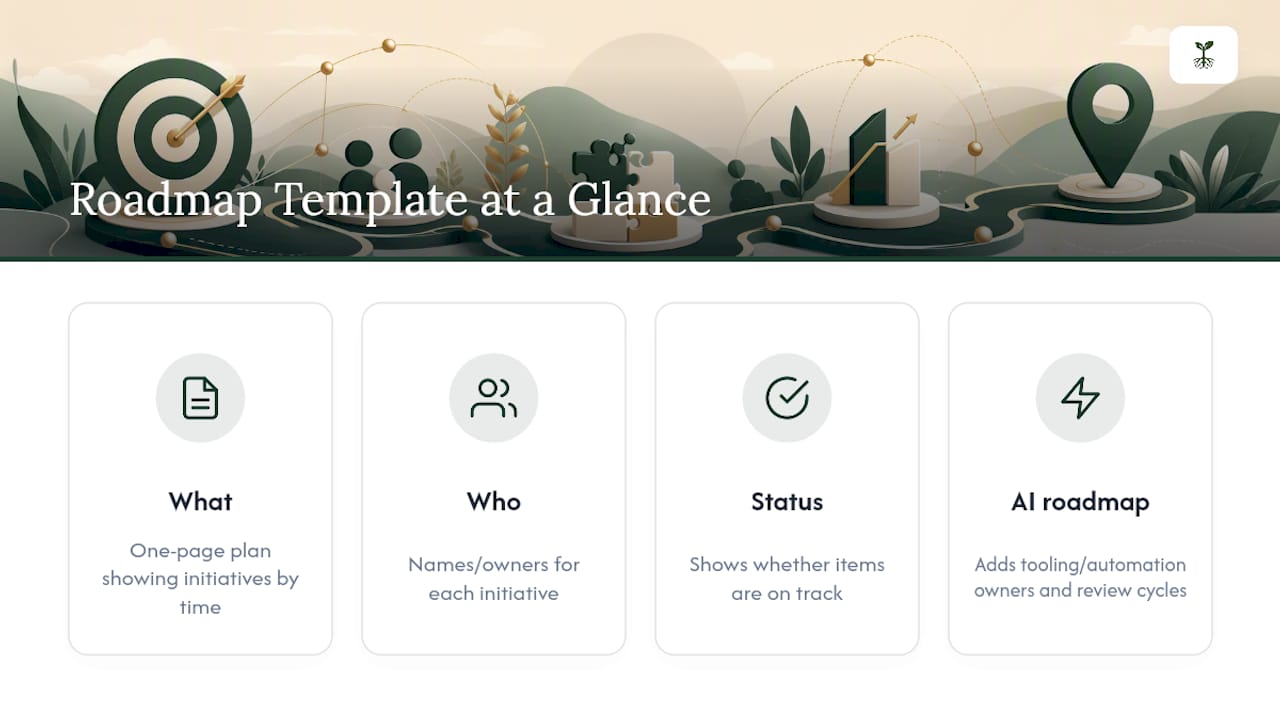
A marketing roadmap template is a reusable structure, usually a spreadsheet, slide, or board, that lays out marketing initiatives against time, ownership, and expected outcomes. It's a one page marketing plan in visual form: instead of a dense strategy document, it compresses your quarter or year into rows and columns anyone on the team can scan in under a minute.
The distinction that trips people up is roadmap versus strategy document. A strategy document explains why you're doing something and the reasoning behind market positioning. A roadmap shows when and who. You still need the strategy thinking behind it, but the template's job is execution visibility, not persuasion.
Practically, that means a good template answers three questions at a glance: what's happening this quarter, who's responsible, and whether it's on track. Templates with sample copy already filled in tend to get adopted faster than blank grids, since a filled example shows people exactly what "done right" looks like instead of leaving them staring at empty cells wondering what belongs where.
An ai marketing roadmap follows the same structure but adds a layer for tooling and automation initiatives, since those projects often carry different owners (IT or operations rather than campaign managers) and different review cycles.
Aligning Your Marketing Roadmap With Business Strategy
A roadmap disconnected from company strategy is just a task list with due dates. The fix starts before you open the template: pull the top two or three company priorities for the year and force every roadmap initiative to trace back to one of them.
If your company's priority is retention, and your roadmap is full of top-of-funnel awareness campaigns, that's a mismatch worth catching before you build the whole quarter around it. Add a column, even an informal one, that names which strategic priority each initiative supports. Rows without an answer are candidates for cutting.
This is also where a digital marketing plan and a company-wide strategy roadmap should overlap rather than compete. If sales, product, and marketing all keep separate roadmaps with no shared reference point, initiatives duplicate or contradict each other. A quarterly sync where roadmap owners from each function compare notes catches this before it becomes an expensive surprise, like marketing launching a campaign for a product feature that got deprioritized in the product roadmap two weeks earlier.
Review your strategic alignment at the same cadence as your roadmap updates. Monthly works for most teams, tightening to weekly during a launch window.
How to Prioritize Initiatives on a Marketing Roadmap
Every roadmap ends up with more good ideas than time to execute them, so the prioritization method matters more than the template design. Start with impact versus effort. Plot each initiative on a simple grid: high impact and low effort goes first, always. High impact and high effort gets scheduled deliberately, not squeezed in. Low impact items, regardless of effort, get cut or deferred without guilt.

Tie priority to the baseline metric you set at the start. If your primary KPI is inbound leads, an initiative that touches lead generation directly should outrank a brand awareness project, even if the awareness project feels more exciting to build.
Watch for the initiative that keeps reappearing on every quarter's roadmap without ever shipping. That's usually a sign it's either poorly scoped or nobody actually owns it. Give it one more quarter with a named owner and a hard deadline, or remove it permanently.
Resource constraints deserve their own priority filter. An initiative that needs a designer, a developer, and three weeks of ad spend competes with everything else that needs those same people. The by-person roadmap view exposes this fastest, since it shows exactly who's overcommitted before you approve one more project on their plate.
Common Pitfalls When Building a Marketing Roadmap Template
The most common mistake is overbuilding the template before anyone has used it once. Twenty-five columns tracking every conceivable metric looks thorough on day one and gets abandoned by week three. Start lean, add fields only when you genuinely miss them.
The second pitfall is treating the roadmap as a one-time document instead of a living file. A roadmap that gets built in January and never opened again until the next planning cycle isn't a roadmap, it's an archive. Build the review cadence into the template itself, even something as simple as a "last updated" date field, so staleness is visible.
Vague ownership kills roadmaps quietly. Assigning an initiative to "the content team" instead of a named person means nobody feels accountable when the deadline slips, because everyone assumes someone else has it covered.
Finally, watch for goal-initiative mismatch, where the KPI column exists but nobody actually checks whether initiatives moved that number. A roadmap that tracks activity (posts published, emails sent) instead of outcomes (leads generated, retention improved) tells you what happened, not whether it worked.
Incorporating Stakeholder Feedback Into the Roadmap
Different stakeholders care about different slices of the same roadmap, and pretending one review meeting covers everyone wastes time and buy-in. Sales wants to know what's coming that affects their pipeline conversations. Product wants visibility into anything that promises a feature timeline. Executives want the outcome column, not the task list.
The practical fix is a short structured feedback pass before the quarter locks. Send the goal-based view to leadership with one specific question: "Does this priority order match what the business needs?" Send the theme-based view to the broader team with a different question: "Is anything missing that affects your work?" Collecting feedback against a specific view, rather than the raw working sheet, keeps the conversation focused instead of turning into a line-by-line editing session.
Log every change that comes from stakeholder input in your version history, with a short note on who requested it and why. This matters more than it sounds. Six months later, when someone asks why a priority shifted, having the reasoning on record beats trying to reconstruct it from memory. It also builds trust that feedback actually changes the plan instead of disappearing into a shared document nobody revisits.
Real Examples of Effective Marketing Roadmaps
Tempo's collection of real-world roadmap examples shows the same pattern across different company sizes: the roadmaps that hold up over a full quarter keep the working version simple and let the presentation layer carry the polish. A launch-focused deadline roadmap, for instance, works best stripped down to a countdown of dependencies with named owners, not a decorative timeline nobody checks daily.
The strongest theme-based examples organize the quarter around three or four named priorities rather than a long initiative list. "Q2: Trust & Local Visibility" as a header, with two or three initiatives underneath, communicates intent in a way a 40-row spreadsheet never will in a town hall setting.
Where goal-based roadmaps succeed, the goal sits at the top of the page in plain language, and every initiative underneath answers the same implicit question: how does this move that number? That structural discipline, more than any particular software or design choice, is what separates a roadmap people actually reference from one that gets built once and forgotten.
A Lean Take on Roadmaps for Solo Professionals
If you're running your own practice, the temptation is to build the same nine-field template a marketing team of twelve would use. Don't. A solo professional needs three things on a page: the one KPI that matters this quarter, who owns each initiative (usually just you), and the next milestone date. Everything else is overhead you'll stop updating by February.
The harder call is knowing when maintaining that roadmap yourself stops making sense. If you're spending more hours updating the plan than executing it, that's the signal to hand the operational upkeep to someone else, whether that's a freelance client-acquisition approach or an outsourced marketing partner, so your calendar goes back to client work instead of spreadsheet maintenance.
— Jason
A Done-for-You Option for Your Marketing Roadmap
If you'd rather hand off the roadmap entirely than maintain one yourself, Rooted Up runs it as part of a monthly plan instead of a one-time template download. Where the templates in this article get you organized for an afternoon, Rooted Up's Foundation, Growth, and Partner plans build the roadmap, turn it into presentation-ready deliverables, and keep it updated every month without you touching a spreadsheet.

That structure solves the exact problem solo professionals run into: the roadmap gets built once, then quietly goes stale because nobody has an hour a week to maintain it. Rooted Up's plans fold roadmap upkeep into the same subscription that handles Google Business Profile management, review automation, and monthly SEO content, so ownership stays clear and output stays consistent instead of depending on whoever remembers to update the sheet. If you want a working plan without the maintenance burden, visit Rooted Up to see which plan fits your practice.
Where to Download Templates and Read Further
- Downloadable templates: Smartsheet's free template collection and Canva's roadmap templates offer editable files across formats
- Guidance and examples: Tempo's roadmap format guide and Monday
- Managed alternative: Rooted Up for done-for-you setup and upkeep
Sources
- 4 real-world marketing roadmap examples
- Free Marketing Roadmap Templates
- Marketing roadmap template: build your 2026 strategy in minutes
FAQ
Can ChatGPT create a marketing roadmap?
Yes, ChatGPT can draft an initial roadmap structure, initiative list, or theme framework if you give it your goals and timeframe. It works best as a starting draft you then refine with real owners, dates, and budget figures, since it won't know your team's actual capacity or constraints.
What are the 7 steps of a marketing plan?
Most versions of this framework cover: research, setting objectives, defining your target audience, developing strategy, budgeting, execution, and measurement. A marketing roadmap template is where steps five through seven become visible and trackable week to week.
What are the 5 P's of a marketing plan?
The 5 P's are Product, Price, Place, Promotion, and People, a framework for shaping strategy decisions rather than a template structure itself. Your marketing roadmap turns those strategic decisions into scheduled initiatives with owners and deadlines.
What is the standard format for a roadmap?
There isn't one universal standard. The most common formats are theme-based (organized by quarterly narrative), goal-based (organized by measurable outcome), deadline-driven (organized around a launch date), and by-person (organized by owner and capacity), with teams often maintaining more than one.
How much does a done-for-you roadmap service cost?
Done-for-you roadmap services typically start with a monthly fee, with higher tiers available for teams needing more scope. Full plan details and pricing are available on the Rooted Up website.