
Most small businesses should expect to pay $750 to $2,500 a month for an entry-level package, $2,500 to $7,500 for a growth package with 2 to 3 channels running at once, and $7,500 or more for a fully integrated program across SEO, paid ads, and content. Ad spend almost always sits outside those management fees. Most owners land in the growth band. If a quote falls far below $750 or promises "unlimited" work for a flat fee, book a scope call before signing anything.
TL;DR:
- Most small businesses pay between $750 and $2,500 monthly for entry-level marketing services, with ad spend usually added outside this fee.
- Pricing models vary widely, with time-based retainers, outcome-based results, access fees, and ad spend percentages, requiring clear written terms.
- Actual costs for services like SEO, social media, paid ads, and content range from a few hundred to several thousand dollars monthly, depending on scope and scale.
- The value of a marketing package depends more on scope clarity and hours worked than on the channel count or price alone.
- Small businesses should budget approximately 7% to 8% of gross revenue for marketing, scaling with the company's growth stage and revenue.
Table of Contents
- Marketing Package Pricing at a Glance
- What Are the Common Pricing Models for Marketing Services?
- What Does Each Marketing Service Actually Cost?
- How Do Marketing Package Tiers Differ in What You Actually Get?
- How Do Agencies Calculate a Fair Retainer Price?
- How Should You Choose a Marketing Package?
- What Should Small Businesses Budget by Stage?
- How Rooted Up Packages Marketing for Solo Professionals
- The Real Problem With Most Marketing Pricing Advice
- Get a Straightforward Quote From Rooted Up
- Sources
Marketing Package Pricing at a Glance
Before you evaluate a proposal, know which bucket it's supposed to fall into. Freelance one-off projects typically run $500 to $20,000 depending on complexity, while ongoing monthly retainers for small and mid-sized businesses commonly land between $1,500 and $25,000, according to HowSociable's 2026 pricing guide. Full-service agencies with broader staffing charge $5,000 to $50,000 or more per month, per Clutch's agency pricing data.
Here's how the three common bands typically break down:
- Entry ($750–$2,500/mo): Google Business Profile management, basic local SEO, one social channel, monthly reporting.
- Growth ($2,500–$7,500/mo): SEO plus 2 to 3 channels, content or blog production, email marketing, quarterly strategy check-ins.
- Scale ($7,500+/mo): Integrated SEO, paid media management, content, email, and dedicated account strategy.
One thing that trips up first-time buyers: ad spend is not included in these numbers. A $3,000 management fee might sit on top of $5,000 in Google Ads spend, and many agencies set a monthly floor of $5,000 to $15,000 in ad budget before they'll even take on paid media work.
What Are the Common Pricing Models for Marketing Services?
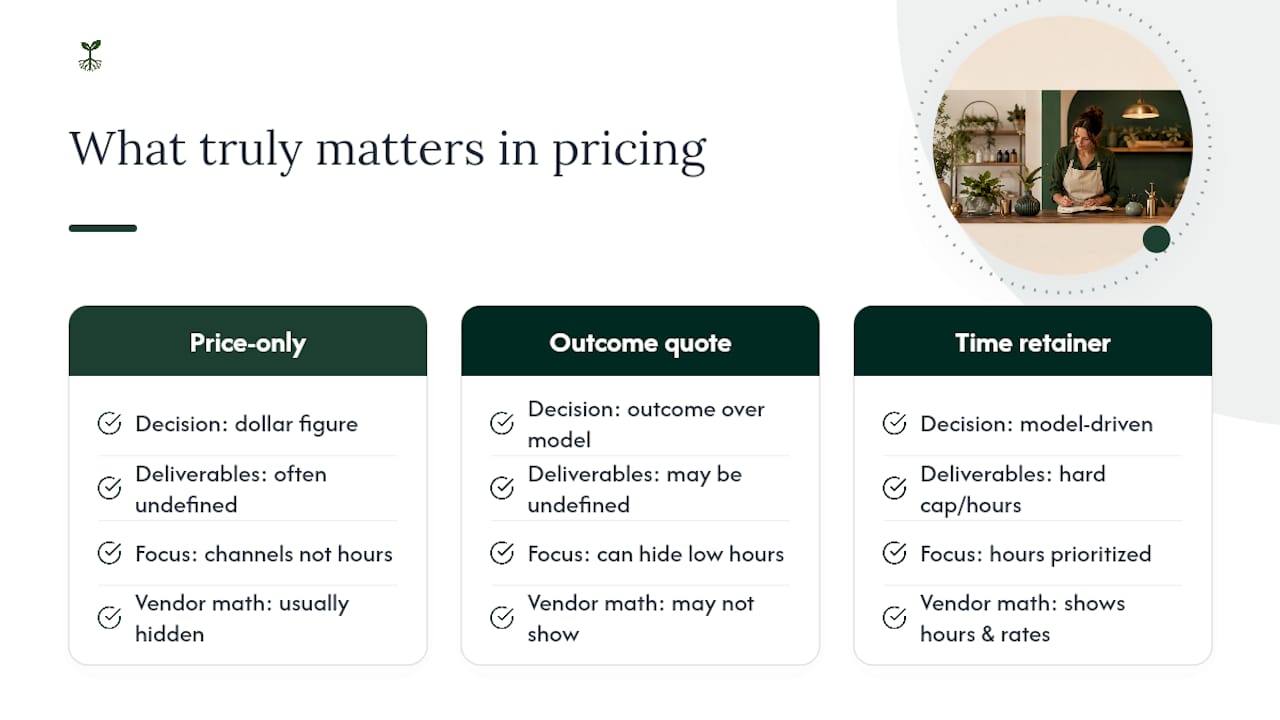
The price on a proposal matters less than the model behind it. Two agencies quoting $4,000 a month can mean very different things depending on how that number gets calculated.
- Time-based retainer with a cap and overage rate. You pay for an estimated block of hours each month, with a defined rate for anything beyond that cap. This is the default recommendation for most small businesses because it protects both sides: the agency doesn't eat unlimited scope creep, and you don't pay for hours that never happened.
- Outcome-based pricing. You pay for results, like leads or ranking positions. It sounds appealing until you realize outcomes depend on variables outside the agency's control, like your sales team's follow-up speed or your website's conversion rate.
- Access-based pricing. You pay a flat fee for a set amount of access to a team or tool stack, regardless of hours used. This works well for ongoing advisory relationships but poorly for project-heavy work.
- Percentage of ad spend. Common for paid media, typically 10% to 20% of the monthly budget. The hazard: the agency has less incentive to shrink your spend even when a smaller budget would perform just as well.
Pro Tip: Ask any vendor to show their model in writing before you ask about the number. A price without a model attached is a number you can't actually evaluate.
Hybrid models exist too. A common structure combines a flat management fee with a small percentage kicker on ad spend, capped at a dollar figure regardless of budget size.
What Does Each Marketing Service Actually Cost?
Bundled packages hide a lot. Breaking a quote into its parts tells you whether you're getting real value or padding.
- SEO: $500 to $5,000+ per month, driven by keyword competition, technical fixes needed, and how aggressive the link-building component is. A $500 to $2,000 local SEO package covers most solo professionals; national or e-commerce SEO climbs fast.
- Social media management: $400 to $3,000 per month, scaling with platform count, post frequency, and whether community management (responding to comments and messages) is included.
- Paid media management: Typically priced as 10% to 20% of ad spend, per HowSociable's data, with most agencies requiring a minimum monthly ad budget of $5,000 to $15,000 to justify the management overhead.
- Content and email marketing: $500 to $3,000 per month depending on volume, ranging from a single monthly blog post to a full editorial calendar with newsletters layered in.
- Website or project work: Usually priced separately, $1,000 to $15,000+ depending on scope, rather than folded into a monthly retainer.
A representative $5,000 monthly retainer typically breaks down as portions allocated to account management, strategy, execution, and the remainder covering tools, overhead, and margin, according to one agency pricing breakdown. That leaves roughly 15 to 25 actual execution hours a month at that price point, which is worth knowing before you expect daily social posts and weekly blog content from a single retainer.
How Do Marketing Package Tiers Differ in What You Actually Get?
Most agencies sell three tiers: Basic, Standard, and Premium. The middle tier is usually engineered to be the one most buyers pick, priced close enough to Basic that Premium looks like a stretch and Basic looks thin by comparison, a common sales pattern noted in retainer pricing research.
Here's roughly what separates the tiers in practice:
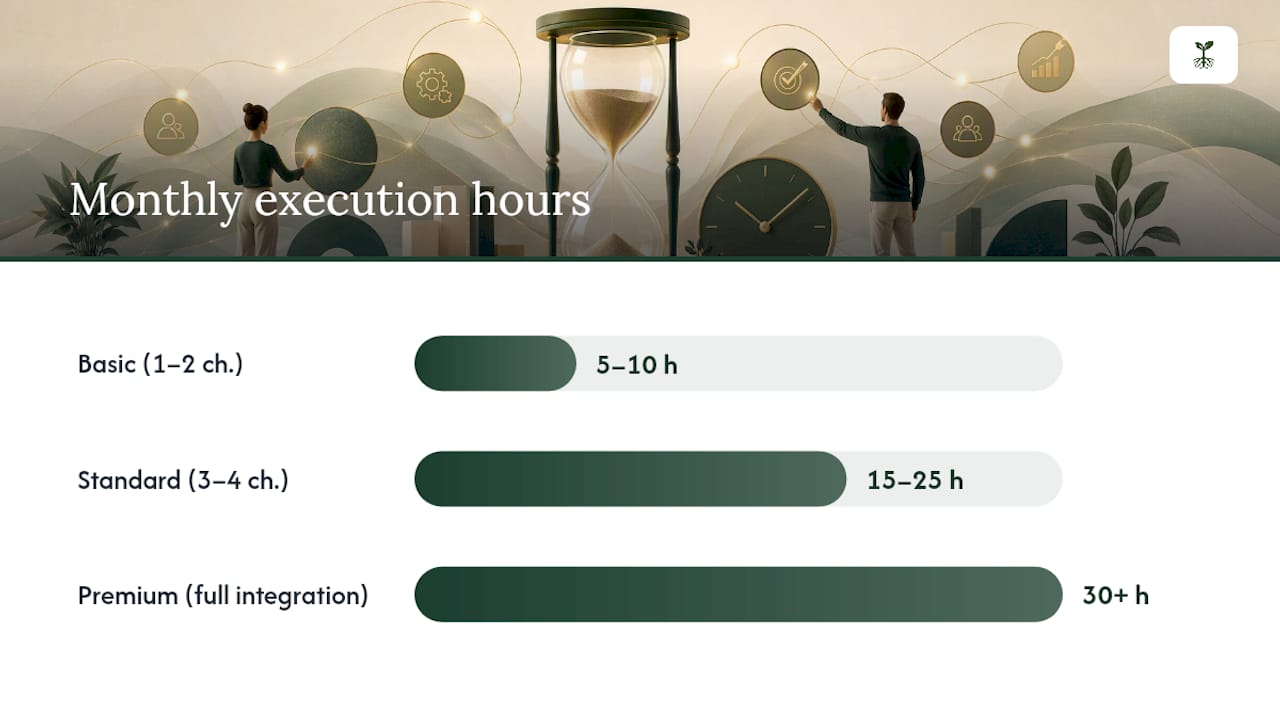
- Basic: One or two channels, 5 to 10 hours of monthly execution, monthly reporting, minimal strategic input.
- Standard: Three to four channels, 15 to 25 hours, biweekly check-ins, a named strategist attached to the account.
- Premium: Full-channel integration, 30+ hours, weekly reporting, dedicated account team, custom research or competitive analysis.
Before you sign anything, force clarity with direct questions: who specifically will do the work, what's the delivery timeline for each deliverable, and what counts as "done"?
Pro Tip: Treat vague phrases like "unlimited revisions" or "ongoing support" as red flags, not perks. Ask the vendor to define the actual hour count or deliverable count behind that word.
How Do Agencies Calculate a Fair Retainer Price?
The formula most legitimate agencies use, and the one you should use to sanity-check any quote, looks like this:
(Estimated monthly hours × loaded cost per hour) ÷ (1 − target profit margin) + scope-creep buffer
Loaded cost per hour isn't just salary — it also includes overhead like benefits, software, and general expenses, as explained in this guide on selecting creative asset management and media production. It includes benefits, software, taxes, and general overhead, which commonly run 25% to 35% on top of base pay, according to retainer pricing guidance from Optivation. A strategist earning $35 an hour in base pay might have a loaded cost closer to $45 to $47.
A worked example: 20 hours a month at a $45 loaded rate is $900. Divide by (1 minus a 25% target margin), or 0.75, and you get $1,200.
- If a proposal comes in well below this kind of math, expect corners cut on hours or experience level.
- If it's far above, ask exactly what's driving the premium.
- Always confirm whether the quote includes a hard cap with a defined overage rate, since that's what actually protects you from a scope-creep spiral.
How Should You Choose a Marketing Package?
Price alone tells you almost nothing. Scope clarity tells you everything.
- Ask for the exact deliverable list, not a category name. "SEO" means nothing without a defined number of pages, keywords, and links per month.
- Ask what triggers an overage charge and what the overage rate is per hour.
- Ask who does the work. A named strategist versus a rotating junior team changes both quality and price.
- Ask for the reporting cadence and what metrics actually appear on it, lead volume or ranking position, not just impressions.
- Ask about the exit clause. A month-to-month agreement with a 30-day notice period is far lower risk than a 12-month lock-in.
Walk away if a vendor can't answer any of these in writing, or if every answer is some version of "it depends." Structure a 90-day pilot period with two or three measurable acceptance criteria, like a specific number of qualified leads or a ranking improvement on named keywords, before committing to a longer contract.
What Should Small Businesses Budget by Stage?
Marketing spend should track revenue, not ambition. A common benchmark has small businesses allocating roughly 7% to 8% of gross revenue to marketing, according to Leaping Lemur Media's small business guide, though very small firms often spend a higher percentage just to get initial traction.
- Solo or micro-business: $500 to $2,500 a month, prioritizing local SEO and Google Business Profile management plus one owned channel like email or a single social platform.
- Small business with steady revenue: $2,500 to $7,500, spread across 2 to 3 channels with clear lead targets attached to each.
- Growth-stage business: $7,500 and up, with real channel diversification and a clear split between management fees and media spend, monitored monthly rather than quarterly.
Whatever the stage, ask vendors to show ad budget in dollar amounts, not just percentages, so there's no surprise when the invoice arrives.
How Rooted Up Packages Marketing for Solo Professionals
Rooted Up builds monthly plans that combine Google Business Profile management, review automation, SEO blog content, and newsletter production into one straightforward subscription rather than an itemized menu solo professionals have to assemble themselves. That bundling matters most for people who don't have a marketing hire on staff and don't want to become one.
Behind the scenes, AI-assisted workflows handle drafting, scheduling, and follow-up tasks like automated review requests, which keeps delivery consistent without inflating the loaded cost per hour that usually drives retainer prices up.
The Real Problem With Most Marketing Pricing Advice
Most pricing guides treat the dollar figure as the decision. It isn't. The model behind the number matters more than the number itself, and that's the piece conventional advice skips past. A $3,000 outcome-based quote with no defined deliverables is a worse deal than a $3,500 time-based retainer with a hard cap, even though the second number is bigger.
The other blind spot: business owners fixate on channel count instead of execution hours. A "premium" package with five channels and 15 total execution hours a month is thinner than a "standard" package with two channels and 25 hours. Ask about hours before you ask about channels.
If there's one thing worth prioritizing first, it's forcing every vendor, Rooted Up included, to show their math: hours, loaded rate, margin, and buffer. A vendor who can't or won't show that math is telling you something about how they'll handle disputes later.
— Jason
Get a Straightforward Quote From Rooted Up
If the formulas above left you wanting someone to just do the math for you, that's the point of a discovery call. Rooted Up replaces the guesswork of assembling separate freelancers or negotiating an agency contract with one flat monthly plan built specifically for solo professionals and small service businesses.

A discovery call typically covers your current visibility gaps, which channels make sense for your stage, and a proposal turnaround within a few business days, not weeks. There's no ad spend markup and no vague "ongoing support" language to decode. If you're weighing a $750 entry plan against a $7,500 integrated program, the fastest way to know which one fits is to look at Rooted Up's services and packages and start that conversation directly.
Sources
The price bands and formula in this guide draw from Clutch's 2026 agency pricing data, which benchmarks market-wide retainer and package ranges across firm sizes, and HowSociable's 2026 pricing guide, which breaks pricing down by channel and business size. The retainer formula itself comes from Optivation's agency retainer pricing guide, a practical resource built for agencies pricing their own services fairly on both sides of the contract.
- Digital Marketing Pricing Guide 2026 | HowSociable
- How to price an agency retainer that works for both sides — Ascend / Optivation