
Marketing as a service is a subscription model that gives you an embedded, outcome-focused marketing team without hiring full-time staff. It replaces one-off agency projects and scattered freelancers with a standing team that owns strategy and execution together, reporting against pipeline and revenue metrics. It fits best for businesses that need multi-channel work running at once and want predictable monthly capacity instead of a stack of invoices.
TL;DR:
- MaaS typically costs between $8,000 and $25,000 per month, depending on the number of channels and level of strategic involvement.
- The model is ideal for businesses juggling multiple vendors or lacking internal marketing strategy ownership, especially when leadership seeks pipeline-focused results.
- Success hinges on clear ownership of login credentials, regular progress reviews tied to pipeline metrics, and transparency about who is executing each task.
- MaaS's effectiveness varies across industries, with healthcare focusing on reputation management, B2B on content lead nurturing, and e-commerce on social and email engagement.
- The real value relies on active governance and honest conversations, not just dashboards, making regular strategic reviews essential to prevent drift from core objectives.
Table of Contents
- What Is Marketing as a Service, and How Is It Different From an Agency?
- How Does MaaS Work Day to Day?
- What Capabilities and Roles Come Included?
- What Do You Gain, and What Do You Give Up?
- Is Marketing as a Service Right for Your Business?
- What Does MaaS Cost, and What Do You Get at Each Tier?
- How Do You Choose the Right MaaS Provider?
- What Does MaaS Look Like Across Different Industries?
- The Real Test of a MaaS Engagement Isn't the Dashboard
- Get Started With Rooted Up's Marketing as a Service Plans
- Sources
What Is Marketing as a Service, and How Is It Different From an Agency?
Marketing as a Service (MaaS) is a subscription based model that gives you ongoing access to a marketing team that handles strategy, execution, and measurement together, rather than in disconnected pieces. Traditional agencies bill by project or campaign. Freelancers bill by task. MaaS bills by month, and in exchange you get continuity: the same people learning your business, your customers, and your sales cycle over time instead of restarting the relationship every quarter.
The practical differences show up fast:
- Spend predictability. A flat monthly fee replaces variable project quotes and change orders.
- Team continuity. The same strategist and specialists stay on your account instead of rotating account managers.
- Outcome orientation. Reporting centers on pipeline and conversion, not just deliverables shipped.
- Built-in integration. Channels work together under one strategy instead of a patchwork of vendors pulling in different directions.
That last point matters more than it sounds. A freelance copywriter and a separate PPC contractor rarely coordinate messaging. A MaaS team does that by design.
How Does MaaS Work Day to Day?
Most MaaS engagements run a predictable rhythm rather than a chaotic string of one-off requests. Expect something close to this cycle:
- Intake. Your team submits requests, campaign ideas, or urgent needs through a shared system.
- Prioritize. The provider ranks work against your quarterly goals, not just whoever asked loudest.
- Produce. Content, ads, or SEO work gets built by the specialist who owns that channel.
- QA. Work gets reviewed against brand and performance standards before it goes live.
- Launch. Campaigns go out on the agreed schedule.
- Optimize. Performance data feeds back into the next cycle's priorities.
Weekly syncs keep both sides aligned on what's moving; monthly reports tie activity to actual numbers using LLM evaluation frameworks; quarterly sessions reset strategy as your business changes. Most providers integrate directly with your CRM, ad accounts, and CMS so reporting reflects real pipeline data instead of vanity metrics pulled from disconnected tools.
Pro Tip: Ask upfront who owns login credentials for your ad accounts and CRM integrations. If the provider doesn't hand over admin access, you don't own your own data, and that's a problem if you ever switch providers.
What Capabilities and Roles Come Included?
A typical MaaS package bundles several disciplines under one roof instead of forcing you to hire, or hire out, each one separately. Growigami's glossary notes that most packages give you immediate access to four to six specialists at once, which is a faster ramp than recruiting the same headcount individually.
Core services usually include:
- Strategy and positioning, usually led by a fractional CMO or senior strategist.
- Content and SEO, covering blog output, on-page optimization, and schema hygiene.
- Paid media, managed by a dedicated buyer across search and social.
- Email and marketing operations, including automation, segmentation, and nurture sequences.
- Design, for landing pages, ad creative, and sales collateral.
- Analytics and reporting, tying every channel back to a shared dashboard.
Specialized add ons, like account based marketing, RevOps alignment, or AI workflow automation, usually sit as upgrades on top of a base package rather than included by default. If your business runs on referrals and reviews, Google Business Profile optimization is one capability worth confirming is in scope before you sign anything.
What Do You Gain, and What Do You Give Up?
The case for MaaS rests on three real advantages: predictable budgeting, faster access to specialist skill, and integrated measurement across channels instead of siloed reports. Gartner has found that marketers use only about 58 percent of their martech stack's capabilities on average, and a specialist team dedicated to running those tools daily tends to close that gap faster than an in-house generalist juggling five platforms alone.
The trade offs are real too:
- You lose some granular, day-to-day control over execution details.
- Success depends heavily on how well the provider communicates, not just how well they execute.
- Dashboards can create a false sense of oversight if you never actually review the strategy behind them.
That last point is the most common failure mode. A provider can hand you clean charts every month and still be drifting off strategy if nobody on your side asks hard questions in the review call. The CIM's 7Ps framework points to People and Process as the two elements that most often separate a trustworthy service relationship from a hollow one.
Is Marketing as a Service Right for Your Business?
MaaS tends to fit companies past the startup scramble but not yet large enough to justify a full internal department, typically businesses running several channels at once with leadership that wants pipeline visibility, not just activity reports.
Signals you're ready for it:
- You're juggling three or more disconnected marketing vendors already.
- Nobody internally owns marketing strategy full time.
- Leadership keeps asking "what did marketing actually produce this quarter" without a clear answer.
Signals to hold off:
- Your budget only supports one narrow channel, like local SEO alone.
- You want to approve every social post and email subject line personally.
- You need a single specialized skill, not a full team.
What Does MaaS Cost, and What Do You Get at Each Tier?
Pricing scales with scope, not just company size. Growigami's pricing guide puts representative monthly bands somewhere between $8,000 and $25,000, depending on how many channels are active and whether you get a dedicated senior strategist or a shared one.
Rough tier shapes look like this:
- Starter tiers usually cover one or two channels, like SEO content plus email, with a shared strategist checking in periodically.
- Growth tiers add paid media and a dedicated account lead with weekly involvement.
- Scale tiers bring in RevOps alignment, ABM support, and a senior strategist embedded in leadership conversations.
Compare that to hiring: a single senior marketing hire with the skill range of a MaaS team's five specialists would cost well past six figures in salary and benefits alone, before you've paid for the tools they'd need. Marketing technology spending keeps climbing in the United States, and that spend has to be operated by someone. What raises your price inside any tier is usually the number of active channels, whether you need a dedicated (versus shared) strategist, and how tight your SLA response times are.
How Do You Choose the Right MaaS Provider?
Vetting a provider comes down to a short list of concrete checks, not gut feel.
- Confirm account access terms. You should retain ownership of your CRM, ad accounts, and CMS logins, not the provider.
- Ask about reporting cadence. Weekly syncs and monthly written reports should be standard, not an upsell.
- Tie KPIs to pipeline. Reports should show cost per opportunity and conversion rate, not just impressions and likes.
- Ask who does the actual work. Get names and roles, not just a sales deck of stock photos.
- Ask for a real example. A provider with genuine outcomes will show you a specific before and after, not a vague success story.
Watch for these red flags: no measurable KPI tied to revenue, reporting that stays vague when you push for specifics, or no clear plan for connecting to your existing CRM.
Pro Tip: During the discovery call, ask directly: "If I canceled tomorrow, what would I walk away with?" A provider confident in their process will have a clean answer about asset ownership. One that hesitates is telling you something.
What Does MaaS Look Like Across Different Industries?
The shape of a MaaS engagement changes with the industry, even when the underlying operating model stays the same. A regional healthcare practice, for example, usually needs the model weighted toward reputation management and local search, since patients choose providers largely off reviews and proximity. A B2B software company running the same subscription instead weights it toward content, SEO, and lead nurturing sequences feeding a longer sales cycle, since MarketingProfs frames MaaS specifically as a way to unify strategy and measurement for B2B teams juggling multiple buyer touchpoints.
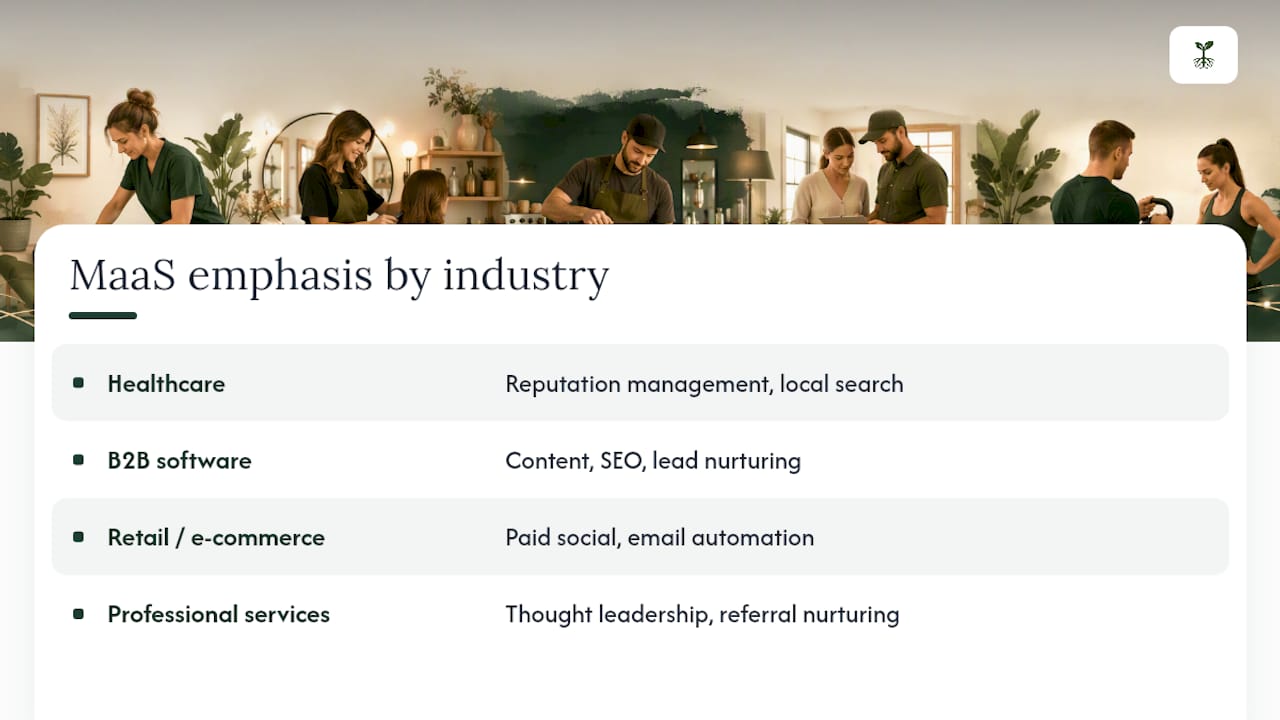
A retail or e-commerce brand tends to lean the model toward paid social and email automation, since purchase decisions happen fast and repeat engagement drives most of the revenue. Professional services firms, like law offices or accounting practices, usually route the model toward thought leadership content and referral nurturing, since trust builds slowly and word of mouth still drives a large share of new client volume.
What stays constant across every one of these shapes is the operating rhythm: intake, prioritization, production, and reporting cycles that repeat monthly regardless of which channel carries the weight. A useful discipline inside any of these setups is the 3-3-3 rule, picking three core messages, three audience segments, and three channels, which keeps a MaaS team from spreading a limited budget across too many fronts at once. Solo professionals and small practices in particular tend to see the fastest returns when the engagement stays narrow and disciplined rather than trying to run every channel simultaneously from month one.
The Real Test of a MaaS Engagement Isn't the Dashboard
Most MaaS pitches sell you on the team you'll get. Fewer sell you on the governance you'll need to actually run it well, and that's the part that decides whether the relationship works after month three. A dashboard full of green metrics feels like accountability, but it's only real accountability if someone on your side is asking why a number moved, not just noticing that it did.
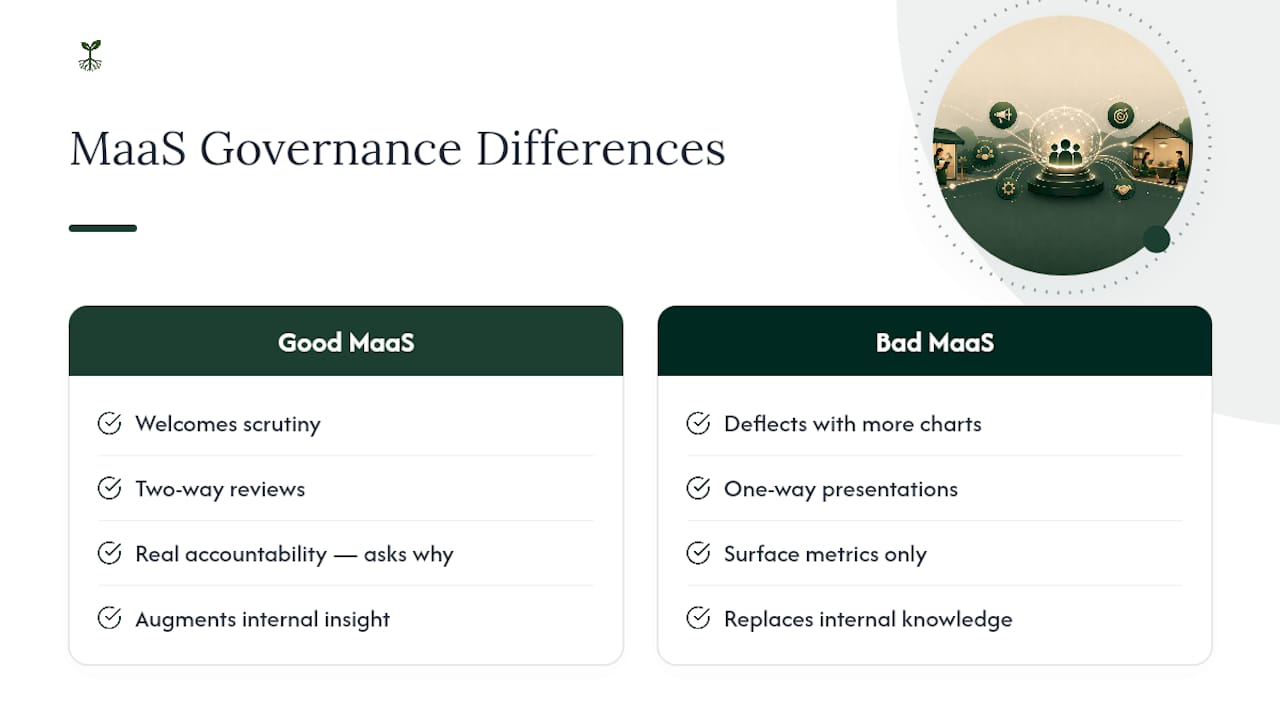
The providers worth paying tend to welcome that scrutiny. The ones to avoid deflect it with more charts. If your monthly review call is a one-way presentation instead of a conversation, you've hired a reporting service, not a marketing team. The businesses that get the most out of MaaS treat the monthly and quarterly sessions as working meetings, not status updates to sit through.
The other underrated truth: MaaS works best when you're honest about what you're actually buying. It's not a replacement for having someone internally who understands your customers better than any outside team ever will. It's a way to execute against that understanding faster than you could alone, with people who show up every week instead of every time you remember to call them.
— Jason
Get Started With Rooted Up's Marketing as a Service Plans
Rooted Up offers monthly marketing and AI operations designed for solo professionals and small service businesses. Their service bundles multiple marketing functions into a single monthly plan, including Google Business Profile management, review automation, SEO blog content, newsletters, and AI workflow audits aimed at reducing administrative workload.

Getting started is simple: a discovery call maps your current setup, gaps, and goals, followed by an initial audit that shapes your first month's scope, usually prioritizing local visibility and review generation first since those tend to move fastest for solo practices. From there, monthly reporting keeps you informed without demanding your time. If you're ready to see what a focused first month could look like for your practice, visit Rooted Up's services and packages to schedule a consult.
Sources
- What Is Marketing-as-a-Service (MaaS): A Complete Guide
- The 7Ps of marketing
- Marketing technology spending — Statista
- Marketing as a Service: Outsourcing Marketing — MarketingProfs