
Most single-location small businesses should budget roughly $500 to $2,000 a month for local SEO, with the final number driven mostly by competition and industry. If you're a plumber in a mid-size town, aim at the lower end. If you're a personal injury attorney, expect the upper end and beyond. Start there, then adjust once you know your specific competitive landscape.
TL;DR:
- Local SEO costs for small businesses generally range from $500 to $2,500 per month, depending on industry and competition density.
- High-competition sectors like legal and healthcare typically require higher retainers, often exceeding $2,500 monthly, especially in dense metro areas.
- One-time projects such as audits and citation cleanup cost between $500 and $5,000, suitable for technical resets or testing providers.
- Essential retainer services include Google Business Profile management, review workflows, citation consistency, local landing pages, schema markup, and monthly content.
- The biggest cost driver is competition density and keyword value, with industry, location size, and site health also influencing prices.
Table of Contents
- What Do Local SEO Services Typically Cost?
- Which Pricing Model Fits Your Business?
- What Should a Local SEO Retainer Actually Include?
- What Actually Drives the Price Up or Down?
- What Do Local SEO Costs Look Like by Industry?
- How Do You Know If You're Overpaying or Underspending?
- How Much Should You Budget, and What Return Should You Expect?
- How Do You Choose Between Competing Proposals?
- Rooted Up's Take on Pricing for Solo Professionals
- Get a Straightforward Monthly Plan Instead of Piecing It Together
- Where These Numbers Come From
- Sources
What Do Local SEO Services Typically Cost?
Local SEO pricing splits into three shapes: monthly retainers, one-time projects, and hourly consulting. Each buys something different, and confusing them is how business owners end up either overpaying for a one-time fix dressed up as ongoing work, or underpaying for a retainer that never touches half the things a local SEO campaign needs.
Most small businesses land somewhere between $500 and $5,000 a month, according to industry benchmarks compiled across sectors, with the bulk of small-business retainers clustering in the $500 to $2,500 range. Across the broader US market, average monthly SEO spend runs at a higher level when you include national and enterprise work, but local-specific SEO averages a moderate monthly amount. That gap between the local average and the blended national average tells you something: local SEO is genuinely cheaper than broad organic SEO, because the geographic scope is narrower and the ranking factors (Google Business Profile, citations, reviews) are more mechanical than a full content and backlink campaign.
One-time projects fill a different need. Audits, Google Business Profile setup, and citation cleanup usually run $500 to $5,000 depending on scope. These make sense when you already have some visibility but need a technical reset, or when you're testing a provider before committing to a retainer.
Hourly consulting sits at the edge of this market and works best for narrow, well-defined problems. Expect $75 to $200 or more per hour depending on the consultant's experience and whether you're hiring a freelancer or an agency principal.
| Pricing model | Typical range | Best fit |
|---|---|---|
| Monthly retainer (small business) | $500–$2,500/month | Ongoing GBP, reviews, citations, reporting |
| Monthly retainer (competitive industry) | $2,500–$5,000+/month | Legal, healthcare, multi-location brands |
| One-time setup/audit | $500–$5,000 | Technical reset, new business launch |
| Hourly consulting | $75–$200+/hour | Specific fixes, second opinions, strategy sessions |
The retainer band you fall into depends less on your revenue and more on how many competitors are fighting for the same map pack spots. A landscaper in a town with three competitors pays far less than one in a metro area with forty.
Which Pricing Model Fits Your Business?
Retainers, hourly billing, project fees, and performance-based deals each carry different tradeoffs around control, risk, and predictability. None is universally "better." The right fit depends on how hands-on you want to be and how much uncertainty you're willing to accept.
- Monthly retainer: Predictable cost, ongoing work, easiest to budget for. Downside: you're locked into a recurring payment even in slow months, and quality varies wildly between providers.
- Hourly: Good for narrow, well-defined tasks or a second opinion on existing work. Downside: costs can balloon fast on open-ended projects, and it's hard to compare hourly quotes across providers with different efficiency levels.
- Project/one-time: Clear scope, clear price, clear end date. Downside: no ongoing optimization once the project wraps, so gains can erode within months.
- Performance-based (pay per lead or per ranking): Appealing because you only pay for results. Downside: providers often cherry-pick easy, low-value keywords to hit targets cheaply, and contracts can get messy around what counts as a "qualified lead."
Retainers are usually structured one of three ways: tiered packages (basic, standard, premium, each adding more citations, content, or locations), fixed monthly hours (say, 15 hours of work regardless of task mix), or a deliverables list (a set number of GBP posts, one landing page, X citations cleaned per month). Deliverables-based retainers are the easiest to evaluate because you can check whether the work actually happened.
Performance models need guardrails or they backfire. Ask exactly how "results" get measured, over what time window, and what happens if rankings dip due to a Google algorithm update outside anyone's control. Without clear terms, performance pricing shifts risk onto you disguised as a discount.
Agencies and freelancers price these models differently too. Agencies typically charge more because they bundle in tooling, reporting infrastructure, and a team with specialized roles, while freelancers cut the sticker price but often skip the packaged reporting that makes it easy to verify progress.
What Should a Local SEO Retainer Actually Include?
A fair retainer isn't vague "SEO work." It's a specific bundle of recurring tasks you can point to and verify. Here's what should show up on any proposal worth paying for:
- Google Business Profile management — regular posts, category and service updates, Q&A monitoring, and photo uploads at least a few times a month. Cadence matters more than most owners realize; a profile updated weekly signals activity to Google's ranking systems that a static one doesn't.
- Review management and response workflow — a system for requesting reviews, generating review links, and responding to every review, good or bad, within a few days.
- Citation building and cleanup — consistent name, address, and phone data across directories. NAP inconsistency quietly kills rankings for a large share of small businesses that never fix it.
- Local landing pages — dedicated pages for each service area or service type, built to rank and convert, not just exist.
- Schema markup and technical hygiene — structured data that helps search engines understand your business details, plus basic site health checks (page speed, mobile usability, broken links).
- Monthly content — blog posts, service page updates, or GBP posts that keep the site and profile active.
Reporting is where a lot of retainers quietly fall apart. At minimum, expect rank tracking for your target keywords, call tracking tied to your GBP and website numbers, Google Business Profile insights (views, searches, actions taken), and some form of lead or form-submission tracking. Reporting on these four metrics is close to non-negotiable for any provider that wants to prove the work is doing something.
What Actually Drives the Price Up or Down?
Two businesses in the same city, buying what sounds like the same service, can get quotes that differ by a factor of eight. The gap almost always comes down to a handful of variables.
- Competition density and keyword value. Competition is the single dominant cost driver in local SEO pricing. Ranking a bakery in a small town for "bakery near me" takes a fraction of the effort it takes to rank a personal injury lawyer in a major metro for "car accident lawyer."
- Industry. High-lifetime-value industries like legal and healthcare justify higher provider fees because a single new client can be worth thousands of dollars, while low-competition niches like local photography or pet grooming rarely need the same budget to compete.
- Number of locations. Multi-location businesses multiply citation work, GBP management, and landing page needs across every additional address.
- Site health and technical debt. A site built on an outdated platform with years of unfixed technical issues costs more to bring up to baseline before any new SEO work can even take hold.
- Provider type. Agencies bring tooling and dedicated reporting staff and price accordingly; freelancers work leaner and typically charge less for comparable hours.
If your quote seems high relative to a friend's business in another city, check whether you're actually competing in a denser market or a higher-stakes industry before assuming you're being overcharged.
What Do Local SEO Costs Look Like by Industry?
Benchmarks shift dramatically by sector because competition and customer lifetime value vary just as dramatically. Here's how typical monthly ranges break down.
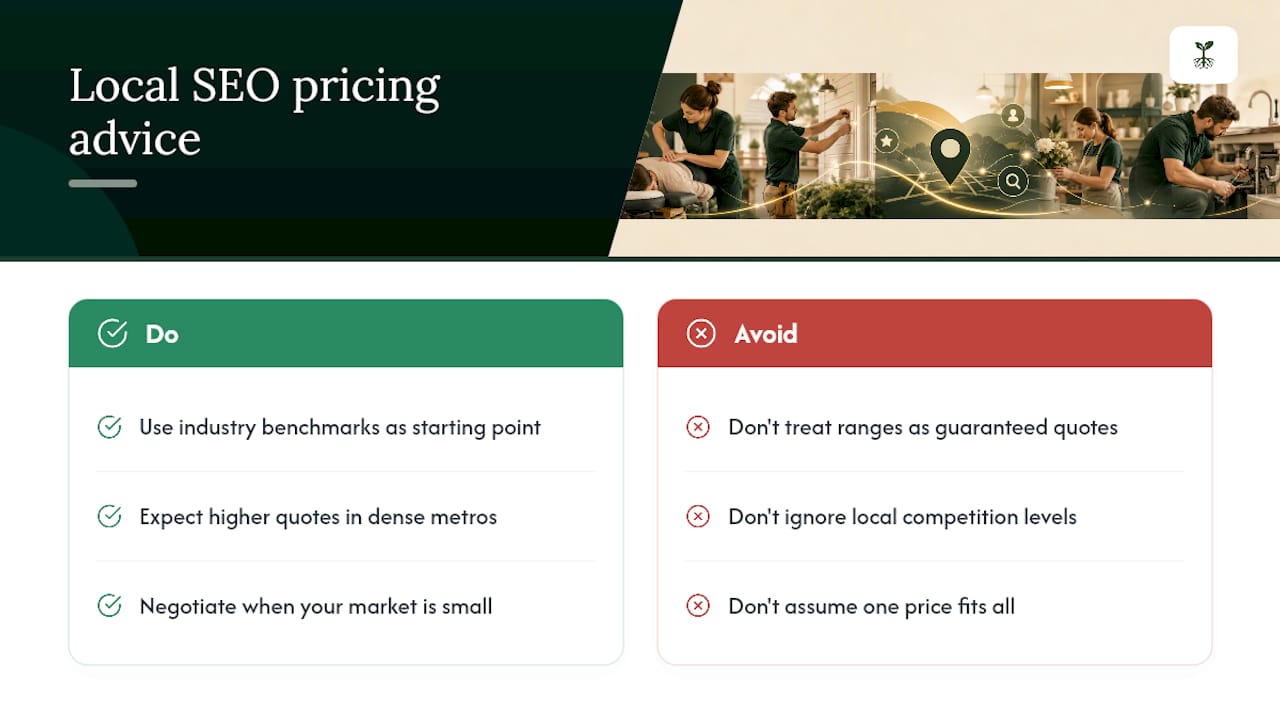
These ranges come from aggregated industry benchmarking and should be treated as a starting point, not a guaranteed quote for your specific business. A dentist in a rural county and a dentist in a dense suburb of a major metro can both fall under "healthcare" and still see prices that differ by thousands of dollars monthly.
Metro versus small-town differences matter just as much as industry. Regional pricing data from markets like Scottsdale shows that dense, affluent metro areas routinely push quotes higher than the same service would cost in a small town, simply because more providers are competing for the same limited map pack real estate. If you operate in a mid-size or smaller market, you have real leverage to negotiate toward the lower end of your industry's range.
How Do You Know If You're Overpaying or Underspending?
A handful of warning signs can tell you a proposal is wrong for your situation before you've spent a dollar.
- No sample reports. If a provider won't show you an anonymized example of what monthly reporting looks like, assume reporting doesn't really exist.
- Vague deliverables. "Ongoing optimization" and "SEO maintenance" mean nothing without a list of specific monthly tasks attached.
- No rank, call, or GBP tracking offered. These three metrics are the baseline proof of work happening; their absence is a real red flag.
- Price far below the going rate with no explanation. A rock-bottom quote sometimes reflects a genuinely lean freelancer operation, but more often it means citations get built once and never touched again.
A low price isn't automatically a bad sign. A solo freelancer with low overhead can legitimately charge less than an agency for comparable local work. The problem is a low price paired with no visibility into what you're actually getting.
Pro Tip: Ask any provider to show you last month's report for an existing client, with names redacted. If they hesitate or say reporting is "coming soon," that's your answer.
Three questions expose value fast: What exactly happens in month one versus month six? Can I see rank tracking and GBP insights from an existing client? What happens to my citations and content if I cancel?
How Much Should You Budget, and What Return Should You Expect?
A workable rule of thumb: allocate roughly 1% to 10% of your total marketing spend to local SEO, scaling up if your business depends heavily on local search traffic (home services, healthcare, legal) and scaling down if local search is a secondary channel.
Two conservative scenarios show how this pencils out. A dental practice spending $2,500 a month that lands even 3 new patients monthly, each worth $1,500 in first-year value, generates $4,500 against that same spend. Neither scenario assumes anything dramatic. Both assume the retainer is actually being executed.
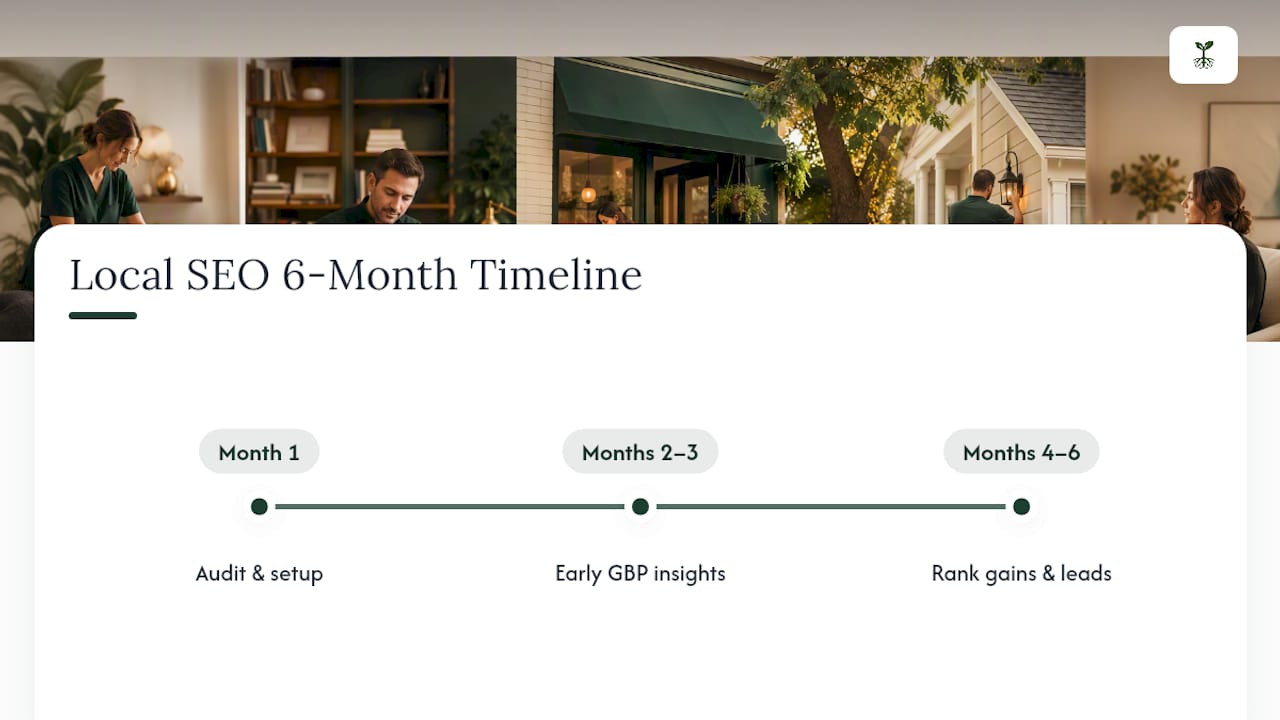
Set milestones for the first three to six months rather than expecting immediate ranking jumps. Month one is typically audit and setup: GBP optimization, citation cleanup, technical fixes. Months two and three should show early movement in GBP insights (views, searches) even before rankings shift meaningfully. By months four through six, expect visible rank improvement for a subset of target keywords and a measurable uptick in calls or form submissions. If none of that shows up by month six, something in the execution is off.
How Do You Choose Between Competing Proposals?
Weigh every local SEO proposal against three axes: expected outcomes, transparency, and execution quality. A provider can score well on one and poorly on the others, so check all three before signing anything.
- Ask for outcomes, not activity. Request specifics: what ranking improvements, call volume increases, or review growth have they delivered for a business similar to yours in size and industry?
- Ask for a sample report. If they can't show you one, they don't have a real reporting process.
- Ask how they measure their own process. A provider who can explain exactly what happens week to week, month to month, is more trustworthy than one who talks only in outcomes.
- Normalize the numbers. Convert every proposal into deliverables per month rather than comparing sticker prices alone. If one quote includes four GBP posts and two landing pages monthly, and another includes none of that for a similar price, you're not actually comparing like for like.
Estimate the hours behind each deliverable list to see which quote is genuinely more efficient, not just cheaper on paper.
Rooted Up's Take on Pricing for Solo Professionals
Most local SEO pricing conversations assume you're a business with a marketing department deciding between vendors. Solo professionals face a different problem: fragmented buying. A citation cleanup here, a GBP audit there, a review tool subscription somewhere else, each with its own invoice and its own login.
Some providers bundle Google Business Profile management, review automation, monthly content, and schema hygiene into one straightforward monthly plan built specifically for solo professionals who don't have time to manage multiple vendors. A subscription makes sense when you want continuous visibility gains without babysitting a project. A one-time setup engagement makes more sense if you just need a technical reset before going it alone.
— Jason
Get a Straightforward Monthly Plan Instead of Piecing It Together
Some services offer a direct alternative to hiring separate freelancers for reviews, citations, and content, then hoping they coordinate. One monthly plan can replace that patchwork with GBP management, review automation, schema and technical hygiene, and monthly content, priced within typical small-business retainer ranges.

A starter plan typically covers the recurring items this article flagged as the baseline for a real retainer: consistent GBP activity, a review request and response workflow, citation consistency checks, and monthly reporting so you can see rank movement and GBP insights without chasing a provider for updates. If you've been comparing quotes and want to see what a transparent, all-in-one plan looks like next to the piecemeal alternative, check Rooted Up's services and packages to see what fits your business.
Where These Numbers Come From
The pricing ranges and industry breakdowns in this guide draw from aggregate benchmarking across industries, which supports the overall monthly ranges, one-time project costs, and the industry comparison table. US-specific averages for agencies, freelancers, and local-versus-national spend come from GoodFirms' 2026 SEO pricing survey. Regional context on how metro density shifts quotes comes from Chrome Cactus's Scottsdale market analysis.
Sources
- Local SEO Budget Benchmarks by Industry: What Small Businesses Actually Pay in 2026
- SEO pricing in USA 2026: What agencies, freelancers, charge?