
You need a local rank tracker the moment you care about where your business shows up on Google Maps across different neighborhoods, not just at your storefront. Geo-grid tracking is the method that matters here: it scans dozens of points around your service area and builds a heatmap of your Map Pack position, showing exactly where you win and where a competitor quietly takes the customer instead. Single-location owners, multi-location operators, and agencies managing several clients all rely on this data to decide what to fix first.
TL;DR:
- Geo-grid tracking provides detailed heatmaps of your visibility across neighborhoods, helping identify areas where your rankings drop below the top three, which most impact clicks and calls.
- UULE geolocation offers GPS-level accuracy for precise diagnostics, while IP proxy methods are cheaper but less exact, suitable for broad monthly health checks.
- Effective metrics include Map Pack rank, average grid rank, and specific zone coverage, all of which directly correlate with actual customer inquiries and foot traffic.
- High-resolution standalone tools are ideal for agencies needing dense data, while all-in-one platforms trade some accuracy for convenience, and free tools are only suitable for quick, superficial checks.
- Combining rank data with GBP insights and turning red zones into actionable tasks consistently improves local visibility and conversion results.
Table of Contents
- What Local Rank Trackers Are and How They Work
- Key Metrics That Actually Tell You Something
- Types of Local Rank Trackers and Their Trade-Offs
- How to Choose a Local Rank Tracker: A Prioritized Checklist
- Setting Up Local Rank Tracking for One Location
- How Rooted Up Turns Rank-Tracker Data Into Local Results
- Where Local Rank Tracking Falls Short
- Comparing Local Rank Tracker Categories by Fit
- Making Rank Data Part of Your Actual SEO Strategy
- Automation and Alerts: What to Expect From Modern Trackers
- Why Location Targeting and Personalization Skew Your Results
- Buy the Tool or Hire the Service?
- Rooted Up: Managed Local Visibility Without the Tool Sprawl
- Sources
- FAQ
What Local Rank Trackers Are and How They Work
A local rank tracker is different from a standard rank tracker in one critical way: it measures where you appear on Google Maps and inside the Local Pack, the three-listing block that shows up for searches like "plumber near me." A generic rank tracker only tells you your position in the regular blue-link results, which is a separate ranking system entirely.
The simplest version of this is a single-point check: one search, one result, run from your business address or a nearby zip code. It's fast and cheap, but it tells you almost nothing about how you rank three miles away, where most of your actual customers live.
Geo-grid scanning fixes that. It runs the same search from a grid of points spread across your service area, often ranging from a tight 3x3 grid to a dense 21x21 grid, and plots the results as a color-coded map. Green means you're in the Map Pack; red means you've disappeared entirely.
The accuracy of that map depends on geolocation method:
- UULE parameters simulate a search from a precise GPS coordinate, which is the closest you'll get to what a real customer standing at that spot would see.
- IP proxy methods approximate location using an IP address tied to a general area, which is faster and cheaper but less exact.
Most advanced local rank trackers often use UULE-based geo-grid scans precisely because that GPS-level precision is what turns a rank check into a real diagnostic tool.
Key Metrics That Actually Tell You Something
Raw rank numbers mean little without context. A few metrics carry the real signal.
Map Pack position is the headline number, and Top 3 is the threshold that matters most. Clicks and calls drop off sharply once you fall outside those three slots, since most searchers never scroll past them.
Average grid rank tells you your overall standing across every point scanned, while Best Node and Top-3 Nodes show you exactly which parts of your service area you dominate and which ones you're invisible in. A business that ranks first downtown but falls off the map two neighborhoods over has a coverage problem, not a general ranking problem.
GBP Insights (views, calls, direction requests) round out the picture. Grid rank tells you where you show up; GBP Insights tells you what people actually did about it.
Combining grid rank movement with GBP-driven calls and views is what separates vanity tracking from tracking that changes decisions.
Practical KPIs like Map Pack coverage and Best Node correlate directly with the calls and foot traffic that pay the bills, which is why they belong on every reporting dashboard, not just the raw average rank.
Types of Local Rank Trackers and Their Trade-Offs
The market splits into three rough categories, and each one asks you to give something up.
- Standalone geo-grid tools. These specialize in high-resolution grids, sometimes with adaptive scanning that adds extra points near your ranking boundary for more useful data per credit. They typically run on credit-based pricing and lean hard into API access and export flexibility, which agencies need for client reporting.
- All-in-one local SEO platforms. These bundle grid tracking with GBP auditing, citation cleanup, and review monitoring in one dashboard. The convenience is real, but many bundled platforms rely on IP proxy geolocation rather than UULE, which can blur the fine-grained accuracy a dedicated grid tool delivers.
- Free or light-tier tools. Fine for a quick gut check on one keyword, but they almost never offer real neighborhood coverage, so don't use them to judge whether your visibility problem is citywide or just three zip codes wide.
Before picking a lane, check the feature list against a short set of non-negotiables: max grid size, scan cadence, API availability, export formats (PDF, XLSX, CSV), and whether white-label reporting is even on the roadmap. Grid sizes across popular tools vary widely (https://geogrid.dev/blog/best-local-rank-trackers-2026), and that range alone determines whether you're getting a snapshot or a map.
How to Choose a Local Rank Tracker: A Prioritized Checklist
Start with grid resolution, because it's the setting with the biggest impact on what you actually learn. A single-location business in a dense urban core can usually get away with a 5x5 or 7x7 grid. An agency managing a client portfolio spread across suburbs and rural service areas needs wider spacing and, often, adaptive grids that add density only where the ranking boundary actually sits.
Geolocation method comes next. If you're diagnosing exact ranking behavior at the block level, insist on UULE. If you're doing a broad monthly health check across many clients, IP proxy accuracy is usually good enough and considerably cheaper to run at scale.
Pricing model matters more than the sticker price. Credit-based tools charge per scan, which rewards infrequent, targeted checks. Flat subscriptions make more sense once your scan volume is predictable and high. Entry-level single-location tracking generally runs from moderate monthly fees typical for small business SEO tools [30 to 60 USD range]., while credit-based agency tools scale cost with grid size and scan frequency.
Before you commit, confirm:
- API access for pulling data into your own reporting
- Export formats that match what your clients or team actually open (CSV, XLSX, PDF)
- White-label options if you're presenting reports under your own brand
- Scheduled reporting so scans don't rely on someone remembering to run them
- Integration with Google Business Profile and Google Search Console for cross-referencing
Pro Tip: Run a free trial or entry tier for two weeks before buying credits in bulk. You'll learn fast whether the tool's grid density actually matches the size of the area you're trying to cover.
Setting Up Local Rank Tracking for One Location
You can have usable data within a day if you follow this order.
- Pick 5 to 10 keywords that historically drive calls or visits, not just search volume. "Emergency plumber [neighborhood]" beats "plumbing services" almost every time for a local business.
- Define your tracking area. Choose a grid size or a handful of representative zip codes, spaced to match how far your real customers actually travel.
- Connect your Google Business Profile and add one to three local competitors so your grid results have context, not just isolated numbers.
- Set your scan cadence (weekly is standard for most small businesses) and decide who receives the reports. Turn on exports or API access now if you already know automation is coming later.
- Act on the first results. A weak grid usually points to one of two fixes: a Google Business Profile refresh (categories, photos, posting cadence) or a new local landing page targeting the underperforming zone.
How Rooted Up Turns Rank-Tracker Data Into Local Results
Rank tracking data can be integrated into monthly plans alongside Google Business Profile management and review automation to ensure the grid data is actively used. When a client's heatmap shows a red zone two neighborhoods over, that becomes a task: a profile update, a targeted local landing page, or a review push in that specific service area.
Case studies built around this workflow show measurable lifts in visibility, review volume, and inbound inquiries over time. The pattern holds because the data drives the task list, rather than the task list driving guesses.
Where Local Rank Tracking Falls Short
No tracker gives you a perfect picture, and pretending otherwise sets you up for bad decisions. A few limitations show up constantly.
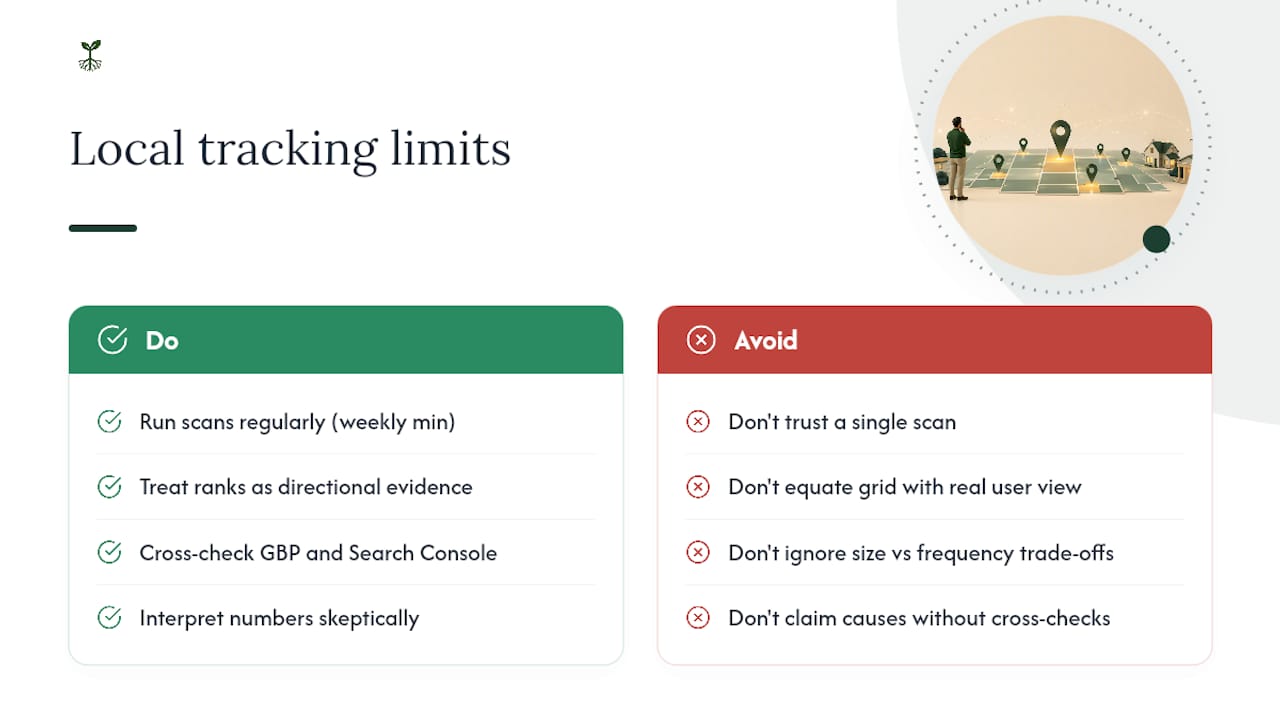
Google's algorithm moves more than any dashboard can fully capture. Local results fluctuate based on time of day, device, and even the individual searcher's history, so a single scan is a snapshot, not a permanent record. Run scans on a consistent schedule (weekly, at minimum) rather than reacting to any one day's numbers.
Grid data can disagree with what a real customer sees. Even UULE-based scans simulate a search rather than replicating one, and personalization signals (a searcher's past visits, saved places, browsing history) can shift results in ways no grid captures. Treat rank data as directional evidence, not gospel.
Sample size and scan frequency limit resolution. A 5x5 grid scanned monthly tells you far less than a 15x15 grid scanned weekly, but the denser option costs more in credits or subscription tier. Budget constraints often force a trade-off between coverage and frequency.
Attribution gets murky. A ranking improvement might follow a GBP update, a new review, a citation fix, or nothing you did at all. Cross-referencing grid movement against GBP Insights and Search Console data helps, but it rarely produces a clean cause-and-effect line.
Competitor data isn't always apples to apples. Competitors change categories, close locations, or get suspended from Google Business Profile without warning, which can make a sudden ranking jump look like your own win when it's really someone else's loss.
None of this makes tracking useless. It just means the numbers need a skeptical read, not a literal one.
Comparing Local Rank Tracker Categories by Fit
Rather than naming specific vendors, it helps to compare tools by what they're built to do, since the right fit depends entirely on your scan volume and reporting needs.
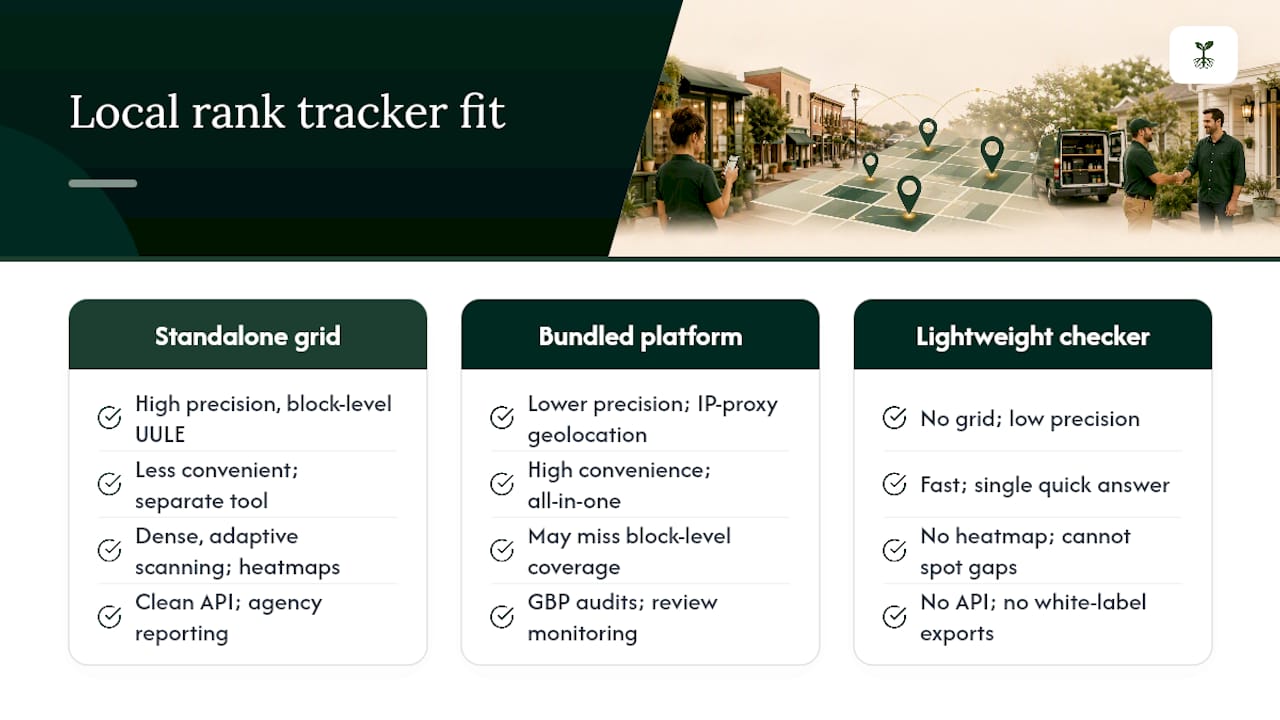
High-resolution standalone grid tools win on precision. Their strength is dense, adaptive scanning and clean API access, which agencies lean on for client reporting. The trade-off is cost at scale: credit-based pricing adds up fast if you're running large grids for many locations every week.
Bundled local SEO platforms win on convenience. Getting GBP audits, review monitoring, and rank tracking in one login saves setup time and avoids juggling logins across five tools. The trade-off is precision: IP proxy geolocation in many bundled platforms doesn't match dedicated UULE-based scanning for block-level accuracy.
Lightweight or free-tier checkers win on speed for a single quick answer. They're fine for a gut check before a sales call or a client pitch. The trade-off is obvious: no real grid, no heatmap, and no way to spot a coverage gap three neighborhoods away.
The honest answer to "which is best" depends on whether you're managing one location casually or reporting to a dozen clients monthly. A solo owner rarely needs agency-grade grid density. An agency rarely can afford to skip API access and white-label exports once it's managing more than a handful of accounts.
Making Rank Data Part of Your Actual SEO Strategy
Tracking data that lives in a dashboard and nowhere else is wasted effort. A few habits turn it into something that actually moves rankings.
Pair grid movement with GBP Insights before drawing conclusions. A rank drop that coincides with falling views and calls is a real problem. A rank drop with flat or rising calls might just be noise. Cross-referencing grid rank deltas with GBP performance data is what turns tracking into prioritization.
Set a review cadence, not a one-time check. Weekly or biweekly scans, reviewed on a fixed schedule, catch trends that a single glance misses.
Turn red zones into specific tasks. A weak grid quadrant should generate a concrete action: a new local landing page, a citation cleanup in that area, or a review request campaign targeting customers from that neighborhood.
Loop rank data into content and landing page decisions. If a service area consistently underperforms, that's a signal to build a dedicated page for it rather than relying on your homepage to rank everywhere at once.
Share the data with whoever owns execution. Reports that sit in an inbox unread don't change rankings. Reports tied to a task list and a deadline do.
Automation and Alerts: What to Expect From Modern Trackers
Manual rank checking doesn't scale past a handful of keywords, which is why automation has become a baseline expectation rather than a premium feature.
Most credible tools now offer scheduled scans (daily, weekly, or biweekly) that run without anyone remembering to trigger them. Alerting layers on top: threshold-based notifications that fire when a keyword drops out of the Map Pack entirely, or when average grid rank shifts by a meaningful margin.
API access extends automation further, letting agencies pull rank data directly into their own reporting systems rather than exporting and reformatting spreadsheets by hand. That's part of why API access and white-label exports often justify a higher monthly cost for agencies managing multiple clients. A tool like AI-driven content workflows can also help agencies turn rank alerts into drafted landing page briefs automatically, cutting the lag between spotting a gap and acting on it.
The trade-off worth knowing: more automation generally means a higher price tier, and alert thresholds set too loosely will bury you in noise you learn to ignore, which defeats the purpose entirely.
Why Location Targeting and Personalization Skew Your Results
Every rank tracker is an approximation, and personalization is the biggest reason why. Google adjusts local results based on a searcher's location history, saved places, past clicks, and even their device type, none of which a scan can fully replicate.
This is exactly why geo-grid scanning, especially with UULE parameters, exists in the first place. It strips personalization out of the equation and shows you a cleaner, more repeatable view of where you rank from a specific point, without one searcher's history skewing the result. IP proxy scanning, by contrast, approximates a region rather than a precise coordinate, which introduces its own layer of imprecision on top of whatever personalization effects remain.
The practical takeaway: don't panic when a customer tells you they "couldn't find you" despite a green grid nearby. Their individual search history, or even the device they searched from, may have shown them something your tracker didn't capture. Rank data measures the field, not any one player standing on it.
Buy the Tool or Hire the Service?
If you have the time to run weekly scans, interpret grid heatmaps, and turn red zones into GBP and content fixes yourself, a standalone tool is the cheaper path. If you'd rather hand over the diagnostic work and get a prioritized task list instead of a dashboard, a managed local SEO plan makes more sense. Solo professionals juggling client work rarely have the bandwidth for the first option.
— Jason
Rooted Up: Managed Local Visibility Without the Tool Sprawl
This service offers an alternative to combining a rank tracker, a review platform, and a reporting spreadsheet independently by providing Google Business Profile management, review automation, and rank-informed SEO reporting within a monthly plan.

That matters most for solo professionals who don't have a marketing hire to own this work. Monthly plans can transform grid rank movement and GBP Insights into a prioritized task list as described earlier in this article, simplifying the workflow for clients. If a service area is underperforming, that becomes a landing page brief or a review push, not a line item you have to notice and act on unassisted.
If you're weighing whether to buy a tracker and manage it in-house or hand the whole workflow off, start with a look at Rooted Up's monthly plans and book a discovery call to see which package matches your current visibility gaps.
Sources
For deeper technical detail on geo-grid methodology and pricing models, see the Geogrid comparison of leading local rank trackers, BrightLocal's guide to local rank tracking, and Flento's breakdown of tracking metrics and pricing.
FAQ
What Is a Local Rank Tracker?
A local rank tracker measures where a business appears in Google Maps and the Local Pack across a defined service area, typically using geo-grid scans rather than a single search result.
How Is Geo-Grid Tracking Different From Regular Rank Tracking?
Geo-grid tracking runs the same search from multiple points across a service area to build a visibility heatmap, while regular rank tracking checks a single position from one location or IP address.
How Much Does Local Rank Tracking Cost?
Entry-level single-location tracking typically runs $30 to $60 a month, while agency-grade tools often use credit-based pricing that scales with grid size and scan frequency.
Should I Use UULE or IP Proxy Geolocation?
UULE gives GPS-level precision and is better for diagnosing exact ranking behavior at the block level, while IP proxy methods are cheaper and adequate for broad, less granular checks.
Can Rooted Up Help With Local Rank Tracking?
Yes. Rooted Up folds rank-tracking data into its monthly managed plans, pairing it with Google Business Profile management and review automation to turn ranking gaps into concrete action items.