
The right lead qualification framework depends entirely on deal complexity and sales motion, not personal preference. Fast, low-complexity sales cycles run best on BANT or CHAMP. Deals with multiple stakeholders and long cycles need MEDDIC or MEDDPICC. Simpler models like ANUM, FAINT, and GPCTBA/C&I fill specific gaps in between. The rest of this guide breaks down each framework, shows you a decision matrix, and walks through the CRM fields and scripts that turn any of them into a repeatable process.
TL;DR:
- Small, quick deals under $25K typically benefit from BANT or ANUM frameworks, focusing on speed and basic qualification questions.
- Larger, complex deals over $50K with multiple stakeholders should adopt MEDDIC or MEDDPICC to ensure thorough discovery and process alignment.
- Hybrid systems often start with fast triage using BANT or CHAMP, then shift to detailed MEDDIC-style discovery for qualified opportunities.
- Automating mandatory CRM fields, scoring models, and fast lead routing significantly increases qualification accuracy and conversion rates.
- Solo professionals should simplify qualification to two or three key questions, automating enrichment to save time and improve lead quality.
Table of Contents
- Lead Qualification Frameworks Explained: What Each One Checks and When to Use It
- Decision Matrix: Matching Deal Size and Motion to a Framework
- Turning a Framework Into an Operational System
- Discovery Scripts You Can Run This Week
- How Rooted Up Applies Qualification Logic for Solo Professionals
- Stop Optimizing the Framework, Start Enforcing It
- Sources
- FAQ
Lead Qualification Frameworks Explained: What Each One Checks and When to Use It
Every qualification framework asks the same underlying question in a different order: is this lead worth your time right now? HubSpot's rundown of the major sales qualification methods lists the six that show up in nearly every sales playbook, and each one earns its place by fitting a different kind of deal.
- BANT (Budget, Authority, Need, Timeline): the oldest framework in the toolkit, built for transactional and SMB deals with a single decision maker. Ask: "What budget range are you working with?" "Who else needs to sign off on this?" "What's driving the urgency now?"
- MEDDIC (Metrics, Economic Buyer, Decision Criteria, Decision Process, Identify Pain, Champion): the standard for complex B2B and enterprise sales with multiple stakeholders. Ask: "How will you measure success six months from now?" "Walk me through how this decision typically gets approved." "Who internally is pushing for this change?"
- MEDDPICC: MEDDIC plus Paper Process and Competition, useful when procurement and legal review routinely stall deals. Ask: "What does your contract review process look like?" "Who else are you evaluating?"
- CHAMP (Challenges, Authority, Money, Prioritization): leads with pain instead of budget, which fits consultative or SaaS motions where the problem sells the deal. Ask: "What's the biggest challenge this creates for your team?" "Where does solving this rank against your other priorities?"
- ANUM (Authority, Need, Urgency, Money): flips BANT's order to filter out unauthorized contacts fast, a good fit for high-volume inbound. Ask: "Are you the person who'll make this call, or will others weigh in?"
- FAINT (Funds, Authority, Interest, Need, Timing): built for markets where buyers don't have a budget line yet, common in emerging categories. Ask: "Is this something you'd need to build budget for, or does it already exist?"
- GPCTBA/C&I (Goals, Plans, Challenges, Timeline, Budget, Authority, Negative Consequences, Positive Implications): HubSpot's own deep-discovery model for high-consideration sales. Ask: "What happens if this problem goes unsolved for another year?"
Decision Matrix: Matching Deal Size and Motion to a Framework
Deal size and sales cycle length tell you almost everything you need to know about which framework to run. A comparison of BANT, MEDDIC, and CHAMP from SyncGTM points out that framework choice should track team maturity and selling motion just as much as contract value.
- Under $25K ACV, short cycle, single buyer: BANT or ANUM. Speed matters more than depth, and a five-minute call should be enough to qualify or disqualify.
- $10K to $100K ACV, mid-length cycle, two to three stakeholders: CHAMP or FAINT. Leading with the problem instead of the budget line works better once you're selling into teams instead of individuals.
- $50K+ ACV, long cycle, five or more stakeholders, procurement involved: MEDDIC or MEDDPICC. You need a documented decision process and a named champion before you invest real AE time.
- Inbound motion: lighter-touch frameworks (BANT, ANUM) at the top of funnel, since inbound leads have already self-selected some intent.
- Outbound or account-based motion: MEDDIC-style discovery from the first qualified call, since you're targeting accounts you've already vetted for fit.
Most mature revenue teams don't pick one framework and stop there. The common hybrid stack runs BANT or CHAMP at SDR triage to kill dead leads fast, then hands qualified opportunities to AEs running full MEDDIC or MEDDPICC discovery. Enforce the handoff with a hard rule: no opportunity moves to an AE without every triage field populated in the CRM.
Turning a Framework Into an Operational System
A framework only works if your CRM makes it impossible to skip. That means building required fields into your pipeline stages, not just training reps on a script they'll forget under quota pressure.
- Lock required fields into stage-gating. A lead can't move from "New" to "Qualified" without budget range, authority level, and timeline populated, at minimum. For MEDDIC teams, add economic buyer name and identified pain as mandatory fields before an opportunity reaches "Discovery Complete."
- Build a simple weighted scoring model. Score ICP fit (firmographic match), engagement (email opens, site visits), intent signals (content downloads, pricing page views), and discovery answers on a 100-point scale, then set your MQL threshold where historical data shows conversion actually picks up, usually somewhere between 60 and 75 points.
- Define who owns the MQL to SQL handoff. Marketing owns the MQL gate; sales development owns the SQL gate. Neither side should be able to unilaterally reclassify a lead without a logged reason.
- Layer in enrichment before human contact. Firmographic, technographic, and intent data appended automatically saves reps from re-asking questions a lead already answered in previous touches, and research on integrating expert rules with automated lead ranking shows this kind of hybrid system meaningfully improves scoring accuracy over manual rules alone.
- Automate for speed-to-lead. Route and notify within minutes of a form fill, not hours.
Speed-to-lead is one of the highest-leverage numbers in this entire process. Contacting a lead within one hour delivers roughly 7 times higher qualification odds than slower follow-up, and AI-driven scoring models can lift qualification accuracy by around 40% compared with static rule sets. For benchmarks, aim for a typical lead-to-MQL rate and MQL-to-SQL rate consistent with common industry references. Variations below such indications may suggest gating issues rather than lead quality problems.
Discovery Scripts You Can Run This Week
You don't need a new framework to fix a broken qualification process. You need a script your team actually follows.
- SDR triage call (3 to 5 minutes, BANT or CHAMP style): Ask about budget range or top challenge, confirm decision-making authority, gauge urgency with a timeline question, and log a prioritization score. Four questions, no more.
- AE discovery call (20 to 30 minutes, MEDDIC or MEDDPICC style): Walk through metrics for success, identify the economic buyer by name, map the decision process step by step, confirm a champion internally, and note any competitive evaluation underway.
- Record answers directly into required CRM fields, not free-text notes. A scoring model can't read a paragraph buried in an activity log, and neither can the AE who inherits the deal next quarter.
A two-gate structure like this, fast triage followed by deep discovery, is the pattern most B2B teams converge on once they've tried running one framework end to end and found it either too slow for inbound or too shallow for enterprise.
How Rooted Up Applies Qualification Logic for Solo Professionals
Solo professionals don't have an SDR team, so Rooted Up builds qualification directly into the intake process instead. That means a short required-field form (service need, timeline, decision authority) feeding straight into automated enrichment, so a client isn't manually screening every inquiry that lands in their inbox. Leads that don't clear the bar get routed into a nurture sequence rather than dropped, and progressive profiling collects the rest of the picture over time instead of front loading a long form that scares off a busy prospect.
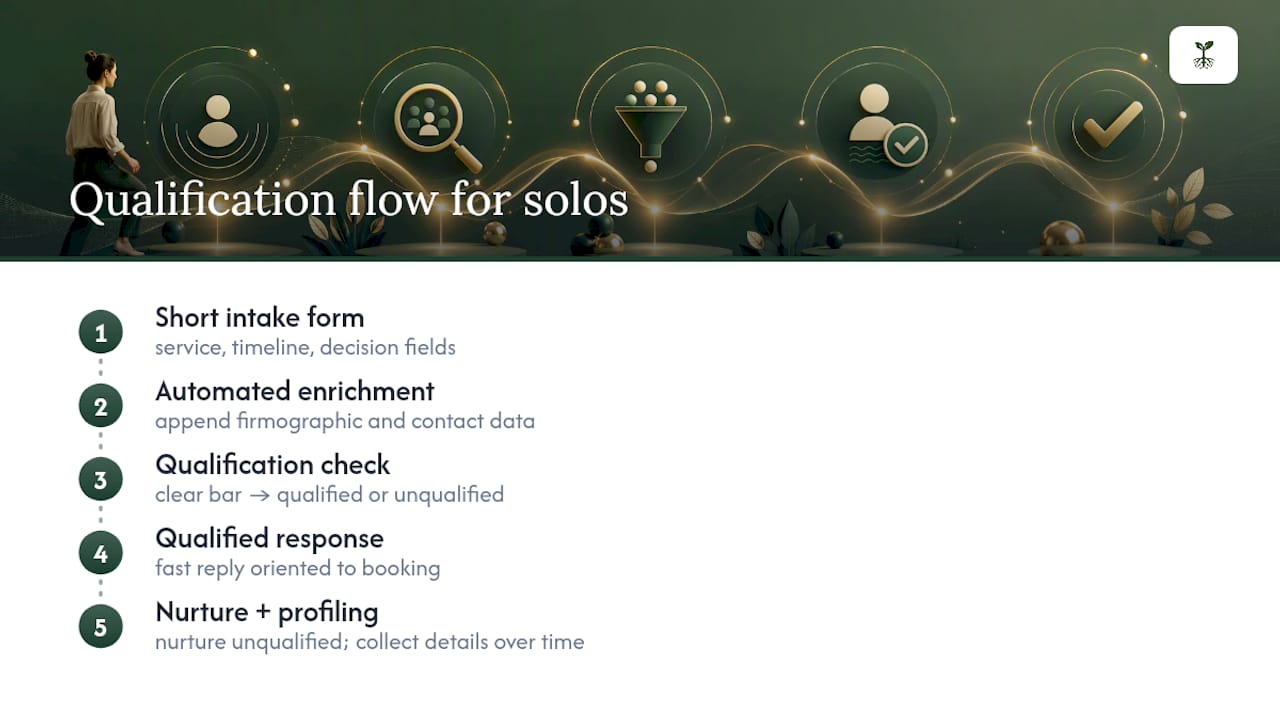
Pro Tip: If you're a solo practitioner, don't build a five-field MEDDIC form. Pick two or three questions that actually predict whether someone becomes a paying client, and automate everything after that.
The realistic outcome for a solo professional running this setup is a tighter gap between inquiry and response, and fewer hours spent chasing leads who were never going to book.
Stop Optimizing the Framework, Start Enforcing It
Pick the simplest framework that matches your deal complexity and put it into your CRM this week. BANT for straightforward deals, MEDDIC for anything with multiple stakeholders. Stop debating BANT vs CHAMP in a planning meeting. Use pipeline reviews to catch missing fields, coach reps on the questions they're skipping, and revisit your scoring thresholds every quarter based on what's actually converting. Adoption beats perfection every time.
— Jason
Sources
Framework definitions and hybrid guidance from HubSpot, qualification benchmarks from Landbase, and automated scoring research via PMC.
If you'd rather have this built and enforced for you, Rooted Up's Foundation, Growth, and Partner plans include AI-driven intake and enrichment workflows sized for solo professionals who don't have a revenue ops team to build it themselves.
- Ultimate guide to sales qualification — HubSpot
- Integrating expert knowledge and multilingual web crawling data in a lead qualification system — Decision Support Systems / PMC
- 35 Lead Qualification Statistics: Essential Data for B2B Sales Success in 2026 | Landbase
FAQ
What Are the Main Frameworks for Qualifying Leads?
The most widely used frameworks are BANT, MEDDIC, MEDDPICC, CHAMP, ANUM, FAINT, and GPCTBA/C&I, each built for a different combination of deal size, stakeholder count, and sales motion.
What Is a Lead Scoring Framework?
A lead scoring framework assigns point values to firmographic fit, engagement signals, intent data, and discovery answers, then sets a threshold, often between 60 and 75 points, that determines when a lead becomes sales-ready.
What Are the Criteria for Lead Qualification?
Core criteria typically include budget or funding availability, decision-making authority, a confirmed need or pain point, and a realistic timeline. Some frameworks add metrics, decision process, and competitive context for larger deals.
What Are the Requirements for a Lead to Be Considered Qualified?
Most frameworks require confirming need, budget or funds, authority to decide, and timeline at minimum. More rigorous frameworks like MEDDIC add a named economic buyer and an internal champion before calling a lead fully qualified.
Should I Use BANT or CHAMP for My Team?
Use BANT when budget and authority are clear early in the conversation, which fits transactional and SMB sales. Use CHAMP when leading with the prospect's challenge converts better, which is common in consultative or SaaS motions.