
Lead nurture automation is a rules-based system that sends the right message, to the right contact, based on behavior and data signals, without a person clicking send each time. Done well, it turns anonymous website traffic and cold form fills into qualified pipeline faster than manual follow-up ever could. Gartner's research on non-linear buying journeys and the FTC's CAN-SPAM rules set the two guardrails that matter most: relevance and compliance. These systems are often built for solo professionals using a pattern of small pilot, clear metric, and fast iteration.
TL;DR:
- Effective lead nurture automation should prioritize pipeline outcomes, including sales qualification, deal velocity, and revenue growth, rather than just email engagement metrics.
- Building a reliable system requires a unified contact record, behavior-based scoring with decay, clear enrollment and exit criteria, and a universal suppression list to ensure compliance and prevent accidental re-enrollment.
- Content pathways should focus on specific buyer tasks instead of funnel stages, with tailored messaging and branching logic for different personas, validated through testing and pilots before scaling.
- Personalization should start with simple tokens and dynamic blocks, reserving one-to-one outreach for high-value accounts with ambiguous intent or legal considerations, supported by AI for testing variants.
- Use KPIs like pipeline influence, deal velocity, and conversion rates to measure success, and avoid relying on open or click rates alone, especially since most automation fails when handling complex, ambiguous, or high-value leads.
Table of Contents
- What Is Lead Nurture Automation and Why It Matters Now
- Core Components of a Reliable Automation Architecture
- How to Build and Launch an Automated Lead-Nurture Program
- Reusable Workflow Examples and Templates You Can Adapt
- Balancing Personalization and Automated Scale
- Compliance, Suppression Architecture, and U.S. Legal Basics
- What to Measure: KPIs and Experiments That Show Real Impact
- Rooted Up's Take on Practical Lead Nurture Automation
- What Actually Matters Going Into 2026
- Get a Working Pilot Instead of a Guessing Game
- Sources
- FAQ
What Is Lead Nurture Automation and Why It Matters Now
Most people picture an email drip when they hear "nurture automation." That's only part of it. A real system spans email, SMS, retargeting ads, on-site content recommendations, and internal task creation for sales reps, all triggered by the same rule engine. The "automation" part isn't the channel. It's the logic that decides who gets what, when, based on what they just did.
Gartner's research on B2B buying journeys found that buyers don't move through a clean funnel stage by stage. They loop back, compare vendors mid-decision, and revisit content they'd already dismissed. Gartner recommends designing nurture paths around the specific "jobs" buyers are trying to complete, like building a business case or getting stakeholder buy-in, rather than assuming everyone marches from awareness to decision in order. A funnel-shaped workflow built around that assumption will misfire constantly, sending "why choose us" content to someone who's still trying to define their problem.
The outcomes worth chasing aren't email metrics. They're:
- Qualified pipeline generated per month, not leads captured
- Time from first touch to sales-qualified handoff
- Retention and expansion revenue from nurtured accounts post-sale
- Sales rep time saved on manual follow-up
Automation earns its keep on volume and consistency. It should never own the moments that require judgment. A prospect who asks a pricing question in a chat widget, or a lead from a six-figure account that just requested a demo, needs a human reply within minutes, not the next scheduled email in a sequence.
Core Components of a Reliable Automation Architecture
Before building a single workflow, get the underlying data structure right. Skipping this step is the single biggest reason nurture programs break within a few months of launch.
- A canonical contact record. Every lead needs one source of truth for identity, consent status, and subscription preferences, synced across your CRM and marketing platform, not scattered across three tools that occasionally disagree.
- Segmentation attributes that actually drive decisions. Industry, company size, and role matter less than behavioral signals like pages visited, content downloaded, and email engagement recency. Firmographic data qualifies; behavioral data times the message.
- A lead scoring model with decay built in. Points for downloading a whitepaper should mean less six months later than they did last week. Static scores that never decay create stale "hot leads" that sales stops trusting.
- Enrollment triggers and exit criteria defined before launch. Know exactly what adds someone to a sequence, what pulls them out early (a reply, a meeting booked, a purchase), and whether re-enrollment is even allowed.
- A centralized suppression list. Unsubscribes, bounces, and manual opt-outs need to block a contact everywhere, across every workflow and every integration, not just in the tool where they clicked unsubscribe.
Pro Tip: Build your suppression logic before you build your first sequence, not after. Retrofitting compliance into five live workflows is far messier than starting with one gate everything passes through.
Firmographic scores tell you if a lead fits your ideal customer profile. Behavioral scores tell you if they're actually paying attention right now. Blend both, and weight behavioral signals higher for anything that triggers sales outreach.
How to Build and Launch an Automated Lead-Nurture Program
- Define buyer jobs, not funnel stages. List the tasks your buyers need to complete: comparing options, justifying cost internally, getting technical sign-off. Map content to those jobs instead of a generic top/middle/bottom split.
- Set segmentation and scoring rules. Decide which behaviors and attributes actually predict sales readiness for your business, and score accordingly.
- Define entry, exit, and handoff triggers. Specify what enrolls a contact, what disqualifies them, and the exact score or action that hands them to a sales rep.
- Design branching logic per persona. A finance buyer and a technical evaluator shouldn't get identical sequences even if they came from the same form. Build the branch points into the workflow, not as an afterthought.
- Write the actual message sequences. Draft three to five touches per branch, spaced by expected buyer pace, not an arbitrary "every three days" rule.
- Test with dummy records first. Push fake contacts through every branch to confirm triggers fire correctly and nobody gets double-enrolled or stuck in a loop.
- Run a small pilot before full rollout. Launch to one segment, measure against pipeline metrics rather than open rates, and only scale once the numbers hold.
- Iterate on what the pilot data shows. Adjust timing, branching, and content based on where leads actually convert or drop off, then expand to additional segments.
Platform documentation from tools like HubSpot's workflow engine shows the mechanics: enrollment triggers, delay steps, conditional branches, and internal notification actions all live in the same rule builder, whether you're on a HubSpot-style platform or a Salesforce-style one. The specific software matters less than whether your team actually tests before scaling.
Reusable Workflow Examples and Templates You Can Adapt
A handful of workflow shapes cover most B2B and service-business needs. Adapt the timing and content, not the underlying logic.
- Welcome series. Triggered by a new subscriber or form fill. Four messages over ten days: an introduction, a proof point (case study or testimonial), a resource tied to their stated interest, and a soft call to book a call. Exit early if they reply or book a meeting.
- Education-to-demo escalation. Starts as a slow-drip content series. If a contact visits the pricing page twice or opens three consecutive emails, the workflow escalates them into a shorter, sales-focused sequence and fires an internal notification to the assigned rep.
- Re-engagement / winback. Triggered when a previously active contact goes 60 to 90 days without opening an email or visiting the site. Sends one direct "still interested?" message with a specific offer, then suppresses the contact from general sequences if there's no response.
- Account-based nurture. For target accounts with multiple stakeholders, route different message tracks by role: an economic buyer gets ROI-focused content, a technical evaluator gets implementation detail, and each track notifies the account owner when engagement spikes. Forrester's research on buying groups argues this role-based split matters more than treating every contact at an account identically.
Salesforce's own engagement program templates walk through building these same shapes with conditional steps. This is a useful reference if you want to see the branching logic laid out visually before you build your own.
Balancing Personalization and Automated Scale
Personalization operates in three tiers, and most teams jump straight to tier three when tier one would already move the needle.
- Basic tokens. First name, company name, industry. Cheap to implement, works everywhere, and prevents the "Dear Valued Customer" problem.
- Dynamic content blocks. The same email template shows different case studies or CTAs based on segment or score. This is where most B2B programs should live.
- One-to-one outreach. A rep personally writes or heavily edits a message for a specific high-value account. Reserve this for accounts where the deal size justifies the time.
Certain signals should always pull a lead out of automation and into a human's hands: ambiguous intent (a form fill with no clear use case stated), high contract value, or any sign that procurement or legal is already involved, which is why many teams rely on speed-to-lead automation to engage these high-intent signals within minutes. Automation can prep the ground, but a stalled enterprise deal needs a person reading between the lines, not another scheduled email.
Pro Tip: Test personalization lift against pipeline conversion, not click rate. A dynamic content block that gets fewer clicks but converts twice as many of those clickers into meetings booked is the one worth keeping.
Tools like AI email drafting speed up writing enough variants to actually test tier-two personalization at scale, which is where most teams get stuck without help.
Compliance, Suppression Architecture, and U.S. Legal Basics
The FTC's CAN-SPAM guidance applies to most commercial email, including a large share of B2B nurture messages. That means every sequence needs accurate sender information, a subject line that doesn't misrepresent the content, and a working unsubscribe link that's honored promptly, not just present for show.
- Build one centralized suppression list that every workflow and integration checks before sending, not per-tool opt-out lists that can drift out of sync.
- Record consent status and its source (form, import, event signup) on the canonical contact record so you can prove compliance if ever asked.
- If you send SMS as part of nurture, TCPA rules add stricter consent requirements than email. Rooted Up's TCPA compliance playbook covers the specifics for U.S. text messaging.
- Audit every workflow quarterly for accidental re-enrollment. A common bug: a contact unsubscribes from one sequence but a data sync re-adds them to a different one because the suppression check wasn't universal.
Suppression logic works best as infrastructure, not a feature bolted onto individual campaigns. Every send, regardless of which tool triggers it, should check the same gate.
What to Measure: KPIs and Experiments That Show Real Impact
Open rates and click rates tell you the email arrived. They don't tell you whether the program is generating revenue.
- MQL to SQL conversion rate. The percentage of marketing-qualified leads that sales actually accepts as sales-qualified. A rising score with a falling conversion rate means your scoring model needs recalibration.
- Pipeline influenced by nurture. Track deals where a nurtured contact was part of the buying group, not just deals where the contact filled out the original form.
- Deal velocity. Compare average time-to-close for nurtured versus non-nurtured leads within the same segment.
- Secondary signals. Email engagement and content consumption still matter, but treat them as leading indicators for score adjustments, not success metrics on their own.
Run experiments that isolate one variable at a time: test a three-day cadence against a seven-day cadence for the same segment, or test whether lowering the score threshold for sales handoff increases accepted leads without tanking close rate. Attribution here is rarely perfect. Multi-touch models that credit every nurture touch a contact received before closing give a more honest read than last-touch attribution, which tends to erase nurture's contribution entirely.
Rooted Up's Take on Practical Lead Nurture Automation
Solo professionals and small service businesses tend to hit the same wall: they know they need consistent follow-up, but building and maintaining workflows eats the time they should spend on client work. An effective approach starts with a small pilot mapped to one clear buyer job, like "get a new patient to book a consultation," rather than trying to automate the entire client lifecycle on day one.
- Draft message variants quickly using AI, then test which angle actually books more calls, following the same pattern Rooted Up uses for newsletter automation.
- Apply straightforward lead qualification frameworks before building scoring logic, so the rules reflect what actually predicts a booked appointment.
- Keep one centralized suppression check across every tool in the stack, verified before every send.
- Measure the pilot against bookings or inquiries generated, not open rates, before expanding to additional segments.
For teams weighing build-it-yourself against a managed option, the cost breakdown for marketing automation is worth reading before committing budget either way.
What Actually Matters Going Into 2026
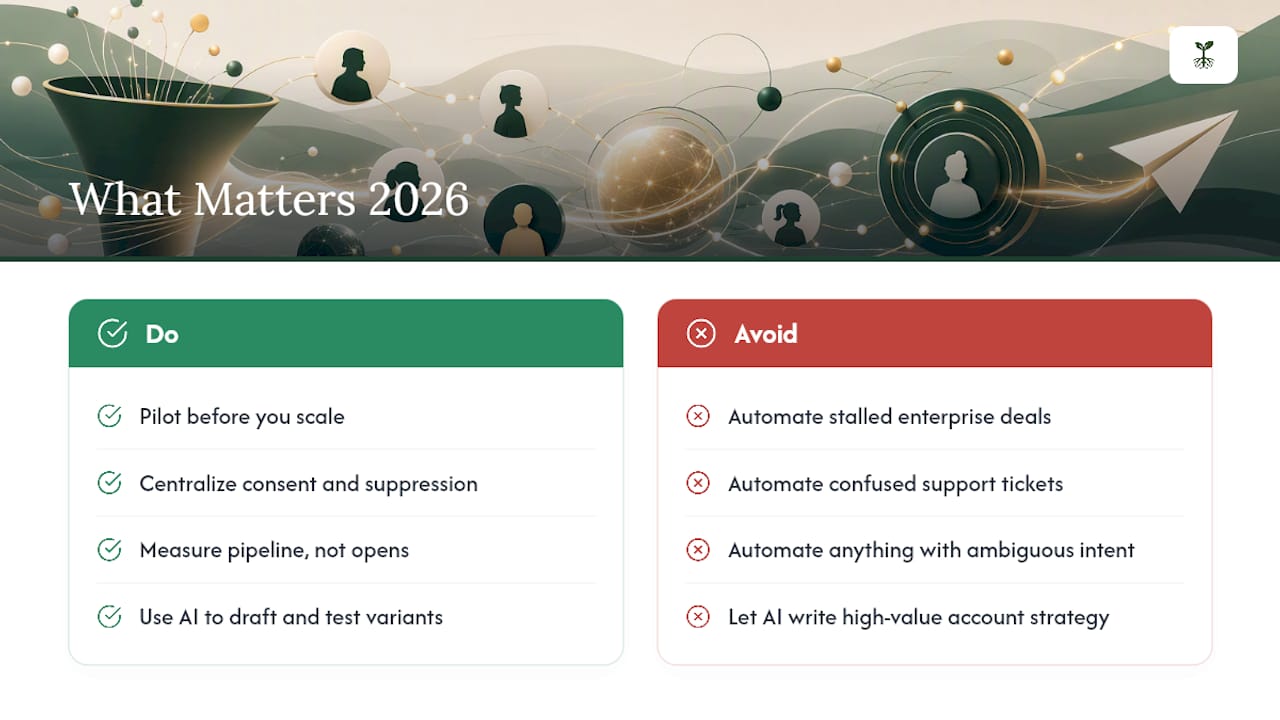
Pilot before you scale. Centralize consent and suppression before you write a single sequence. Measure pipeline, not opens. Use AI to draft and test variants faster, but never let it write the strategy behind a high-value account's messaging.
The teams that struggle aren't the ones automating too little. They're the ones automating a stalled enterprise deal, a confused support ticket, or anything with ambiguous intent, situations that need a person's read, not a scheduled touch three. AI will keep speeding up how fast you can draft and test. It won't replace the judgment call on when to pull a lead out of the sequence entirely.
— Jason
Get a Working Pilot Instead of a Guessing Game
Building this system solo means learning workflow logic, scoring models, and suppression architecture while still running your actual practice. A bundled monthly plan can serve as an alternative to hiring an agency or hiring in-house for solo professionals, combining marketing execution, including automated follow-up sequences, with AI operations management.

The Foundation plan fits professionals who need reliable follow-up and review automation without a complex multi-stage program. Growth adds deeper segmentation and content cadence for businesses juggling multiple lead sources, and Partner is built for practices ready to run account-based nurture across several referral channels. If you'd rather start with a defined project than a monthly plan, the Foundations Sprint is a one-off engagement, priced between $1,500 and $3,000, that sets up your first automated pilot end to end. Either way, the next step is the same: visit Rootedup and tell us which buyer job you want automated first.
Sources
- Gartner — B2B buying journey insights
- FTC — CAN-SPAM Act: A compliance guide for business
- Forrester — Buying groups guidance
- Salesforce Trailhead — Lead nurturing strategy & engagement programs
FAQ
How Does Lead Nurturing Work?
Lead nurturing works by sending targeted content and follow-up based on a contact's behavior, score, and lifecycle stage, rather than blasting the same message to everyone at once. A workflow engine watches for a trigger, like a form fill or page visit, then routes that contact into the sequence and branch that fits their signals.
What Is Lead Nurturing in Salesforce or Similar CRM Platforms?
In CRM platforms like Salesforce or HubSpot, lead nurturing means building automated workflows tied to a contact's record that send emails, create tasks, or update fields based on rules you define. HubSpot's lead pipeline automation shows how stage movement and workflow actions connect directly to the CRM object, so sales sees the same data marketing acted on.
What Is Lead Automation and How Does It Work?
Lead automation uses enrollment triggers, scoring rules, and branching logic to decide what happens next for a contact without a person manually deciding each time. It works by evaluating a contact against defined criteria continuously, then firing the matching action, whether that's an email, an SMS, or a notification to a sales rep.
What Is a Lead Automation System?
A lead automation system is the combination of your CRM, marketing platform, and the rule logic connecting them, built to capture, score, route, and follow up with leads automatically. Rooted Up builds these systems for solo professionals as part of its monthly plans, centering the architecture on one canonical contact record and a single suppression gate.
How Much Does Lead Nurture Automation Cost to Set Up?
Cost depends heavily on complexity and whether you build it yourself or hire it out. Rooted Up's Foundations Sprint, a one-off setup engagement, runs $1,500 to $3,000 depending on scope, available through Rootedup.