
Yes, texting can be HIPAA compliant — but only when you use a properly configured secure messaging platform, pair it with a signed Business Associate Agreement (BAA), and back the whole setup with documented policies and staff training. Standard SMS from your iPhone or Android, no matter how convenient, does not meet the bar. HIPAA Journal's 2026 update confirms that compliance depends on message content, the service used, and whether a BAA is in place.
Three things to do right now:
- Stop sending PHI over consumer SMS. Appointment times without identifiers are low risk; lab results, diagnoses, or medication details sent via iMessage or standard text are not.
- Verify your vendor will sign a BAA. Major carriers (AT&T, Verizon, T-Mobile) do not sign BAAs. If your messaging vendor won't either, you have a compliance gap regardless of how the messages are encrypted.
- Start a risk assessment if texting is already in use. The minimum necessary standard applies to every message: send only what the recipient needs to do their job, and document that decision.
Patient consent to receive texts is not a compliance bypass. A patient who asks you to text them has exercised a communication preference, not waived your Security Rule obligations.
Key Takeaways
HIPAA-compliant texting requires a signed BAA, encryption, audit logging, a documented risk analysis, and staff training — no single element substitutes for the others.
| Point | Details |
|---|---|
| Stop consumer SMS for PHI immediately | Standard carrier texts fail transmission security and audit control requirements under 45 CFR §164.312. |
| BAA before any PHI is transmitted | No BAA means no compliance, regardless of how the platform encrypts messages. |
| CMS QSO-24-05 governs hospital texting | Texted orders must be authenticated and promptly entered into the EHR to satisfy Conditions of Participation. |
| Patient consent is not a safeguard bypass | Consent documents a communication preference; it does not replace encryption, audit logs, or a BAA. |
| Rooted Up supports solo providers | Rooted Up offers policy templates, vendor selection support, and documentation management for practices that prefer a managed approach. |
Table of Contents
- What "HIPAA-compliant texting" actually means in practice
- Standard SMS vs. secure messaging: the technical risks that matter
- Required HIPAA safeguards for text messaging, mapped to practice
- What your BAA with a messaging vendor must actually cover
- CMS guidance on texting patient information and orders
- Step-by-step rollout: policy, consent, training, and audits
- How to evaluate messaging vendors before you sign anything
- Examples of HIPAA-capable messaging platforms and what to verify
- Penalties, breach notification obligations, and common pitfalls
- What auditors and OCR actually look for: key compliance artifacts
- How small practices actually implement compliant texting
- Rooted Up helps solo providers manage compliant patient communications
- Sources
What "HIPAA-compliant texting" actually means in practice
HIPAA does not ban texting. It regulates how protected health information (PHI) is transmitted, stored, and accessed. AccountableHQ's practical guidance puts it plainly: the minimum necessary standard applies, secure platforms with encryption and audit logging are required, BAAs must be executed, and policies and training must be documented before PHI moves through any messaging channel.
In practice, "HIPAA-compliant texting" means every element below is in place simultaneously:
- BAA signed with the messaging vendor before any PHI is transmitted
- Transmission encryption (TLS in transit, AES-256 or equivalent at rest)
- Access controls and unique user authentication so only authorized staff can read messages
- Audit logging that records who sent what, to whom, and when
- Message retention and archiving consistent with your state's medical record retention rules
- Minimum necessary policy governing what content may be sent via text
To make the content distinction concrete: texting "Your 2 PM appointment is confirmed" carries minimal PHI risk. Texting "Your hemoglobin A1c came back at 9.2 — we're adjusting your metformin" is clinical detail that requires a secure channel, a BAA, and an audit trail. The line isn't always obvious, which is exactly why a written policy matters.
Standard SMS vs. secure messaging: the technical risks that matter
The gap between a carrier text message and a purpose-built secure healthcare messaging platform is not a matter of degree. It is a structural difference in how messages are routed, stored, and controlled.
| Feature | Standard SMS (carrier) | Secure healthcare messaging platform |
|---|---|---|
| Encryption in transit | None (or carrier-level, not end-to-end) | TLS/end-to-end encryption |
| Encryption at rest | Not guaranteed | AES-256 or equivalent |
| BAA available | No | Yes (required for HIPAA use) |
| Audit logs | Not available to provider | Full sender/recipient/timestamp logs |
| Access controls | None | Role-based, MFA-enforced |
| Remote wipe | Not available | Available via MDM integration |
| Wrong-number risk | High — no recall or alert | Message recall, delivery confirmation |
| Regulatory basis | Fails 45 CFR §164.312(e) and §164.312(b) | Designed to satisfy both |
45 CFR §164.312 requires covered entities to implement transmission security controls (§164.312(e)) and audit controls that record and examine activity in systems containing ePHI (§164.312(b)). Standard SMS satisfies neither. Carriers do not sign BAAs, and consumer messaging apps — even encrypted ones — typically lack the contractual assurances and enterprise controls that HIPAA requires.
Three specific risks deserve attention beyond the table above. First, wrong-number delivery: a misdirected text containing a patient's diagnosis or medication list is a reportable breach with no technical recall option on standard SMS. Second, fallback to unencrypted SMS: some platforms default to plain SMS when the recipient's app isn't installed, silently dropping all security controls. Third, metadata exposure: even when message content is encrypted, carrier metadata (sender, recipient, timestamp, location) is retained and accessible without a BAA.
Required HIPAA safeguards for text messaging, mapped to practice
The Security Rule organizes controls into three categories. All three apply when texting involves ePHI.
Technical safeguards
- Encryption in transit and at rest: TLS 1.2 or higher for transmission; AES-256 for stored messages and attachments.
- Multi-factor authentication (MFA): Required for any staff account that can access PHI via the messaging platform.
- Unique user IDs: Shared logins are a Security Rule violation. Every clinician and staff member needs a distinct account.
- Session timeouts: Platforms should auto-lock after a configurable idle period, especially on mobile devices.
- Mobile device management (MDM): Devices used for clinical texting should be enrolled in an MDM solution that enforces encryption, screen lock, and remote wipe.
- Remote wipe capability: If a device is lost or stolen, you need the ability to erase PHI remotely.
- Integrity controls: Messages should not be alterable after delivery; platforms should flag or prevent tampering.
- Audit logging: Every message event — sent, received, read, deleted — should be logged with user ID and timestamp.
Administrative safeguards
- Documented risk analysis: Required before deploying any texting solution involving PHI.
- Written texting policy: Defines which staff may text PHI, what content is permitted, and what channels are approved.
- Role-based access: Not every staff member needs access to every patient's messages.
- Staff training: Documented, role-specific training before any staff member uses the platform for PHI.
- Incident response plan: Covers misdirected messages, device loss, and vendor breaches.
Physical safeguards
- Screen-lock enforcement: Auto-lock within 2–5 minutes on all devices.
- Device handling policy: Rules for using personal devices (BYOD) versus organization-issued hardware.
- Storage and disposal: Decommissioned devices must be wiped before disposal; policies must document the process.
Pro Tip: One control many organizations skip: disable in-app screenshots on the messaging platform. A clinician who screenshots a patient's lab result and saves it to their camera roll has just moved PHI outside your audit perimeter entirely.
What your BAA with a messaging vendor must actually cover
A BAA is not a checkbox. It is a legally binding contract that makes your vendor directly liable for certain HIPAA obligations. HHS is clear: business associates handling PHI must enter into BAAs that specify permitted uses, security obligations, and breach reporting, and those business associates are directly liable for compliance with the Security Rule.
When evaluating or onboarding a messaging vendor, request written confirmation of the following:
- BAA scope: Does the BAA cover the specific product tier you are purchasing? (Free tiers often exclude BAA coverage entirely.)
- Permitted uses of PHI: The BAA should restrict the vendor from using your patients' data for any purpose beyond providing the contracted service.
- Breach reporting timeline: The vendor must notify you within 60 days of discovering a breach, per 45 CFR §164.410. Many BAAs specify shorter windows — 30 days is common and preferable.
- Subcontractor flow-down: If the vendor uses subprocessors (cloud hosting, analytics), those subcontractors must also be covered by BAAs.
- Security Rule adherence: The BAA should explicitly commit the vendor to implementing Security Rule-required safeguards.
- Encryption approach: Ask for specifics — TLS version, key management model, and whether keys are held by the vendor or by your organization.
- Audit log availability: Confirm you can export raw audit logs on demand, not just view a dashboard.
- Data residency: Where are messages stored? U.S.-based storage is standard for healthcare; confirm it.
- EHR integration support: Does the vendor support direct integration with your EHR, or does message documentation require manual entry?
One common trap: many organizations assume that a vendor's marketing claim of "HIPAA compliance" means a BAA is automatically available. It does not. Always request the BAA before piloting, and have legal review it before signing.
CMS guidance on texting patient information and orders
Hospitals and critical access hospitals (CAHs) operate under an additional layer of regulatory scrutiny beyond HIPAA: the Conditions of Participation (CoPs). CMS has addressed texting directly.
The practical implications of QSO-24-05 are specific. CPOE (computerized physician order entry) remains the preferred method for clinical orders. Secure texting is an acceptable alternative, but only when three conditions are met: the platform is HIPAA-compliant, the author's identity can be verified, and the message is promptly incorporated into the patient's medical record. A text order that sits in a messaging app and never makes it into the EHR creates both a retention gap and a CoP violation.
The AMA guidance reinforces this: secure text messages may be used for clinical orders when platforms meet HIPAA and CoP requirements, but texted orders must be authenticated and promptly entered into the medical record. Authentication means the ordering clinician's identity is confirmed in the record, not just in the messaging app.
For hospitals implementing compliant texting, this means three operational requirements: the platform must log the sender's identity in a way that satisfies authentication standards, staff must have a defined workflow for transferring texted orders into the EHR within a specified timeframe, and the platform itself must undergo regular security assessments to confirm it continues to meet the CoP standard.
Step-by-step rollout: policy, consent, training, and audits
A compliant texting implementation is not a single purchase. It is a sequenced process. Skipping steps — especially risk analysis and training — is where most enforcement actions originate.
- Conduct a risk analysis. Before any PHI moves through a messaging platform, document your current texting practices, identify where PHI is at risk, and assess the likelihood and impact of a breach. This is required under 45 CFR §164.308(a)(1) and is the foundation for every decision that follows.
- Draft a texting policy. Define which staff roles may send PHI by text, which message types are permitted, which platforms are approved, and what the incident response process is for misdirected messages.
- Select a vendor and execute a BAA. Use the checklist in the section above. Do not pilot any platform with real PHI until the BAA is signed.
- Run a limited pilot. Start with one department or care team. Verify that audit logs are generating correctly, that EHR documentation workflows are functioning, and that staff can use the platform without reverting to personal SMS.
- Train all staff before full rollout. Training must be role-specific and documented. A clinician's training needs differ from a front-desk coordinator's. Keep attendance records.
- Integrate with the EHR and configure logging. Confirm that the platform's audit logs are accessible to your compliance team and that any clinical orders or care-relevant messages have a defined path into the patient record.
- Audit and iterate quarterly. Pull audit logs, review access reports, and check that training records are current. Update the risk analysis when the platform, workflows, or staff change.
Patient consent and documentation. When a patient requests to receive PHI by text, document that preference in the EHR. HHS OCR guidance confirms that patients may request alternative communications, but the covered entity must still apply Security Rule safeguards. Sample consent language:
"I understand that text messaging may not be fully secure. I request that [Practice Name] communicate with me via text message at [phone number] for [appointment reminders / general health information / other: ___]. I understand this preference will be documented in my medical record."
Audit artifacts to maintain:
- Signed BAAs with all messaging vendors and subcontractors
- Current risk analysis with date and reviewer signature
- Staff training completion records (name, date, content covered)
- Platform audit logs (minimum 6 years, per HIPAA record retention standards)
- Incident logs for any misdirected messages or suspected breaches
- MDM configuration documentation
How to evaluate messaging vendors before you sign anything
Marketing claims and compliance reality diverge more often than vendors admit. A structured evaluation process surfaces the gap.
Technical criteria to score:
- End-to-end encryption vs. encryption in transit only (the distinction matters for at-rest data)
- BAA availability for your specific product tier
- EHR integration: native connector, API, or manual export only
- Audit log detail: does the log capture message content or only metadata?
- Message retention period and whether it is configurable
- Admin controls: can you revoke access instantly when staff leave?
- SSO and MFA support
- Incident response SLA: how quickly does the vendor notify you of a breach?
Questions to ask vendors directly:
- "Can you deliver raw audit logs for Q1 2026 in a format my compliance team can review?"
- "Do you support remote wipe for enrolled devices?"
- "Who are your subcontractors, and do you have BAAs with each of them?"
- "Is the BAA included in my tier, or is it a paid add-on?"
- "What is your encryption key management model — do you hold the keys, or do we?"
- "Has your platform undergone a third-party penetration test in the last 12 months? Can you share the summary?"
Weighing security vs. cost for small practices. A solo practice or small group does not need enterprise-grade infrastructure, but it does need a BAA, encryption, and audit logs. Those three are non-negotiable at any size. Where small practices can reasonably trade off: deep EHR integration (manual documentation is more work but not a compliance violation) and advanced admin dashboards (a simpler interface is fine if the core controls are present). Never trade off the BAA or encryption to save money.
Examples of HIPAA-capable messaging platforms and what to verify
The following platforms are widely referenced in healthcare compliance discussions. Each has features worth verifying against your specific needs and the product tier you intend to purchase.
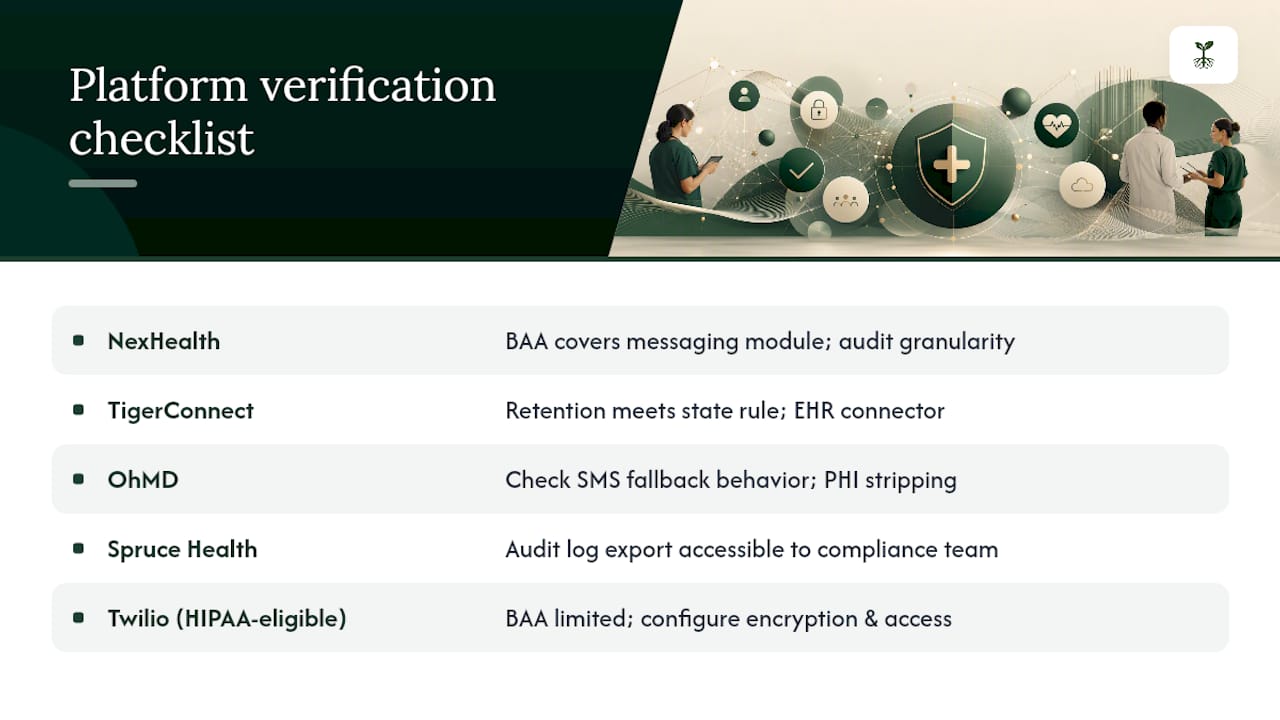
NexHealth Designed for patient engagement, NexHealth offers two-way messaging with BAA availability and EHR integration for scheduling and communication workflows. Verify: confirm that the specific messaging module — not just the scheduling feature — is covered by the BAA, and check audit log granularity for clinical messages.
TigerConnect A purpose-built clinical communication platform with end-to-end encryption, role-based access, and detailed audit logging. Widely used in hospital settings. Verify: confirm message retention configuration matches your state's requirements and that the EHR connector supports your specific system.
OhMD Focused on patient-provider texting with a BAA-included model and two-way SMS capability through a HIPAA-compliant layer. Verify: confirm how the platform handles fallback to standard SMS when patients don't have the app installed, and whether that fallback strips PHI automatically.
Spruce Health Built for small and independent practices, Spruce offers HIPAA-compliant messaging, voicemail, and team communication in one platform. BAA is available. Verify: check that the audit log export is accessible to your compliance team, not just viewable in the dashboard.
Klara Patient communication platform with two-way messaging, intake forms, and EHR integration. BAA available. Verify: confirm which EHR connectors are included in your tier and whether message archiving meets your retention requirements.
Twilio (HIPAA-eligible offerings) Twilio's HIPAA-eligible products allow developers and healthcare organizations to build custom messaging workflows with BAA coverage. This is a developer-facing platform, not a turnkey clinical app. Verify: the BAA covers only specific Twilio products (not all services), and your implementation team must configure encryption and access controls — they are not automatic.
Pro Tip: Free or consumer-tier licenses from any of these vendors often exclude BAA coverage and advanced audit logging. Always confirm the exact product tier and BAA terms before running a pilot with real patient data.
Enterprise-grade platforms typically include audit features, SSO, and EHR connectors in standard tiers. Entry-level or startup-focused tiers may gate those features behind higher pricing. The compliance requirement does not scale with your budget — the BAA and encryption requirements are the same for a solo practice as for a 500-bed hospital.
Penalties, breach notification obligations, and common pitfalls
OCR enforcement is not theoretical. Settlements tied to texting incidents and inadequate mobile device policies have resulted in monetary penalties and corrective action plans. Enforcement-context research shows that misdirected texts and missing policies or training are among the most common drivers of citations and settlements.
Breach notification timelines under 45 CFR §164.404:
- Affected individuals must be notified within 60 days of discovering a breach.
- If the breach affects 500 or more individuals in a state or jurisdiction, OCR and prominent media outlets must also be notified within 60 days.
- Breaches affecting fewer than 500 individuals are logged and reported to OCR annually.
- Notification must include what happened, what PHI was involved, what the covered entity is doing, and what affected individuals can do to protect themselves.
A misdirected text containing a patient's name and diagnosis triggers this process. So does a lost phone with unencrypted messages and no remote wipe capability.
Common pitfalls that lead to enforcement:
- Using personal phones for clinical texting without MDM enrollment or a BYOD policy
- Relying on patient consent to justify sending PHI over standard SMS
- Missing BAAs with messaging vendors or subcontractors
- Audit logs that exist but are never reviewed
- Staff who revert to personal SMS because the approved platform is inconvenient
- Failing to update the risk analysis when a new platform or workflow is introduced
The HHS HIPAA enforcement page documents that standard SMS lacks encryption, audit trails, and carrier BAAs, and that patient consent alone does not relieve Security Rule obligations. Enforcement has included monetary settlements tied to texting incidents.
What auditors and OCR actually look for: key compliance artifacts
When OCR investigates a complaint or conducts a compliance review, the artifacts below are what they request first. Having them organized and current is the difference between a corrective action plan and a closed investigation.
| Artifact | What it demonstrates | Minimum retention |
|---|---|---|
| Signed BAA with messaging vendor | Contractual compliance and vendor accountability | Duration of relationship + 6 years |
| Current risk analysis | Documented identification and mitigation of PHI risks | 6 years from creation or last effective date |
| Staff training records | Workforce training requirement under 45 CFR §164.308(a)(5) | 6 years |
| Platform audit logs | Access control and audit control compliance under §164.312 | 6 years |
| Incident/breach log | Breach notification compliance and response documentation | 6 years |
| MDM configuration snapshot | Physical and technical safeguard documentation | Current + prior version |
| Patient consent records | Documentation of communication preferences | Per state medical record rules |
CMS QSO-24-05 adds a hospital-specific requirement: for any texted orders, the medical record must show author identification and the order must be incorporated promptly. That means the audit trail extends into the EHR, not just the messaging platform.
For E-E-A-T purposes, the strongest compliance file includes: signed BAAs with all vendors, a penetration test summary from the messaging vendor (requested annually), MDM configuration documentation, and training completion records with the specific curriculum covered. These are the artifacts that demonstrate an active, maintained compliance program rather than a one-time setup.
How small practices actually implement compliant texting
The compliance framework above is accurate and complete. It is also written for organizations with dedicated compliance staff. Here is what the rollout actually looks like for a solo physician or a two-provider group practice.
Realistic timeline: A solo practice that starts from scratch can reach a defensible compliance posture in 8–12 weeks. The first two weeks go to the risk analysis and policy drafting, which for a small practice is often a half-day of focused work using a template. Weeks three through five cover vendor selection, BAA execution, and platform configuration. The pilot runs in weeks six and seven, typically with one staff member and one care team workflow. Full rollout and staff training complete by week ten. The first quarterly audit happens at week sixteen.
The most common resource trade-off for small practices is EHR integration depth. A native connector that automatically logs messages into the patient record costs more and requires IT configuration time. Manual documentation — a staff member copying relevant message content into the EHR note — is more labor-intensive but costs nothing beyond staff time and is not a compliance violation as long as it happens consistently and promptly. Many solo practices start with manual documentation and add integration later when volume justifies the investment.
What success looks like at 90 days:
- Audit logs are generating and have been reviewed at least once by the compliance lead or practice manager
- All staff have completed documented training on the approved platform
- BAAs are signed and filed with vendor contact information
- No PHI has been sent via personal SMS since rollout
- At least one misdirected-message scenario has been walked through in a tabletop exercise
The biggest practical risk for small practices is not the technology. It is staff reverting to personal SMS because the approved platform adds one extra step. The solution is choosing a platform with a mobile UX that is genuinely faster than texting from a personal phone, and making the policy consequence for non-compliance explicit during training.
Rooted Up helps solo providers manage compliant patient communications
Solo healthcare providers face a specific problem: the compliance workload for secure messaging is real, but hiring a full-time compliance officer is not. The documentation, vendor vetting, policy drafting, and ongoing audit cycles described in this guide take time that most solo practitioners simply do not have.

Rooted Up works with solo professionals and small practices to reduce exactly this kind of administrative drag. The service covers policy template development, vendor selection facilitation, documentation support, and the ongoing operational tasks that keep a compliance program current without requiring a dedicated internal hire. For practices that want a managed approach rather than a DIY build, Rooted Up's monthly subscription model means you get consistent output without a long-term agency retainer or a one-time project that goes stale six months later.
If you are at the "where do I even start" stage of implementing compliant patient communications, see what Rooted Up's services include and book a discovery call to map your specific needs to a plan.
Sources
Keep these sources bookmarked. Each one serves a specific function during vendor review or an OCR investigation.
- QSO-24-05-Hospital and CAH: Texting of Patient Information among Health Care Team Members
- Hhs
- Can clinicians communicate orders via text message to clinical staff? | AMA
- Is Texting in Violation of HIPAA? 2026 Update
- HIPAA-Compliant Text Messaging: What It Is, Requirements, and How To Do It Right
This article provides general compliance information for educational purposes. It is not legal advice. Consult a qualified healthcare attorney or compliance professional to confirm how current HIPAA rules apply to your specific organization and workflows.
This article is general information, not a substitute for advice from a qualified doctor. Consult a qualified healthcare professional about your own circumstances before acting on anything here.