
Yes, you can respond to patient reviews, but the reply has to stay neutral and non-identifying. Never confirm or deny that the reviewer was your patient, and never reference treatment, dates, or payment. The safest habit: a short, warm, practice-level acknowledgment plus an invitation to call or message through a secure channel. OCR has already fined providers for getting this wrong, so treat every public reply as a compliance decision, not just a customer-service one.
TL;DR:
- Responses to reviews must avoid confirming patient status or referencing specific treatment details to prevent HIPAA violations and OCR penalties.
- Using pre-approved templates reviewed by legal or privacy officers reduces the risk of unintentionally disclosing Protected Health Information (PHI).
- Critical violations often occur when replies inadvertently mention diagnosis, date of service, or payment, triggering deeper OCR investigations and possible enforcement actions.
- Happy, neutral, and negative responses should be crafted to be generic, non-specific, and capable of fitting any reviewer, including strangers, to ensure compliance.
- Implementing a documented policy, staff training, monitoring, and secure communication channels minimizes the risk of violations and simplifies maintaining compliance.
Table of Contents
- Immediate Do's and Don'ts for Healthcare Review Responses
- What HIPAA Limits and OCR Enforcement Actually Mean for You
- HIPAA-Safe Reply Templates You Can Use Today
- When to Respond Publicly vs. Take It Offline
- Building the Policy, Training, and Audit Trail
- Moving Patient Conversations to Secure Channels
- How Rooted Up Supports Compliant Review Workflows
- Why the Standard Advice on Review Responses Falls Short
- Get Help Implementing a Compliant Review Response System
- Where to Verify These Rules Yourself
- Sources
- FAQ
Immediate Do's and Don'ts for Healthcare Review Responses
The moment a review lands, the instinct is to fire back fast. Resist it. Pause, route the review to a trained staff member or your privacy officer, and pull from a pre-approved template library before anyone types a word.
- Do assign a specific, trained person to draft or approve every public reply, not whoever is nearest a keyboard.
- Do use pre-vetted templates reviewed by legal or a privacy officer, especially for anything negative.
- Do stick to safe phrases: a thank you, a general statement about your standards, and an invitation to call the office or use the patient portal.
- Don't use phrases like "your treatment," "your visit on," "as we discussed at your appointment," or anything that assumes the person was ever a patient.
- Escalate immediately if a review alleges clinical harm, threatens legal action, or looks like fraud or a fake posting. Those go to your compliance officer or attorney, not to a front-desk reply.
What HIPAA Limits and OCR Enforcement Actually Mean for You
HIPAA doesn't stop the moment a patient posts publicly. Even if a reviewer names their own diagnosis or complains about a specific visit, the provider still can't confirm or elaborate on it. Patient self-disclosure never waives your obligations.
OCR has already made an example of practices that got this wrong. In 2023, a psychiatric practice settled with OCR for $30,000 and a two-year corrective action plan after staff disclosed patient information while responding to negative reviews, according to the HHS OCR resolution agreement. A similar penalty hit a New Jersey mental health provider, as reported by the National Law Review.
Here's the part practices underestimate: one reply can trigger several violations at once. Confirming the person was a patient, referencing a specific date of service, and mentioning a procedure or payment amount are three separate disclosures stacked into a single sentence. OCR investigations then widen into audits of your broader HIPAA posture, sometimes triggering breach-notification requirements and monitoring periods that outlast the original complaint by years.
HIPAA-Safe Reply Templates You Can Use Today
Every reply needs to survive one test: would a stranger with zero context learn that this person was your patient, what happened, or when? If yes, rewrite it, according to the redact/test framework many compliance teams use.
For a positive review: "Thank you for sharing this. We're glad to hear you had a good experience, and we'll pass your kind words along to our team."
No confirmation of visit status. No specifics. Safe to post as-is.
For neutral or mixed feedback: "We appreciate you taking the time to share your feedback. We're always working to improve, and we'd welcome the chance to talk more. Please reach out to our office directly."
This acknowledges the comment without validating any detail the reviewer mentioned.
For a negative complaint: "We take all feedback seriously and hold ourselves to high standards. Please contact our office at [phone number/secure portal] so we can address your concerns privately."
That third template does the real work. It never says "we're sorry your appointment didn't go well," a line that sounds compassionate but quietly confirms an appointment happened, per the Healthgrades compliance analysis. That single sentence has been enough to trigger scrutiny.
Before posting anything, run two quick checks: Does the reply confirm or deny a patient relationship? Does it reference any diagnosis, procedure, date, or dollar amount? If either answer is yes, send it back for a rewrite.
Pro Tip: Write your negative-review templates so they'd make sense as a reply to a complete stranger who never set foot in your office. If the sentence only works because the reviewer is assumed to be a patient, it's not safe to post.
When to Respond Publicly vs. Take It Offline
Not every review needs the same treatment. An anonymous complaint about wait times gets a different response than an identified patient alleging a clinical error.
- Triage first. Sort by whether the reviewer identified themselves and whether the complaint touches billing and service (lower risk) or clinical outcomes (higher risk).
- Assign an owner. Front-desk or marketing staff can handle routine acknowledgments; anything clinical routes to your privacy officer or a designated clinician.
- Set response windows. Aim to publicly acknowledge within 24 to 48 hours with a generic reply, then resolve specifics offline within a few business days.
- Escalate hard cases immediately. Threats, fraud allegations, or claims of clinical harm go straight to counsel, bypassing the standard reply queue entirely.
Building the Policy, Training, and Audit Trail
A good template means little without the paperwork behind it. Your written policy should define who may post replies, what the approval workflow looks like, and where the current template library lives, similar to the authorization structure covered in HIPAA marketing compliance guidance.
Training matters just as much as the policy itself. New hires need it during onboarding, and everyone else needs a refresher at least annually, ideally reinforced with mock-review drills that test whether staff catch a risky phrase before it goes live.
Keep a response log for every review handled, including who approved it and why. OCR investigators specifically look for missing training records and inconsistent logs as a sign of weak oversight, and gaps there tend to make penalties worse, not just slower to resolve.
Moving Patient Conversations to Secure Channels
Public replies should never carry the real conversation. That happens afterward, somewhere encrypted. A patient portal tied to your EHR keeps everything in one documented place. Encrypted email services like Paubox work well for one-off follow-ups, detailed in this HIPAA compliant email guide. Secure texting platforms fill the gap for patients who want something faster than email but still protected.
A safe public redirect sounds like: "Please call our office or message us through the patient portal so we can look into this." Simple, and it never confirms anything.
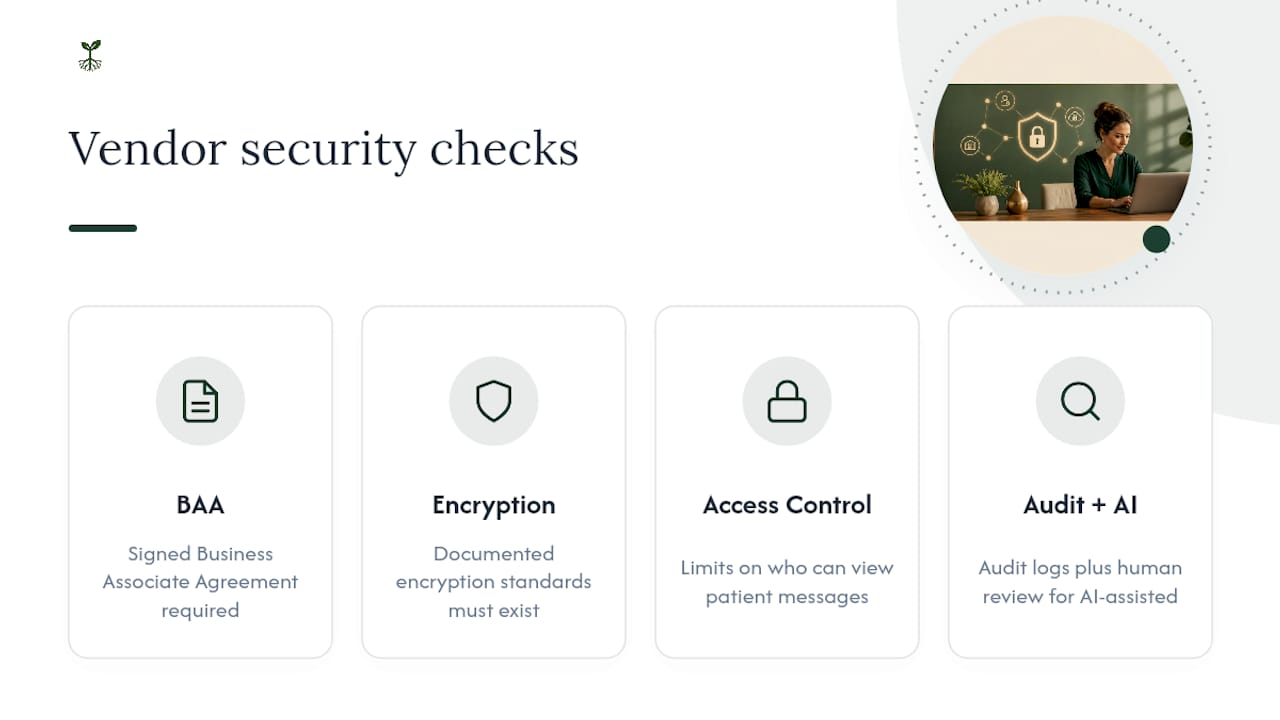
Before adopting any vendor, confirm four things: a signed Business Associate Agreement, documented encryption standards, access controls limiting who can view messages, and audit logs paired with human review of anything AI-assisted.
How Rooted Up Supports Compliant Review Workflows
Practices that build this system from scratch often underestimate the ongoing maintenance: templates go stale, staff turn over, and monitoring slips. A managed monthly program that bundles template governance, monitoring, and secure follow-up channels can lower OCR exposure while freeing up staff time. Rooted Up's approach to review automation pairs pre-approved reply frameworks with ongoing monitoring, so practices aren't reinventing the wheel every time a new review lands. For solo practitioners without a compliance department, that kind of standing infrastructure often matters more than any single well-written template.
Why the Standard Advice on Review Responses Falls Short
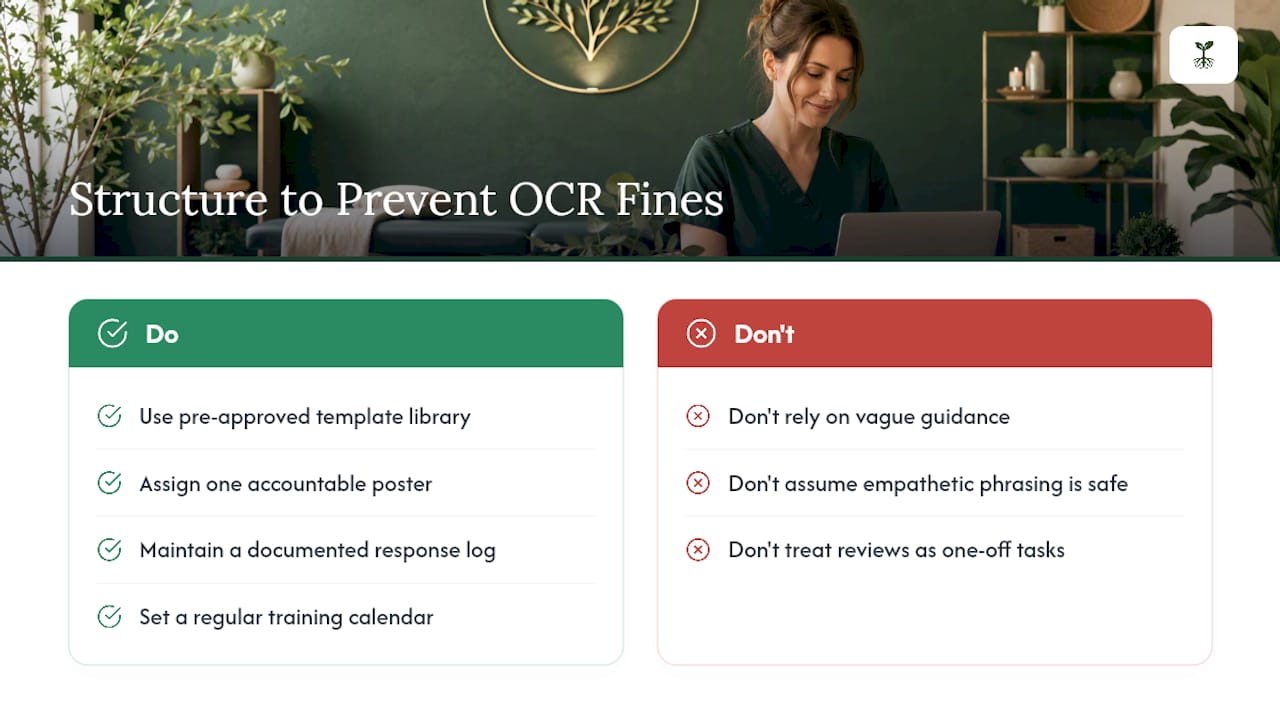
Most guidance on this topic stops at "don't say too much," which is true but useless without a system behind it. The real failure point isn't a rogue employee typing something careless. It's the absence of a template library, a training calendar, and a response log, exactly the gaps OCR investigators flag when penalties escalate beyond a warning letter.
The conventional advice also underrates how ordinary an unsafe reply can sound, as detailed in this step-by-step guide for SMBs on managing online reputation. "We're sorry your visit didn't go as planned" reads as basic empathy, yet it confirms a patient relationship on its own. That's the trap solo practices fall into repeatedly: the violation isn't malicious, it's habitual.
What should actually come first isn't more caution. It's structure. A short list of pre-approved templates, one person accountable for posting, and a documented escalation path will prevent more violations than any amount of general awareness training. Practices that treat this as an operational workflow, not a one-off writing exercise, are the ones that stay out of OCR's inbox.
— Jason
Get Help Implementing a Compliant Review Response System
Some providers choose managed services that bundle templates, monitoring routines, and secure follow-up channels into a single monthly plan, which may include AI tools to maintain reply consistency and efficiency.

The Foundation, Growth, and Partner plans each include online reputation and review management built around consistent, quality output, so every reply follows the same vetted structure whether it's posted by you or your office manager. That consistency is exactly what reduces OCR exposure over time: fewer improvised responses, fewer risky phrases slipping through. If you'd rather test the waters first, the Foundations Sprint offers a one-time setup engagement to get your templates and workflow in place before committing to a monthly plan. Visit Rooted Up to request a review of your current reply process and see what a managed system would look like for your practice.
Where to Verify These Rules Yourself
Don't take secondhand summaries as the final word on enforcement or policy. Read the HHS OCR resolution agreements directly for exact settlement terms, and check HHS OCR's HIPAA guidance for professionals for the underlying rules. The AMA's guidance on responding to online patient reviews is written specifically for clinicians, and legal breakdowns like the National Law Review's coverage explain how penalties actually get calculated.
This article is general information, not a substitute for advice from a qualified doctor. Consult a qualified healthcare professional about your own circumstances before acting on anything here.
Sources
- AMA resource: Are physicians prohibited from responding to online patient reviews?
- Reviewgen
- National Law Review: NJ mental health provider OCR penalty
FAQ
Can a healthcare provider reply to a negative review at all?
Yes. Providers can and should reply, but the response must stay neutral and avoid confirming the reviewer's patient status or referencing any treatment detail. A general statement of your practice's standards plus an invitation to contact the office privately is the safest structure.
Does it violate HIPAA if the patient already named their diagnosis in the review?
Yes, it still can. A patient's own public disclosure doesn't waive the provider's HIPAA obligations, so repeating or confirming any detail they mentioned still counts as a disclosure on your end.
What happened in the OCR enforcement cases tied to review responses?
A 2023 settlement involved a psychiatric practice paying $30,000 and agreeing to a two-year corrective action plan after staff disclosed PHI while replying to reviews. A separate New Jersey provider faced a comparable penalty for the same type of violation.
How do I collect more patient reviews without risking PHI exposure?
Send review requests through automated, HIPAA-aware systems that ask for feedback without referencing any visit details in the outreach message itself. Rooted Up's review request automation approach handles this by keeping the request generic and timed appropriately after a visit, not tied to specific treatment language.
Does Rooted Up offer HIPAA-safe review response templates?
Rooted Up's monthly plans include online reputation management built around vetted, consistent response frameworks. Current pricing and plan details are available on the Rooted Up website.