
A fractional CMO makes sense once you have paying customers, some marketing activity already running, and no one senior steering it. It rarely makes sense before product-market fit or as a stopgap for someone to just execute tasks. The real trade-off is strategic direction versus hands-on execution, and the cost and evaluation sections below tell you exactly where you land.
TL;DR:
- A fractional CMO is most suitable when a small business has marketing activity without strong conversion rates and lacks senior strategic direction.
- The typical engagement involves setting strategy, defining KPIs tied to revenue, and overseeing vendors, without managing day-to-day execution tasks.
- Costs range from $5,000 to $15,000 per month depending on scope, offering a flexible, lower-cost alternative to full-time hiring with reduced recruiting risks.
- A successful first 90 days includes discovery, quick-win strategy implementation, and establishing reporting systems focused on KPIs like pipeline velocity and customer acquisition costs.
- Without internal or external execution support, a fractional CMO’s strategic plan remains ineffective; pairing strategy with execution is essential for tangible results.
Table of Contents
- What Is a Fractional CMO for Small Business, Exactly?
- When Should You Hire a Fractional CMO?
- What Does a Fractional CMO Actually Do Day to Day?
- How Much Does a Fractional CMO Cost?
- How Do You Choose the Right Fractional CMO?
- What Happens in the First 90 Days?
- How Rooted Up Approaches Fractional Marketing Leadership
- The Honest Trade-Off Nobody Puts on the Sales Page
- How to Get Started With Rooted Up
- Sources
What Is a Fractional CMO for Small Business, Exactly?
A fractional CMO is a senior marketing executive who works with your company part-time, on a retainer, and owns strategic direction and commercial accountability the same way a full-time CMO would. That's the distinction most people miss: this isn't a freelancer picking up tasks. It's leadership, sized down to the hours your business can absorb.
The confusion usually comes from lumping this role in with three others that look similar on paper but do very different work.
- Marketing manager: executes campaigns, manages a calendar, reports up to someone else. No strategic ownership.
- Marketing consultant: advises on a specific problem (a launch, a rebrand) then leaves. No ongoing accountability for results.
- Agency: runs execution for hire, often specialized in one channel (paid ads, SEO, content). Rarely owns your overall positioning or measurement framework.
- Fractional CMO: sets strategy, owns the numbers, and directs whoever executes, whether that's your internal team, an agency, or contractors.
A fractional CMO typically does not build your website, write your ad copy, or manage your social calendar day to day. What they do produce: a defined ideal customer profile, a positioning statement your whole team can repeat without looking at notes, a measurement framework tied to revenue (not vanity metrics), and oversight of whatever vendors or agencies you already have on payroll. Practitioner guides on the fractional CMO model consistently draw this same line: strategy and accountability sit with the CMO, execution sits elsewhere.
When Should You Hire a Fractional CMO?
The sweet spot is narrower than most articles suggest. Companies that benefit most have already outgrown founder-led marketing but haven't generated enough revenue to justify a full-time executive salary plus benefits plus a marketing team under them. Practitioner data on fractional CMO hiring puts this in the mid-revenue range for most small businesses and startups, though exact thresholds vary a lot by industry and margin structure.
Three signals usually mean you're ready:
- You have marketing activity but weak conversion. You're running ads, posting content, or sending emails, and none of it ties back to a coherent strategy or clear numbers.
- The founder is the de facto CMO. You're making channel decisions between customer calls, at 9 p.m., with no framework guiding the choices.
- You have a small team but no senior direction. A coordinator or two exists, but nobody above them can set strategy or hold vendors accountable.
Three signals mean you should wait:
- You don't have product-market fit yet. No amount of strategic positioning fixes a product nobody wants.
- You need a warm body generating leads next week. That's an execution problem. Hire a marketer or an agency, not a strategist.
- Your only gap is hands-on work, not direction. If you know exactly what to do and just need someone to do it, a fractional CMO is the wrong purchase.
Pro Tip: Before you post a job listing, write down the last three marketing decisions you made. If you can't explain the reasoning behind any of them beyond "it seemed like a good idea," that's your readiness signal.
What Does a Fractional CMO Actually Do Day to Day?
The job splits into strategy ownership and light operational oversight, not campaign execution. Core responsibilities typically include setting the overall marketing strategy, defining your channel mix, owning the KPIs that get reported to you or your board, and managing whichever vendors or agencies handle the actual production work. Some fractional CMOs also weigh in on hiring your first marketing employee and building the handoff plan for when that person starts.
How they embed with your team varies by engagement, but most follow a predictable rhythm: a weekly or biweekly check-in, a monthly reporting cadence tied to revenue metrics, and direct oversight of any agency or contractor relationships rather than direct management of internal staff. You stay in the loop without having to translate marketing jargon yourself.
Engagement models generally fall into four buckets:
- Advisory: strategic guidance and reviews, lightest touch, fewest hours.
- Operator led: the CMO also directs day-to-day execution through a small team or contractors, more hands-on.
- Project based: focused on a specific initiative, like a rebrand or a new-market launch, with a defined end date.
- Hybrid: a strategy retainer plus a defined execution budget, often the best fit for small businesses trying to move fast on a limited runway.
One insight worth internalizing here: fractional CMOs work across multiple companies at once, and that cross-industry exposure often means they've already solved a version of your specific problem somewhere else, according to Chris Waldron's fractional CMO playbook. That pattern recognition is part of what you're paying for.
How Much Does a Fractional CMO Cost?
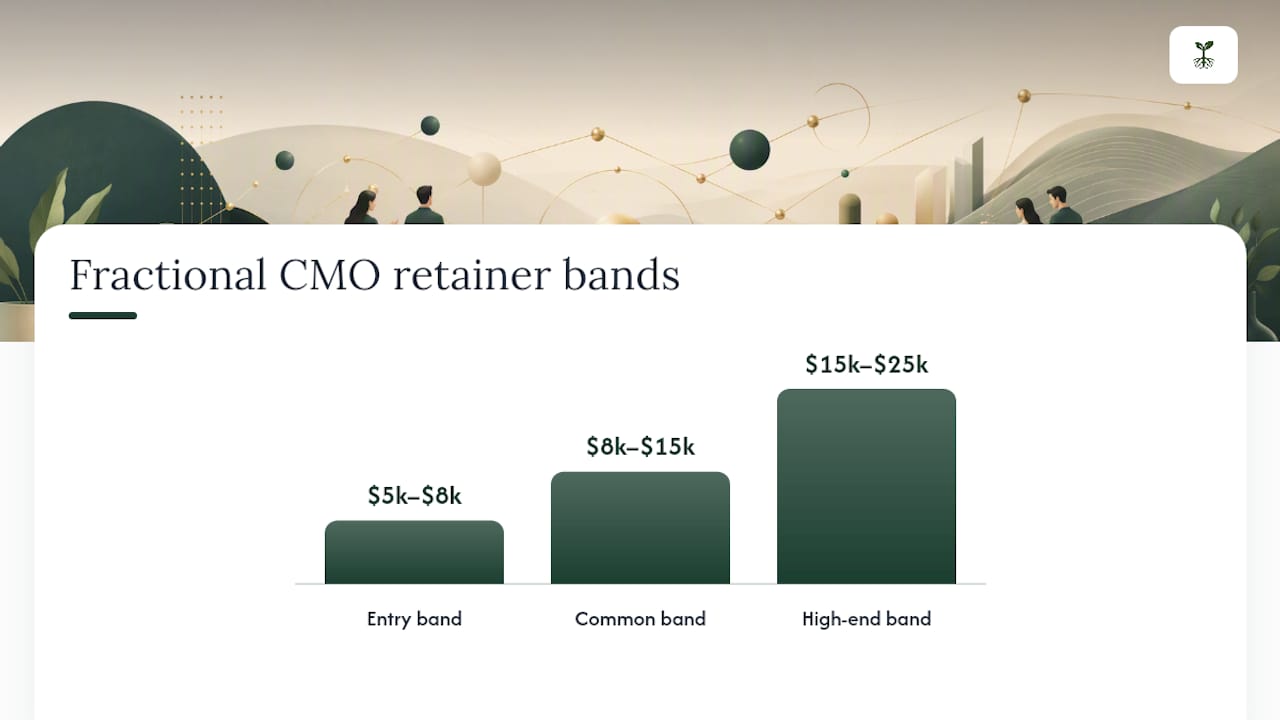
Retainer pricing generally lands in three bands, and the difference between them is almost entirely hours and scope, not just seniority.
- Entry band: roughly $5,000 to $8,000 a month, usually 10 to 15 hours, advisory-heavy with limited vendor oversight.
- Common band: $8,000 to $15,000 a month, the densest fit for most small businesses, typically 15 to 25 hours and covering strategy plus active vendor management.
- High end: $15,000 to $25,000 a month, closer to operator-led engagements with heavier involvement in execution oversight and team hiring.
A fractional CMO retainer commonly runs $5,000 to $15,000 a month according to one widely cited practitioner breakdown, while other 2026 guides put the fuller range at $5,000 to $25,000 depending on hours and scope.
Compare that to a full-time CMO, where loaded cost (salary, benefits, equity, recruiting) frequently pushes well past what most small businesses can absorb before they have the revenue base to support it. Comparisons between fractional and full-time models consistently show the fractional route compresses both the financial commitment and the downside risk if the fit turns out wrong. Recruiting overhead alone is a real cost avoided; the SHRM talent acquisition data on hiring costs across industries shows why companies increasingly default to part-time executive models before committing to a full-time search.
Payment structures vary. Some fractional CMOs work on a flat monthly retainer, some price by day-rate for lighter engagements, and a smaller number will take a partial equity component in early-stage startups in exchange for a reduced cash rate.
How Do You Choose the Right Fractional CMO?
Start the conversation with questions that expose whether this person has actually operated at your stage, not just advised companies that were already bigger than you.
- "Walk me through a client at my revenue stage and what you changed in the first 90 days." Vague answers here are a warning sign.
- "How many other clients are you currently serving?" Anything past four or five active retainers usually means you get less attention than the pitch implied.
- "Can I talk to a past client, ideally one whose engagement ended?" References who stayed on don't tell you what happens when things get hard.
- "What does your sample 90-day plan look like for a company like mine?" If they can't sketch this loosely on the spot, they haven't done this enough times.
- "What KPIs will you be accountable for, specifically?" "Brand awareness" is not an answer. Pipeline velocity, cost per acquisition trend, and lead-to-customer conversion are.
Watch for these red flags:
- No evidence of senior decision-making experience, just execution history relabeled as strategy.
- A client roster so large the math doesn't support real attention to your business.
- Anyone promising full strategic leadership and full hands-on execution at entry-level pricing. That combination doesn't exist at scale.
A simple scoring approach works better than gut feeling. Rate each candidate 1 to 5 on: availability (do their hours match your stated needs), domain fit (have they worked in something adjacent to your industry), commercial accountability (do they tie their work to revenue metrics or just activity metrics), and transition plan (do they have a clear answer for how the engagement ends or evolves). Anyone scoring below a 3 on transition planning is worth a second look before signing.
What Happens in the First 90 Days?
Most credible fractional CMO engagements follow a three-phase arc, and you should expect deliverables at each stage, not just a strategy deck at the end.
- Weeks 1 to 3, discovery and audit. The CMO reviews your existing channels, past campaign data, and customer conversations. You get an audit summary that names what's working, what's wasted spend, and where the biggest gaps sit.
- Weeks 4 to 8, strategy and quick wins. A 90-day playbook comes together alongside one or two fast, visible launches, something small enough to ship quickly but real enough to prove direction. Practitioner playbooks treat this audit-then-quick-wins sequence as the standard early deliverable.
- Weeks 9 to 12, systems and handoff. Measurement dashboards go live, reporting cadence gets locked in, and any internal team members get briefed on their ongoing role.
Early KPIs worth watching include pipeline velocity, the SAL to SQL conversion rate, and early movement in customer acquisition cost. A tight 90-day plan tied to these numbers is what separates an accountable engagement from a purely advisory one.
How Rooted Up Approaches Fractional Marketing Leadership
Rooted Up was built around a version of this same problem, just for solo professionals rather than venture-backed startups. The overwhelming administrative and marketing load solo practitioners carry is exactly the gap fractional leadership is meant to close, just scaled to a one-person operation instead of a ten-person team.
The approach maps closely to fractional CMO responsibilities:
- Strategic oversight of local visibility through Google Business Profile management
- Systematic reputation and review generation instead of hoping happy customers remember to leave a review
- Monthly SEO content and newsletters that follow a defined strategy rather than random posting
- AI workflow audits that identify where administrative tasks are eating the hours that should go to client work
The same discipline that makes a fractional CMO engagement work, structured strategy plus consistent execution, shows up in Rooted Up's client work through measurable gains in local search rankings and inquiry volume.
The Honest Trade-Off Nobody Puts on the Sales Page
Here's what I'd tell a founder over coffee: a fractional CMO fails most often not because the strategy was wrong, but because the business never budgeted for execution. You can hire the sharpest strategic mind in your industry, and if nobody on your side actually builds the landing page or answers the follow-up email, the strategy sits in a document.
The businesses that get real value pair the fractional CMO with someone, internal or contracted, who executes without hand-holding. If you're not ready to fund that second half, wait. If you are, ask hard questions in the interview, get a real 90-day plan in writing, and hold them to the KPIs they proposed, not the ones that sound good in a pitch. Rooted Up offers a diagnostic audit if you want an outside read on whether you're actually ready.
— Jason
How to Get Started With Rooted Up
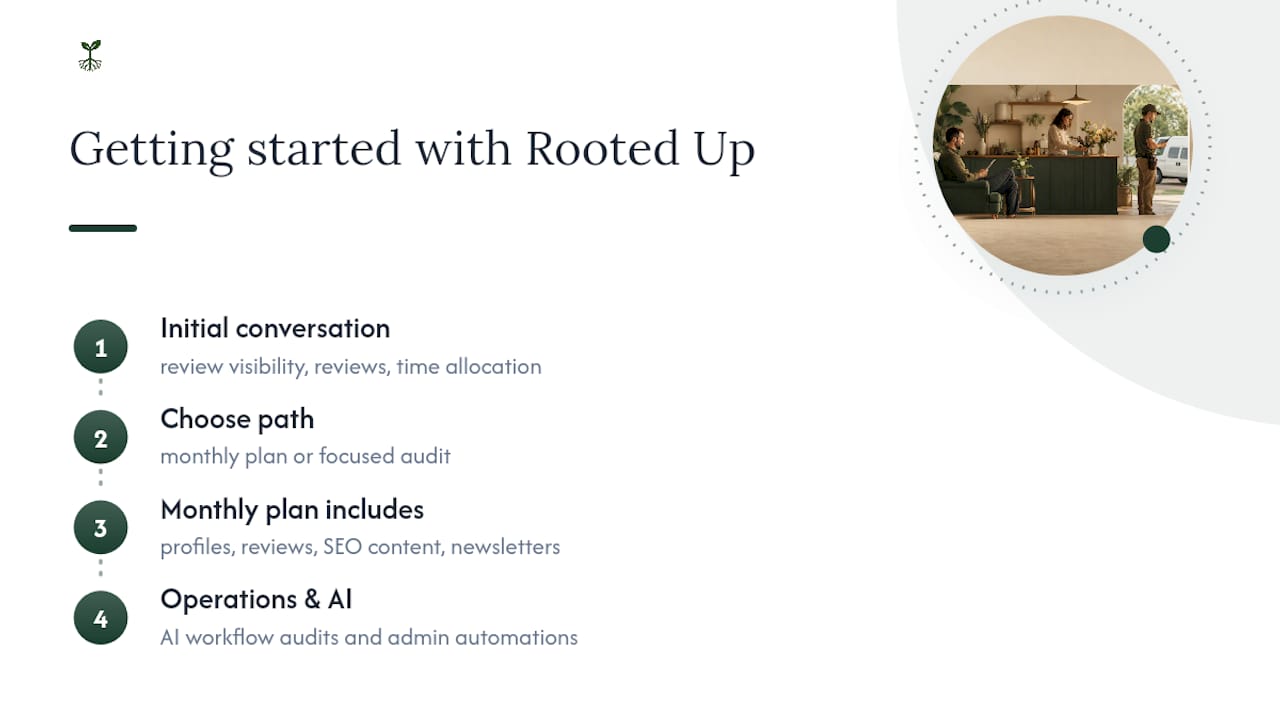
This service offers solo professionals and small teams the strategic structure of a fractional marketing leader scaled to smaller budgets. Instead of managing multiple vendors and tools, the service provides a unified monthly plan covering content, reviews, and AI workflows.

Typical plans include local business profile management, automated review generation, SEO blog content and newsletters, ongoing SEO and schema maintenance, and strategic advisory sessions. On the operations side, Rooted Up also runs AI workflow audits and builds custom automations for the administrative work that eats into billable hours, the same kind of task-outsourcing many small businesses handle piecemeal, as outlined in this SMB task-outsourcing playbook.
An initial conversation includes a review of current visibility, review activity, and time allocation, similar to a discovery phase. From there, you can move into a monthly plan or start with a focused audit. Check out Rooted Up's services and packages to see what fits your stage.
Sources
The revenue-band guidance and 90-day framework in this article draw from Chris Waldron's fractional CMO playbook, one of the more detailed practitioner breakdowns of engagement structure and timing. Pricing bands cross-reference ASP Marketing's 2026 fractional CMO guide. The cost comparison against full-time hiring leans on gRO's fractional versus full-time analysis and SHRM's talent acquisition cost data. Strategic messaging's effect on campaign performance comes from Harvard Business Review's research on ad creative.
- The Fractional CMO Playbook | When to Hire One — Chris Waldron
- Fractional CMO for Startups: When to Hire One (2026 Guide) — ASP Marketing