
A well-built freelance case study does one thing better than any testimonial or portfolio sample: it answers the buyer's real question, "Will this work for me?" before they even ask it. That's what shortens sales calls, justifies higher rates, and pulls in clients who already trust you before the first conversation.
Three outcomes you can expect from one strong case study:
- Shorter sales conversations because the proof is already in front of the prospect
- Higher perceived value, which supports premium pricing
- Better-fit client inquiries from people who recognize their own problem in your story
Your next step takes 30 minutes: pick one project you can prove end-to-end and send a permission email to that client today.
Table of Contents
- Why case study marketing for freelancers outperforms testimonials
- What every freelance case study must include
- How to build a case study from scratch, step by step
- Which format and length should you use?
- Where to publish and how to deploy case studies
- Pro tips and pitfalls that separate strong case studies from weak ones
- Key Takeaways
- Why case studies are the asset most freelancers underinvest in
- Rooted Up helps freelancers turn projects into client-winning assets
- Useful sources and tools
Why case study marketing for freelancers outperforms testimonials
A testimonial gives a buyer social proof. A portfolio sample proves craft. A case study proves outcome and method, which is the only thing that matters at the comparison stage, when a prospect is deciding between you and two other freelancers.
Case studies increase buyer confidence by providing tangible results and a narrative prospects can see themselves in. That's a fundamentally different job than a five-star review. A testimonial says "this person is great." A case study says "here is the exact problem, here is what was done, and here is what changed." One of those answers the hiring question directly.
They also reduce perceived hiring risk. A prospect reading your case study can judge whether your scope, timeline, and approach match their situation. That judgment happens before they contact you, which means the leads you get are already pre-qualified.
Case studies are a future-proof freelance asset precisely because they require interviewing, storytelling, and industry nuance that AI cannot replicate. They position you as a strategic partner, not a task executor.
What every freelance case study must include
The non-negotiable blocks are: client context, the goal, your scope, your approach, measurable results with dates, a client quote, and a next step. Miss any one of them and the buyer fills in the gap with doubt.
Scope honesty matters more than most freelancers realize. State clearly what you did and what you did not do. If you wrote the copy but someone else handled design, say so. Buyers who discover a scope mismatch after hiring you become the worst kind of client.
A stepwise structure covering client background, challenge, solution, results, and a client quote helps attract better-fit clients and can be published in short formats without losing its persuasive core.
Trust signals to include: written client permission, metrics tied to a specific date range, before/after screenshots where available, and an approved direct quote. On NDAs: you can still publish an anonymized version. Replace the client name with a descriptor ("a regional healthcare provider"), redact revenue figures if required, and keep the problem and outcome language intact. The story holds even without the logo.
How to build a case study from scratch, step by step
The five-step flow: pick the right project, get permission, capture evidence during the work, write to the problem-to-results arc, then approve and publish.
- Pick the project. Choose work where you have baseline data, a clear deliverable, and a measurable outcome. Avoid projects where results are ambiguous or shared with other vendors.
- Get permission. Send this email: "Hi [Name], I'd love to feature our work together as a briefcase study on my website. I'll share a draft for your approval before publishing anything. Would you be open to that?" Simple, low-pressure, and it sets the approval expectation upfront.
- Capture evidence during the project. Gather case-study material during the engagement, not after. Record baseline metrics at kickoff. Take screenshots of dashboards, traffic reports, or before-state assets. Note milestone dates.
- Write to the arc. Hook (result first), client context, the problem, your approach, the evidence, the client quote, and a CTA. Keep it tight.
- Approve and publish. Send the draft to your client. Give them a one-week window to request changes. Publish only what they approve.
Data to collect at each stage:
- Kickoff: baseline traffic, leads, revenue, or performance metric relevant to your service
- Mid-project: milestone notes and any interim screenshots
- Close: final performance snapshot, Google Analytics export, or platform report
- Post-project: a 10–12 minute recorded call to capture the client's before-and-after in their own words
Pro Tip: Book the client call within two weeks of project completion, while the experience is fresh. Ask: "What was the situation before we started?" and "What's different now?" Those two answers write the case study for you.
Which format and length should you use?
Match the format to the channel and the buyer's stage. A prospect discovering you on LinkedIn needs a 300-word proof block. A prospect evaluating you against two other freelancers needs the full website version.
| Format | Word Range | Best Use |
|---|---|---|
| Social proof snippet | 300–400 words | LinkedIn post, discovery stage |
| Website case study | 500–800 words | Services page, evaluation stage |
| Proposal annex | Use condensed version or excerpt | Attached to a proposal, decision stage |
| Long-form thought piece | 1,200–1,500 words | Thought leadership, SEO, keynote |
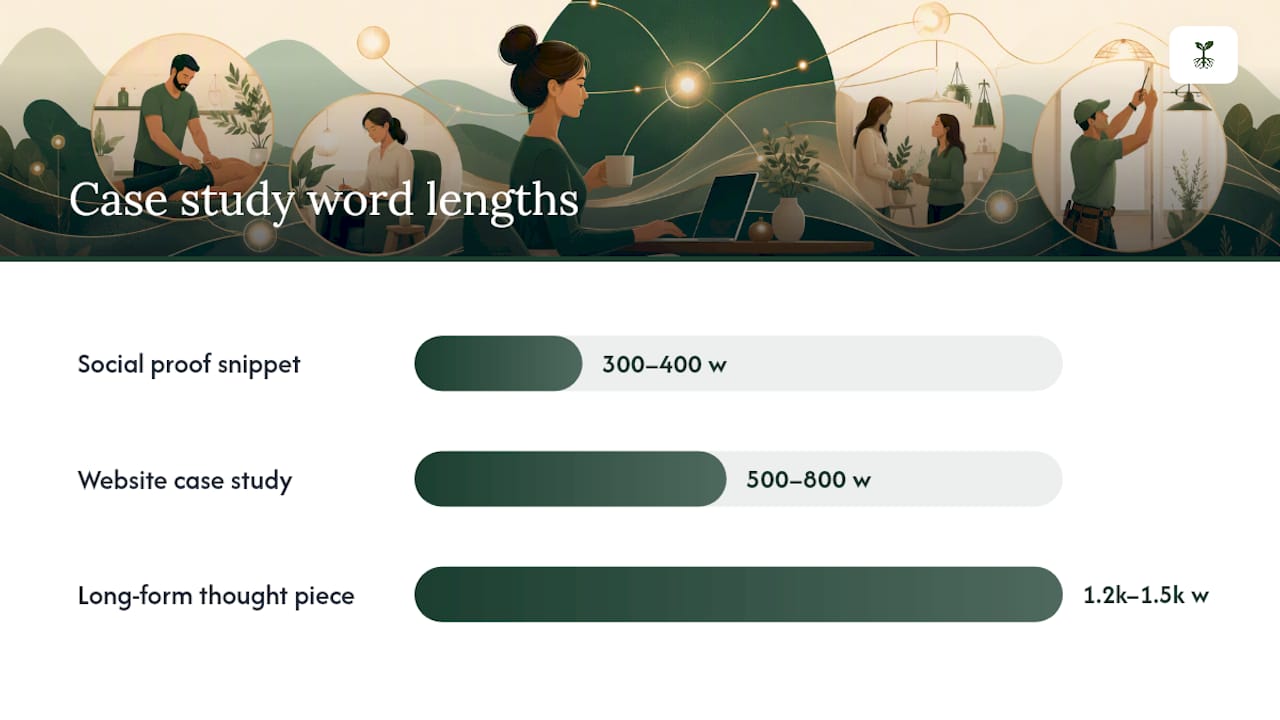
Front-load the results in every format. The outcome goes in the headline or the first sentence, not the conclusion.
Visual assets that lift credibility:
- Before/after screenshots from Google Analytics or your platform of choice
- A simple chart showing the key metric over time (Canva handles this in minutes)
- A hero image or project thumbnail
- A PDF one-pager for proposals, kept under 2MB for email attachments
For mobile, keep PDF text at 12pt minimum and test how your website case study renders on a phone. Most buyers read proposals on mobile.
Where to publish and how to deploy case studies
Publish one approved master asset, then build channel-specific variants from it. Every variant must use only claims present in the approved master — never strengthen a claim as you shorten it.
| Channel | Variant | Buyer Stage |
|---|---|---|
| Services page | 2–3 sentence proof block + link to full case | Awareness/evaluation |
| 300-word post with result in line 1 | Discovery | |
| Proposal | — | Decision |
| Follow-up email | 2-sentence result + link | Re-engagement |
Warm outreach snippet: "I recently helped [descriptor, e.g., a B2B SaaS company] increase qualified leads by [X%] in [timeframe]. I've written up the full story here: [link]. Happy to walk you through how it might apply to your situation."
For distribution cadence: repost a case study on LinkedIn every 60–90 days with a fresh angle (different result, different lesson). Use email distribution tools, including options covered in Mailchimp alternative approaches, to send case study updates to your list quarterly.
Pro tips and pitfalls that separate strong case studies from weak ones
What top freelancers do differently:
- They capture metrics at kickoff, not after the fact
- They ask for the client quote at peak satisfaction, usually right after a win, not at project close
- They anonymize by descriptor, not by vagueness ("a mid-market e-commerce brand" beats "a client")
Common pitfalls:
- Vague claims ("improved performance") with no number or timeframe
- Mixing scope (claiming credit for results that involved other vendors)
- Burying the result in paragraph four
- Publishing without written client approval
Pre-publish checklist:
- Result stated in the headline or first sentence
- Baseline metric and end metric both present, with dates
- Scope clearly bounded
- Client quote approved in writing
- No claims that exceed what the data supports
Pro Tip: Structure portfolio items as case studies with a headline outcome and three impact bullets. A prospect should be able to scan it in 30 seconds and understand exactly what you did and what changed.
Key Takeaways
A single well-built case study, published in the right places and adapted for each buyer stage, does more for your freelance pipeline than a full portfolio of untitled work samples.
| Point | Details |
|---|---|
| Start with provable projects | Pick work where you have baseline data, a clear deliverable, and a measurable outcome. |
| Capture evidence during the project | Record baseline metrics at kickoff; collect the client quote at peak satisfaction, not at close. |
| Build one approved master | Write one approved master case study and adapt channel-specific variants without strengthening claims. |
| Match format to buyer stage | Use 300 words for social discovery, — for website evaluation, and — for proposals. |
| Rooted Up for done-for-you production | Rooted Up's monthly plans handle case study creation, publication, and distribution for solo professionals. |
Why case studies are the asset most freelancers underinvest in
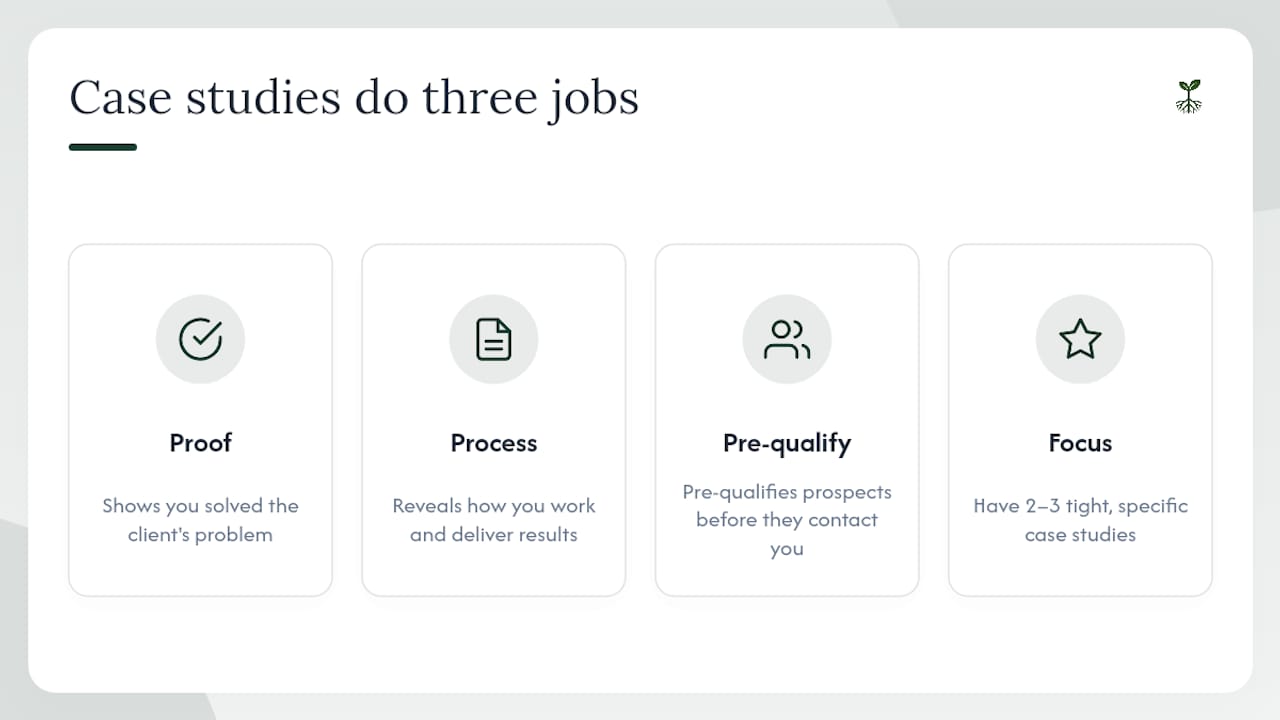
Most freelancers treat case studies as a nice-to-have, something to write when they have time. That's a mistake. A case study is the only marketing asset that does three jobs at once: it proves you can solve the problem, it shows how you work, and it pre-qualifies the prospect before they ever contact you.
The freelancers I see winning higher-fee clients consistently are not the ones with the longest portfolios. They're the ones with two or three tight, specific case studies that speak directly to the problem their best clients have. One case study placed on a services page, sent in a proposal, and reposted on LinkedIn every quarter does more work than a dozen generic portfolio thumbnails.
The other thing most guides miss: the best time to build a case study is during the project, not after. By the time the engagement closes, baseline data is gone, the client's memory has faded, and the emotional peak of the win has passed. Set up a simple tracking note at kickoff. Ask the client for a quote the week you deliver the best result. That 10-minute habit produces material that would take hours to reconstruct later.
Rooted Up helps freelancers turn projects into client-winning assets
Freelancers who want to build case studies but keep deprioritizing the work face a real cost: every month without one is a month of proposals that rely on trust alone instead of proof. Rooted Up's monthly marketing plans for solo professionals include case study creation, publication on your site, and distribution across your key channels, so the asset gets built and deployed without pulling you away from client work.
The process starts with a single project. Rooted Up handles the interview framework, the writing, the Google Analytics integration for metrics, and the LinkedIn distribution variant. You approve the final draft and own the asset permanently. For freelancers who want AI-assisted marketing strategies built into their workflow, Rooted Up's plans also include AI workflow audits that identify where case study production fits your existing process.
See the full service options at Rooted Up's services page and book a free advisory session to map out your first case study.
Useful sources and tools
- Why Case Studies Are the Ultimate Future-Proof Freelance Gig - Ravenwood Writing Academy
- How to Use Case Studies to Attract Better Freelance Writing Clients
- Case Studies for Freelancers to Win Better-Fit Clients
- How to Write Case Studies That Actually Win Clients | alfred_
- How to Write a Freelance Case Study | Remote Pro Life
- How to Write a Case Study: Step-by-Step for Freelancers
- Create a Freelance Portfolio | Billed
- How to create case studies | Freelancermap