
Which automation marketing agencies in Tennessee lead on AI?
The strongest options for AI-driven marketing automation in Tennessee right now are Horton Group, Franklin Marketing Co., and Marketing Hatchery. Each brings a distinct specialization, so the right pick depends on your industry, budget, and how deeply you want AI woven into your workflows.
| Agency | Core Services | Best For | Google Rating |
|---|---|---|---|
| Franklin Marketing Co. | SEO, social media, CRM, newsletters, web management | Local businesses needing multi-channel exposure | 5★ (75 reviews) |
| Bauer Entertainment Marketing | Strategic consulting, campaign management | Sports, music, and entertainment brands | 5★ (67 reviews) |
| Horton Group - Websites + Marketing | SEO, AI search optimization, PPC, web design, inbound marketing | Businesses wanting AI-augmented digital marketing | 4.9★ (54 reviews) |
| Nashville Marketing Systems Inc | Full digital marketing suite (post-merger with Boro Business Lab) | Local businesses seeking integrated expertise | 5★ (45 reviews) |
| Marketing Hatchery - Nashville SEO Company | Data-driven SEO, PPC, email, creative content | ROI-focused businesses prioritizing lead generation | 5★ (22 reviews) |
| Aroluxe Marketing | Campaign strategy, SEO, media buying, internal process improvement | Businesses wanting external and internal marketing clarity | 5★ (21 reviews) |
| 5by5 Agency | Research, strategy, creative, video, PR, digital marketing | Healthcare and nonprofit organizations | 5★ (15 reviews) |
| iPitCrew | SEO, SEM/PPC, drone video, email, content marketing | Automotive and B2B brands needing data-driven execution | 5★ (15 reviews) |
Horton Group stands out for businesses that want AI built into their marketing from day one. The agency explicitly integrates AI search optimization alongside traditional SEO and PPC, making it the clearest choice for Nashville-area businesses trying to stay ahead of AI-driven search changes.

Franklin Marketing Co. covers the full local marketing stack: SEO, CRM, social media, newsletters, and web management, all customizable for businesses across Tennessee. Its strength is breadth and flexibility rather than a single vertical focus.
Bauer Entertainment Marketing is purpose-built for sports, music, and entertainment clients. The agency earned both "Best in Business" and "Best Place to Work" recognition from the Business Journal, and its campaign management is explicitly data-driven for fan growth and revenue.
Marketing Hatchery keeps its focus tight: measurable ROI through data-driven SEO, PPC, and lead generation. If your primary goal is filling a sales pipeline rather than brand awareness, this agency's track record in lead generation makes it worth a close look.
Aroluxe Marketing takes an angle most agencies ignore: improving your internal marketing processes alongside the external campaigns. That dual focus suits businesses where the bottleneck is as much internal workflow as it is market reach.
Nashville Marketing Systems Inc merged with Boro Business Lab to expand its local digital marketing capabilities. The combined entity serves Tennessee businesses looking for integrated expertise under one roof.
5by5 Agency is employee-owned, which shapes how it operates. Its research-driven approach and specialization in healthcare and nonprofit marketing make it the clearest fit for mission-driven organizations that need a full-service partner.
iPitCrew brings a white-glove partnership model to automotive digital retail and B2B clients. Its service mix includes drone video and LiDAR alongside standard SEO and SEM, which is unusual and genuinely useful for dealerships and property-related businesses.
How do you choose the right marketing automation agency?
The biggest mistake buyers make is letting an agency lead with software. A good marketing automation agency starts with your workflow, not its preferred platform.
Key criteria to evaluate:
- Workflow alignment: Does the agency map your existing processes before recommending tools? If the first conversation is about software, walk away.
- Technical transparency: Can the agency explain its automation architecture in plain language? Agencies that hide behind jargon often lack the depth to support you post-launch.
- AI philosophy: Ask directly whether the agency treats AI as a tool for specific tasks or as a way to automate entire end-to-end workflows. The latter produces far better results, as mature AI automation agencies focus on building digital workers rather than just installing software.
- Integration capability: The agency should work with your existing CRM, email platform, and analytics tools. Agencies that push proprietary stacks with no integration path create expensive lock-in.
- Post-launch support: Automation implementations require a 30–90 day stabilization phase for tuning and data quality improvements. Ask exactly what support looks like during that window.
- ROI metrics: Before signing anything, get a clear definition of what success looks like and how it will be measured.
Questions to ask every agency:
- What does your onboarding process look like in the first 60 days?
- Which platforms do you integrate with, and do you support our current tech stack?
- How do you handle errors or performance drops after launch?
- Can you show a case study with measurable results in our industry?
- What happens to our automations if we end the contract?
Red flags to watch for:
- No clear ROI metrics or measurement framework offered upfront
- Pressure to adopt a proprietary platform with no third-party integrations
- Vague answers about who owns the automation workflows you pay to build
- No mention of a stabilization or tuning phase after launch
Pro Tip: Ask for a detailed process map before any software discussion begins. An agency that cannot document your workflow before recommending tools is selling technology, not solving your problem.
What do AI marketing automation agencies actually do?
The term gets used loosely, so it helps to know what separates a genuine AI-driven agency from one that simply uses a few scheduling tools.
Real automation agencies build what practitioners call "digital workers": automated systems that handle entire workflows from start to finish, not just individual tasks. The difference matters because task-level automation still requires a human to connect the steps, while workflow-level automation runs end-to-end with minimal oversight.
What a mature AI automation agency delivers:
- Automated content creation pipelines that produce first drafts aligned to your brand voice, cutting production time from hours to minutes using AI content production
- Campaign optimization agents that monitor performance across platforms and adjust targeting or budgets without waiting for a weekly check-in
- Client or internal reporting that pulls data from Google Analytics, ad platforms, and CRM systems and generates written summaries automatically
- Lead qualification workflows that engage prospects, ask screening questions, and route high-value leads to your sales team
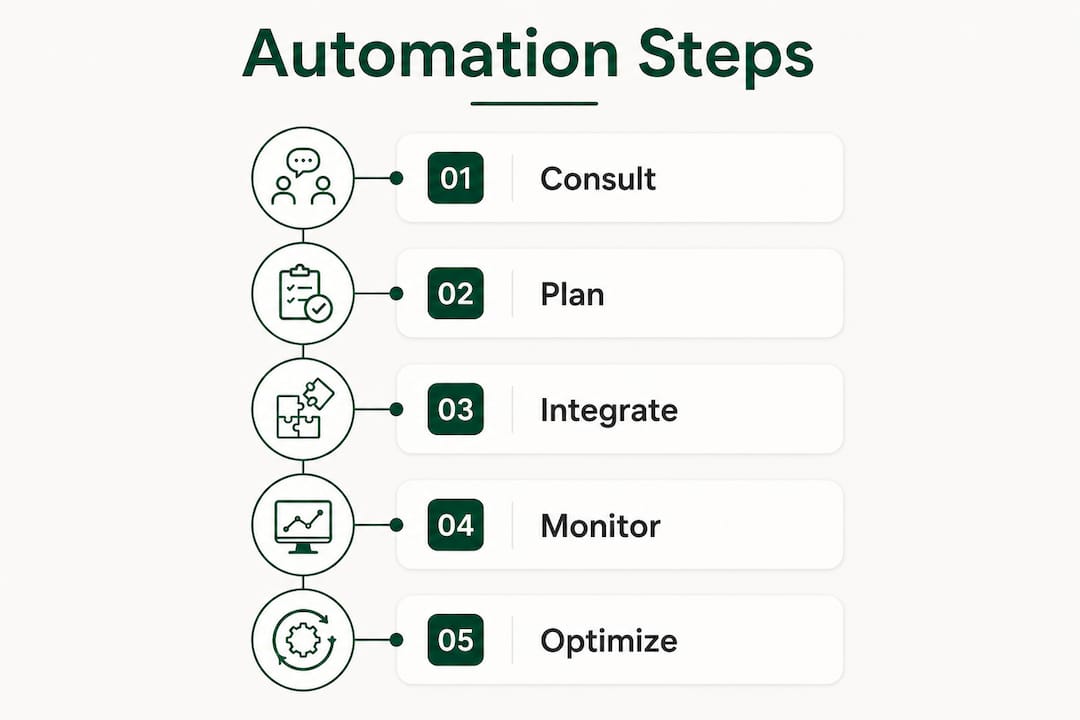
What to expect on the timeline: Most implementations go through three phases. The first 30 days focus on setup and integration. Days 30–60 involve testing and catching errors. The final phase, through day 90, is active tuning where the agency adjusts guardrails and improves data quality. Agencies that promise full results in week two are skipping steps that matter.
The quality gap is real. Post-2025, the market filled with agencies claiming AI expertise. The ones worth hiring can explain their architecture, show you the workflow logic, and demonstrate results with named metrics. Agencies using AI automation report faster content cycles, lower operational costs, and improved gross margins within the first year, but only when the implementation is done properly.
Frequently asked questions about marketing automation agencies
What does a marketing automation agency actually do? It builds and manages automated systems that handle repetitive marketing tasks: email sequences, social posting, lead nurturing, reporting, and campaign optimization, so your team focuses on strategy instead of execution.
How much does a marketing automation agency cost? Pricing varies widely. Mid-market AI implementations typically run $1,000–$5,000 per month, with ROI appearing within 3–6 months. See the pricing section below for more detail.
Is marketing automation worth it for small businesses? Yes, particularly for businesses spending significant time on repetitive tasks like follow-up emails, review requests, or social scheduling. The payoff comes faster when you start with one high-volume workflow rather than trying to automate everything at once.
Can an agency automate my existing tools, or will I need new software? A good agency integrates with what you already use. If an agency insists you replace your current CRM or email platform before they can help, that is a red flag worth taking seriously.
What do marketing automation services typically cost?
Pricing structures across Tennessee agencies vary, and most do not publish fixed rates publicly. The market follows a few common models including retainer-based, project-based, and performance-based pricing. Mid-market AI implementations typically run $1,000–$5,000 per month, with ROI appearing within 3–6 months.
Contract terms and service level agreements to watch for
Most agency contracts look reasonable until you read the fine print. A few clauses consistently cause problems for Tennessee business owners.
Ownership of deliverables: Confirm in writing that you own the content, automations, and data produced during the engagement. Some agencies retain ownership of workflow logic or creative assets, which creates problems if you switch providers.
Minimum contract length: Many agencies require 6 or 12-month commitments. That is reasonable for complex implementations, but make sure the contract specifies what deliverables you receive each month, not just a vague "services" description.
Exit terms: What happens to your automations, data, and integrations when the contract ends? Get a clear answer before signing. Agencies that cannot answer this question cleanly often built their systems in ways that make migration difficult by design.
Reporting cadence and access: You should have direct access to your analytics and ad accounts at all times, not just monthly PDF reports. If an agency controls your accounts and limits your access, you have no visibility into what is actually happening.
Scope creep clauses: Understand exactly what triggers an additional charge. Agencies that bill hourly for anything outside a vague "scope" can make ongoing work unpredictable and expensive.
Rooted Up is a different kind of option for solo professionals
If you run a solo practice or small operation in Tennessee and the agencies above feel sized for a larger business, Rooted Up offers a monthly subscription model built specifically for professionals who need consistent marketing output without a full agency overhead.
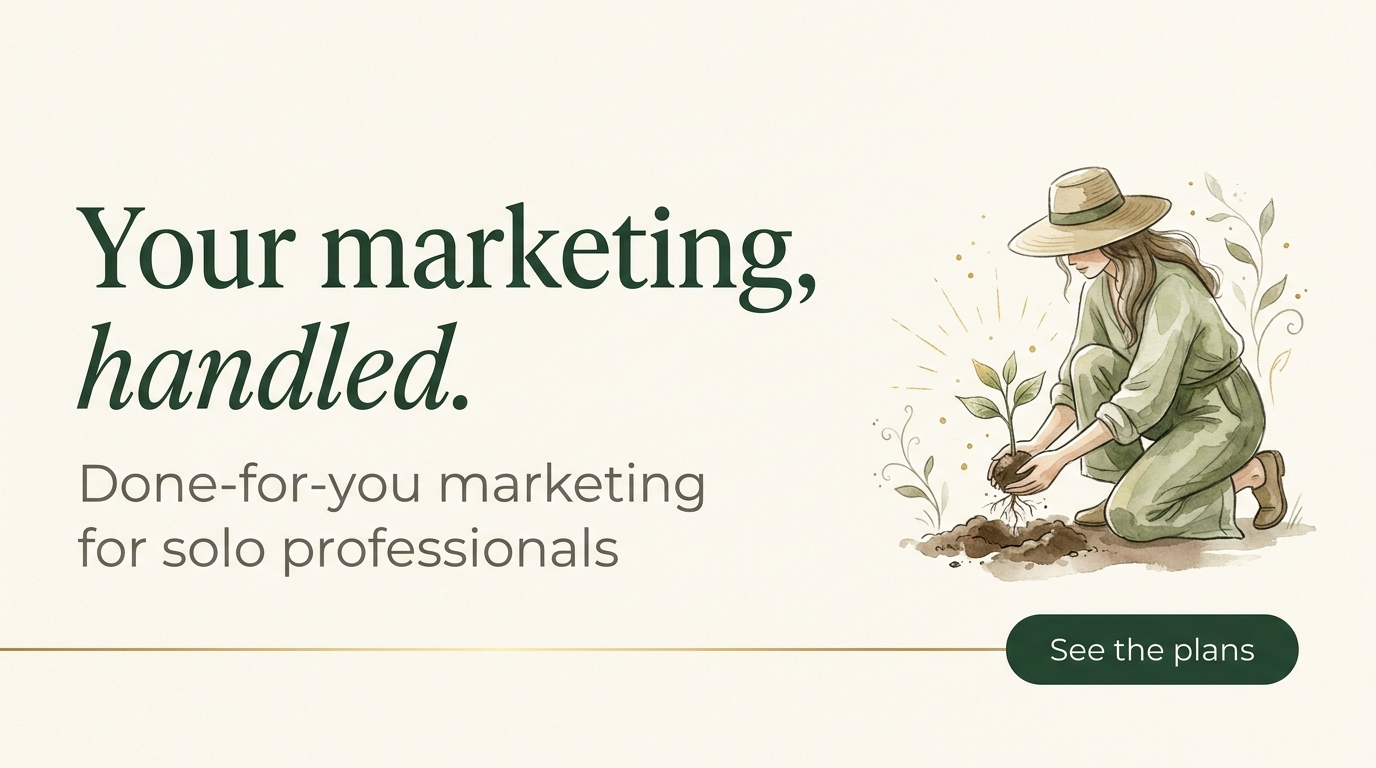
Rooted Up handles Google Business Profile management, review automation, monthly SEO blog posts, newsletters, schema hygiene, and AI workflow audits, all packaged into straightforward monthly plans. The focus is on the tasks that eat the most time for solo professionals: client acquisition, local search visibility, and reputation management.
If you want to see what a subscription-based approach to AI marketing operations looks like in practice, Rooted Up's services page lays out exactly what each plan includes.
Key Takeaways
The right marketing automation agency in Tennessee depends on your industry, workflow complexity, and how much AI integration you actually need.
| Point | Details |
|---|---|
| AI integration varies widely | Horton Group explicitly builds AI search optimization into its core service; most others use AI selectively. |
| Stabilization takes time | Expect a 30–90 day tuning phase after any automation launch before results stabilize. |
| Contract terms matter | Confirm deliverable ownership, exit terms, and direct account access before signing any agreement. |
| Pricing follows scope | Mid-market AI implementations typically run $1,000–$5,000 per month, with ROI appearing within 3–6 months. |
| Rooted Up for solo professionals | Rooted Up's monthly subscription model covers SEO, review automation, and AI workflow audits for solo practitioners. |