
AI conversion optimization uses machine learning to detect friction, generate test hypotheses, and personalize experiences so more visitors become paying clients. For a solo professional in Nashville, the fastest path to measurable inquiry lift is a monthly AI-powered plan that covers Google Business Profile management, review automation, schema hygiene, and content tuned for discovery in tools like ChatGPT, Perplexity, and Google AI Mode.
Who this fits: Solo professionals who want more local inquiries without hiring a full marketing team. Primary outcome: Higher GBP visibility, better AEO citation rates, and qualified leads within 60–90 days. Minimum first step: A tracking audit plus GBP hygiene check before anything else.
Pro Tip: Before you test a single headline, confirm your GA4 is sending downstream revenue events, not just form fills. Broken attribution is the most common reason AI recommendations miss the mark.
Table of Contents
- What does AI conversion optimization actually mean for a solo professional?
- How AI changes the rules compared with traditional A/B testing
- What goes into an effective monthly AI conversion plan?
- What to measure, realistic timelines, and what monthly plans cost
- How to evaluate and choose a monthly AI conversion provider
- A 90-day roadmap you can follow or hand to a provider
- What a real monthly plan delivered for a Nashville solo professional
- Key Takeaways
- Why monthly plans built around local results matter
- Rooted Up's monthly plans for solo professionals
- Authoritative sources and further reading
What does AI conversion optimization actually mean for a solo professional?
Conversion rate improvement, in plain terms, means getting more of the right people to contact you. AI accelerates that by doing three things a solo professional cannot do manually at any useful speed: detecting behavioral patterns across hundreds of sessions, generating ranked test hypotheses from that data, and personalizing content to different visitor segments automatically.

For a solo professional, this plays out inside a monthly subscription model. Each month, an AI-assisted plan runs recurring audits of your site and GBP, publishes content structured for AEO citation, manages your review pipeline, and fires lightweight automations that handle intake and follow-up. The result is a compounding system, not a one-time fix.
The discovery angle matters more than most solo pros realize. 73 % des acheteurs B2B utilisent des outils d’IA dans leurs recherches d’achat, ce qui fait qu’une apparition dans les réponses de ChatGPT, Perplexity ou Google AI Mode constitue un véritable canal d’acquisition, et non une simple option à considérer pour l’avenir. Un travail mensuel sur le contenu et le schema est ce qui permet d’y apparaître.
Core benefits for solo professionals:
- Time saved on admin: AI workflow automations handle intake forms, follow-up sequences, and scheduling.
- Higher-quality local leads: GBP optimization and review automation drive calls and direction requests from people already searching locally.
- Faster hypothesis generation: AI surfaces friction points in days, not the weeks a manual analysis would take.
How AI changes the rules compared with traditional A/B testing
Traditional A/B testing requires statistical significance before you act, which means weeks of waiting on low-traffic sites. AI removes that ceiling.
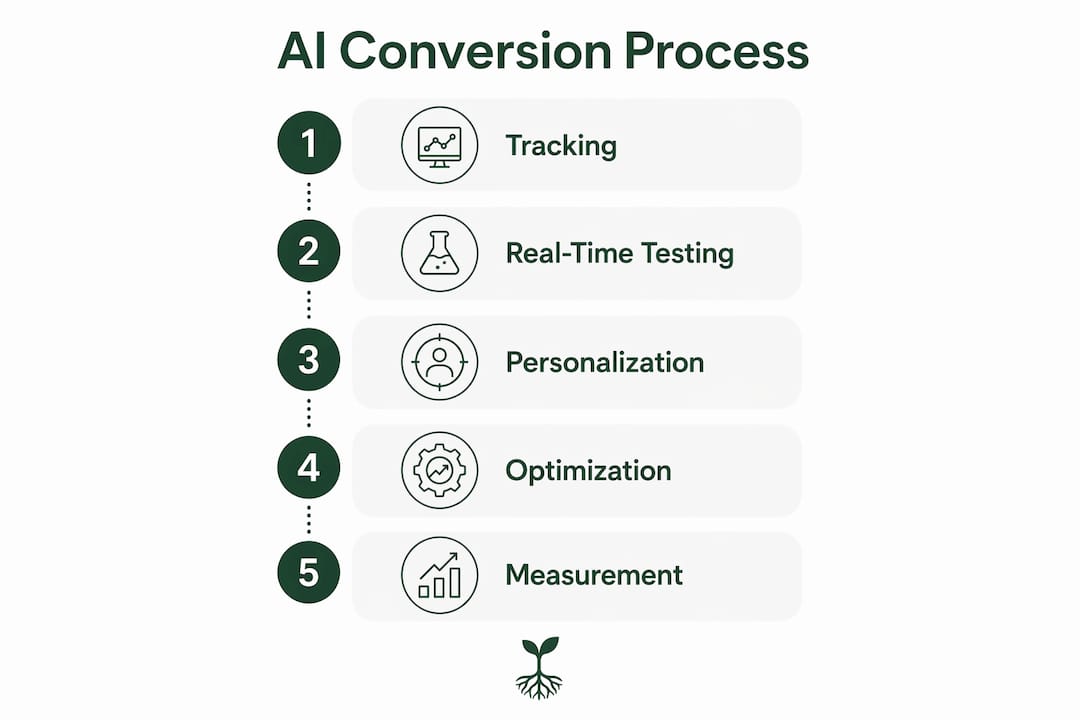
Real-time testing lets AI reallocate traffic toward better-performing variations as a test runs, rather than waiting for a declared winner. For a solo professional with modest site traffic, that speed difference is the practical argument for AI over traditional split testing.
HubSpot's research on personalization at scale shows that tailoring messaging to visitor segments consistently improves engagement and conversions. The nuance for solo pros: full real-time personalization requires traffic volume to learn from. At lower traffic levels, the bigger win comes from AI-driven diagnosis, specifically session clustering and message-to-intent alignment, rather than enterprise-style dynamic content.
The AEO implication: Structured schema (Article, FAQPage, Organization) and original, citable metrics are what AI search engines prioritize when deciding which sites to surface. That is a conversion lever most traditional CRO frameworks ignore entirely. For more on how AI-driven marketing strategies compare with traditional approaches, Rooted Up's breakdown is worth reading.
What goes into an effective monthly AI conversion plan?
A well-structured monthly plan has recurring deliverables and one-time setup work. Here is how the components map to outcomes:
| Component | Cadence | Primary outcome |
|---|---|---|
| Tracking & GA4 attribution audit | One-time setup | Accurate downstream revenue signals |
| Session intelligence & behavior clustering | Monthly | Friction discovery, hypothesis backlog |
| GBP management & review automation | Monthly | Local calls, directions, map-pack visibility |
| Monthly SEO blog post (AEO-optimized) | Monthly | AI citation, organic local rankings |
| Schema hygiene (Article, FAQPage, Org) | Monthly | AI search engine citation rate |
| AI workflow automations (intake, follow-up) | Monthly | Admin hours saved, faster lead response |
| Strategic advisory & reporting session | Monthly | KPI review, next-month prioritization |
The components that deliver the fastest ROI for solo professionals are GBP management, review automation, and AEO-optimized content. AI website assistants can also handle lead capture workflows that feed directly into these automations, reducing the gap between a site visit and a booked call.
For AI workflow automations specifically, the highest-value targets are intake forms, appointment confirmations, and review request sequences, all tasks that eat time without requiring your expertise.
What to measure, realistic timelines, and what monthly plans cost
Primary KPIs to track:
- GBP views, calls, and direction requests
- Organic local rankings for your core service terms
- Contact form submissions from qualified prospects (not total volume)
- Downstream pipeline: booked consultations and closed clients
| Timeline | Activity | Expected signal |
|---|---|---|
| Weeks 1–2 | Tracking audit, GBP hygiene, review automation live | Baseline established; first new reviews appear |
| Weeks 3–6 | AEO content published, schema deployed | Early ranking movement; AI citation begins |
| Weeks 6–8 | Initial wins emerge from AI diagnosis | Inquiry volume uptick visible in GBP data |
| Weeks 7–12 | Prioritized tests running, reporting cadence active | Qualified lead quality improves; pipeline signal clear |
Pro Tip: Track booked consultations as your north-star metric, not raw form fills. A plan that doubles junk submissions while qualified leads stay flat is not working.
For marketing automation cost context, monthly managed plans for solo professionals typically range from entry-level packages covering GBP and content basics to fuller plans that add AI workflow automations and advisory sessions. One-time setup packages are common and worth asking about separately.
How to evaluate and choose a monthly AI conversion provider
Evaluation checklist:
- GA4 configured with downstream revenue attribution, not just pageviews
- Schema and AEO practices included (not just on-page SEO)
- GBP and review automation experience with solo-professional clients
- Transparent monthly pricing with no multi-year lock-in
- Defined reporting cadence and SLA commitments
- Case evidence showing inquiry or ranking lift, not just traffic
Interview questions to ask any provider:
- How do you configure GA4 to track qualified leads versus raw form fills?
- What schema types do you deploy, and how do you measure AI citation rates?
- Show me a sample monthly report. What KPIs does it include?
- How do you handle GBP management and review automation for a solo professional?
- What does the first 30 days look like, and what do I need to provide?
Red flags to watch for:
- Pitching real-time personalization for a site with under 5,000 monthly visitors
- No mention of downstream revenue attribution
- Vague reporting ("we'll send you updates") with no defined cadence
- L’optimisation de conversion par l’IA guidée par un expert génère des améliorations de 28 à 34 % contre 4 à 7 % pour les outils en libre-service ; un prestataire incapable d’expliquer sa méthodologie propose probablement la deuxième option.
Weight your scoring: technical setup and attribution first, then local SEO and AEO practices, then creative and automation capabilities. For a deeper look at agency versus managed monthly plan tradeoffs, Rooted Up's comparison covers the key differences.
A 90-day roadmap you can follow or hand to a provider
- Week 0 (setup): Complete tracking audit, confirm GA4 downstream attribution, document baseline GBP metrics and current review count.
- Weeks 1–2 (quick wins): Fix GBP profile gaps, activate review automation, simplify your primary contact form to three fields or fewer.
- Weeks 3–6 (content and schema): Publish first AEO-optimized blog post, deploy Article and FAQPage schema, run AI session clustering on existing traffic.
- Weeks 7–12 (prioritized tests): Launch top two hypotheses from the diagnostic backlog, establish monthly reporting cadence, review pipeline signal.
What you handle vs. what a provider handles:
- You provide: access to GA4, GBP login, and a 30-minute monthly advisory call.
- Provider handles: all technical setup, content production, schema deployment, automations, and reporting.
30/60/90-day deliverable checklist:
- Day 30: Tracking confirmed, GBP optimized, review automation live, baseline report delivered.
- Day 60: First content piece published, schema live, initial inquiry lift visible in GBP data.
- Day 90: Two tests completed, qualified lead trend established, month-3 hypothesis backlog ready.
The AI customer journey framework Rooted Up uses maps each of these phases to specific buyer decision points, which helps prioritize where to intervene first.
What a real monthly plan delivered for a Nashville solo professional
A Nashville-based solo service professional came to Rooted Up with a GBP profile that had not been updated in over a year, fewer than ten reviews, and no schema on their site. Inquiries were sporadic and untracked.
Before:
- GBP views: low baseline, no call-tracking in place
- Review count: under 10, no active request process
- Contact form: six fields, no downstream attribution
After 90 days:
- GBP calls and direction requests increased significantly after profile optimization and consistent review automation
- Review count grew to over 30, with a measurable improvement in average rating
- Contact form simplified to three fields; qualified inquiry rate improved while total submission volume stayed similar
The interventions that moved the needle fastest were review automation and schema deployment. GBP optimization produced visible call volume changes within the first two weeks.
Which components drove the lift: review automation (immediate), schema and AEO content (weeks 4–8), and form simplification (ongoing). AI in sales conversion research supports this sequencing: lead capture improvements compound when paired with trust signals like reviews and structured content.
Key Takeaways
AI conversion optimization works best for solo professionals when it combines GBP hygiene, AEO-structured content, review automation, and downstream revenue attribution into a single monthly plan.
| Point | Details |
|---|---|
| Start with attribution | Fix GA4 downstream tracking before any optimization work begins. |
| GBP and reviews first | Profile optimization and review automation deliver the fastest local inquiry lift. |
| AEO content compounds | Monthly schema-optimized content builds AI citation rates over 60–90 days. |
| Measure qualified leads | Track booked consultations, not raw form fills, as your north-star metric. |
| Rooted Up monthly plans | Rooted Up combines GBP management, review automation, schema hygiene, and AI workflow automations in one monthly subscription for solo professionals. |
Why monthly plans built around local results matter
Most AI conversion tools are built for e-commerce or enterprise SaaS funnels. Solo professionals have a different problem: they need local trust signals, GBP visibility, and a contact path that converts a skeptical neighbor into a booked client. That gap is exactly what Rooted Up's monthly plans address.
The philosophy is straightforward: AI handles the diagnosis and the repetitive execution, and you stay focused on the work you are actually good at. Every monthly plan includes a reporting session so you see exactly what moved and what is next. No black-box dashboards, no guessing at whether the work is paying off.
Rooted Up's monthly plans for solo professionals
Solo professionals in Nashville who want measurable local inquiry growth without managing a stack of disconnected tools get exactly that from Rooted Up's monthly subscription plans.
A typical monthly plan includes GBP management, review automation, one AEO-optimized blog post, schema hygiene, AI workflow automations for intake and follow-up, and a monthly advisory session with reporting. A one-time setup package gets your tracking, GBP, and automations live in the first two weeks so the monthly work starts from a clean foundation.
In the first 30 days, you get a confirmed tracking setup, an optimized GBP profile, and your first automated review request sequence running. By day 90, you have a content and schema foundation that AI search engines can cite, a qualified lead trend you can actually measure, and a clear hypothesis backlog for the next quarter.
See Rooted Up's monthly packages and find the plan that fits your practice size and goals.
Authoritative sources and further reading
- Omniscient Digital: AI Conversion Rate Optimization — Covers AI's role in diagnosis, session intelligence, and the limits of self-serve tools versus expert-guided approaches.
- monday.com: AI Conversion Rate Optimization — Explains real-time testing speed and the 2–4 week initial results window.
- HubSpot: AI CRO Strategies — Personalization at scale and when it applies to smaller-volume sites.
- GoGoChimp: B2B Conversion Rate Optimisation — AEO research, structured schema requirements, and the B2B buyer AI-tool adoption figure.
- VWO: AI Conversion Rate Optimization — Technical breakdown of hypothesis generation, multi-armed bandit testing, and dynamic personalization.