
AI-generated content can rank well, but only when a person adds real experience, verification, and editorial judgment before it publishes. AI drafting speeds up indexing; human editing is what keeps rankings, snippet capture, and backlinks alive past the third month. Skip the editing, and you're gambling on Google's next spam update. The next section breaks down exactly what Google says about this trade.
TL;DR:
- Human editing remains essential to maintain rankings, snippet capture, and backlink strength, especially after the initial AI drafting process.
- Google's guidelines clarify that AI-produced content is judged the same as human work based on helpfulness and expertise, not creation method.
- Long-term performance favors AI-assisted content with thorough human verification over purely AI-generated pages, which underperform after three months.
- Publishing high volumes of low-value content or unverified citations triggers Google’s spam enforcement, regardless of AI use.
- Effective SEO requires a disciplined workflow with limited, well-reviewed content production, rather than focusing solely on volume scaling.
Table of Contents
- What Does Google Say About AI Content and SEO?
- Does AI-Generated Content Actually Rank?
- How to Build an AI-Plus-Human SEO Workflow
- Where AI Content Crosses Into Spam Territory
- How Should You Measure AI Content Performance?
- How Rooted Up Applies This for Solo Professionals
- The Bottom Line on AI Content and SEO
- Why Editorial Discipline Beats Publishing Volume
- A Managed Path for Professionals Without a Content Team
- Sources
What Does Google Say About AI Content and SEO?
Google's position hasn't changed much since generative AI features launched; the production method is not a ranking signal. A page written by a person, a model, or some mix of both gets judged the same way, on helpfulness and demonstrated expertise, not on who typed the first draft. That's the whole message buried inside Google Search Central's guide to optimizing for generative AI features, and it's easy to misread as a green light for mass production. It isn't.
Eligibility for AI Overviews, and other generative features still run through the same technical gates that have governed organic ranking for years:
- Your pages need to be crawlable and cleanly indexed, with no orphaned URLs or blocked resources.
- Page experience signals (load speed, mobile usability, intrusive interstitials) still factor into whether Google surfaces you at all; implementing practical local SEO tactics can enhance these signals for better visibility in search results, as explained in Restaurant SEO: The Fastest Path to More Diners From Search.
- Structured data helps Google parse your content faster, though the guidance is explicit that it's a convenience, not a requirement.
- Retrieval-augmented generation, the process behind how AI Overviews pull and cite sources, favors pages with clear, well-organized answers over pages stuffed with keywords.
What Google explicitly warns against is scaled content abuse: publishing high volumes of pages with little original value, purely to capture search traffic. Google has also clarified that its spam policies now explicitly cover generative AI responses, closing the loophole some publishers assumed existed. Inauthentic expert mentions, fabricated citations, and content built to game AI Overviews specifically all fall under active enforcement.
Does AI-Generated Content Actually Rank?
Sometimes, and the honest answer depends on your timeline. A paired 6-month tracking study following 200 matched AI and human articles found AI drafts got indexed faster, no surprise there. But the same study found human-authored pieces pulled ahead on ranking position, snippet capture, AI Overview citations, and backlink accumulation by month three, and the gap widened by month six.
Pages published purely by AI without editorial enrichment saw measurably weaker backlink growth and lower AI Overview citation rates than paired human-written pages, even when both ranked for the same keyword cluster.
A separate 16-month Google ranking study reinforces the pattern: pure AI content underperforms over the long run, but AI-assisted content with substantive human editing gets close to parity with fully human work. The editing is what closes the gap, not the drafting tool.
Where does that leave content-format decisions?
- Informational explainers, glossaries, and comparison breakdowns tolerate AI drafting well, provided a human verifies every fact.
- Opinion pieces, product reviews, and first-party case studies need a human voice from the start. Readers and Google both notice when "I tested this" reads like nobody actually did.
- Anything citing statistics or studies needs a human checking sources, since AI models routinely misattribute or invent citations.
How to Build an AI-Plus-Human SEO Workflow
The teams getting this right treat AI as a production accelerant, not a replacement for judgment. Here's the phased approach that holds up against the studies above.
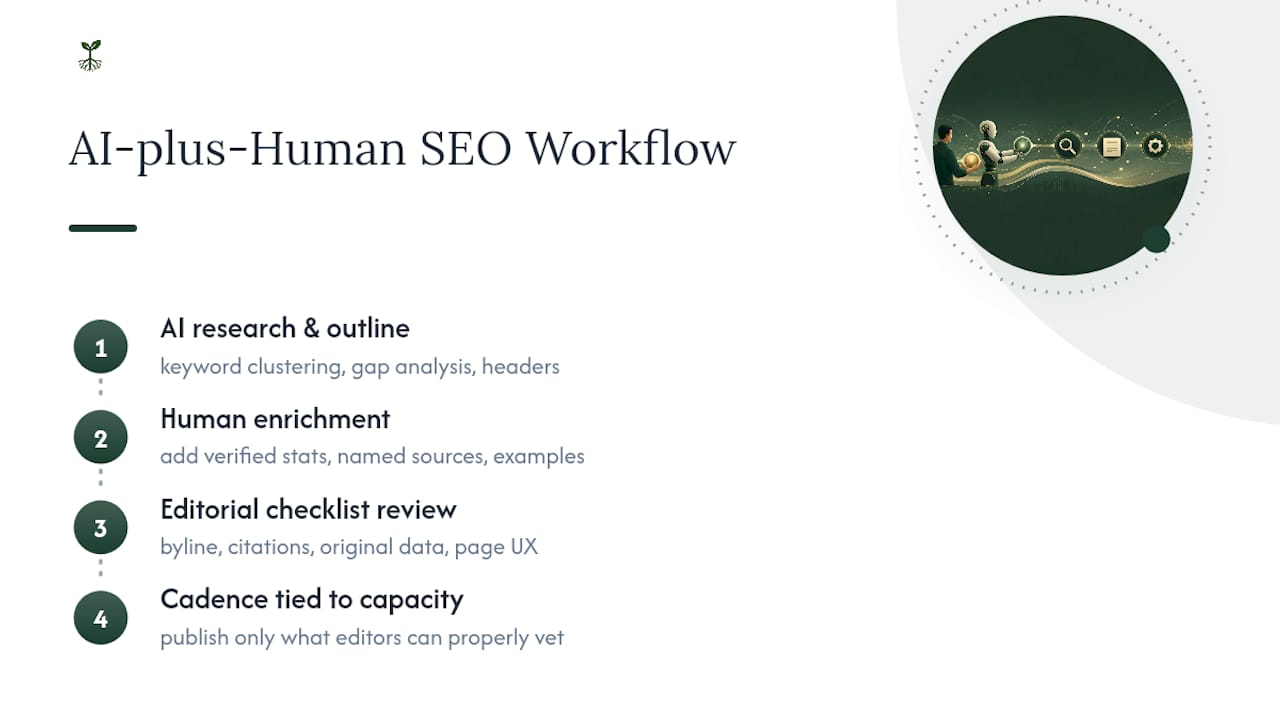
1. Research and outline with AI assistance. Use AI for keyword clustering, competitor gap analysis, and first-pass heading structures. This is genuinely pattern-matching work, and AI is fast at it. A tool built for answer engine optimization can also flag where your outline needs a direct-answer format to compete for AI Overview citations.
2. Draft, then hand off for human enrichment. Let AI produce the skeleton draft. Then a person adds what the model can't: verified statistics, named sources, first-hand examples, and the specific details that only come from actually doing the work being described. This is the step most teams skip, and it's the one the 16-month study says determines whether you approach human-level performance or fall short of it.
3. Run every draft through an editorial checklist before it publishes. Byline attribution, working citations, at least one piece of original data or firsthand observation, and a page experience check (speed, mobile rendering, no intrusive pop-ups).
4. Set cadence limits tied to editorial capacity. If your editor can properly vet three articles a week, publish three. Publishing ten AI drafts with rushed review is the exact pattern Google's spam policies target.
Pro Tip: Scale your editorial investment to keyword difficulty. A low-competition how-to post might need one editing pass. A page targeting a competitive commercial keyword, or one meant to earn an AI Overview citation, needs a subject-matter expert reviewing it, not just a copy editor.
Where AI Content Crosses Into Spam Territory
Scaled content abuse is Google's term for publishing many pages, across one site or a network, primarily to manipulate rankings rather than serve readers. The enforcement focus sits on volume paired with low originality, not on AI use itself.
Watch for these operational red flags in your own production:
- Publishing velocity that outpaces your editorial team's actual review capacity.
- Multiple pages answering nearly identical queries with only surface-level rewording.
- Citations or statistics that can't be traced to a real, checkable source.
- Author bylines attached to people with no verifiable connection to the content's subject matter.
If an audit turns up these patterns, the fix isn't panic, it's remediation. Slow your publishing velocity until editorial capacity catches up. Add genuinely unique experience to thin pages: a screenshot, a specific number from your own data, an expert quote. Some teams also add AI-use disclosures for transparency, which doesn't affect rankings directly but builds reader trust, an increasingly relevant asset for small-business AI governance. Google's own March 2024 update specifically targeted unoriginal, low-value content at scale, and that enforcement direction hasn't reversed.
How Should You Measure AI Content Performance?
Short-term metrics lie to you here. Indexing speed and first-week rank both favor AI content, which tempts teams into declaring victory before the real signal arrives.
| Timeframe | What to track | What the studies show |
|---|---|---|
| Week 1 to 2 | Indexing speed, crawl status | AI drafts often index faster |
| Month 1 | Initial rank position, page experience score | Comparable between AI and human content |
| Month 3 | Snippet capture, AI Overview citations | Human-edited content starts pulling ahead |
| Month 6 | Backlinks, ranking stability, engagement | Gap widens for pure AI vs. human-edited content |
Set your evaluation window at a minimum of three months before drawing conclusions, six if you can afford the patience. Run true A/B pairs: matched keyword difficulty, matched publish date, one AI-drafted-and-human-edited version against one fully human version. Tracking what actually earns AI Overview citations separately from standard rank position gives you a cleaner read on whether your content is winning the newer visibility surfaces, not just the old ones.
How Rooted Up Applies This for Solo Professionals
Automation is run where it earns its keep: monthly blog production, review response drafting, Google Business Profile updates. A person still reviews every piece before it goes live, because the studies are clear that unedited AI output loses ground over time.
The credibility problem with AI content isn't that a model wrote a paragraph. It's that models have no lived experience to draw on, which is exactly why ethical AI-content guidance pushes publishers to layer in named human expertise.
On client pages, that means real case studies, visible before-and-after ranking data, and bylines tied to actual people. Pro Tip: Disclose AI assistance in your process, not as a disclaimer buried in fine print, but as a normal part of describing your editorial standard. Readers trust transparency more than they distrust the tool itself.
The Bottom Line on AI Content and SEO
The operating model that survives scrutiny is simple: AI-assisted drafting, human editorial ownership, and measurement before you scale anything. Skip any one of those three and you're exposed, either to a spam policy update or to a slow bleed of rankings you won't notice until month four.
Three moves to make this week:
- Audit your last twenty published pieces for byline accuracy, source verification, and genuine original detail.
- Pilot the phased workflow above on five new pieces, capping publishing velocity to what your editor can actually review.
- Measure at the three-month mark before deciding whether your process works, not at week one.
Budget editorial time as roughly a third of total production time per piece. That ratio holds up whether you're producing two articles a month or twenty.
Why Editorial Discipline Beats Publishing Volume
The teams chasing volume are optimizing for a metric that stopped mattering the moment Google folded generative AI responses into its spam policies. I'd argue most of the anxiety around AI content is misplaced. It's not "will Google penalize AI," it's "will your editorial process catch the problems before Google's algorithms do." Those are very different questions with very different fixes.
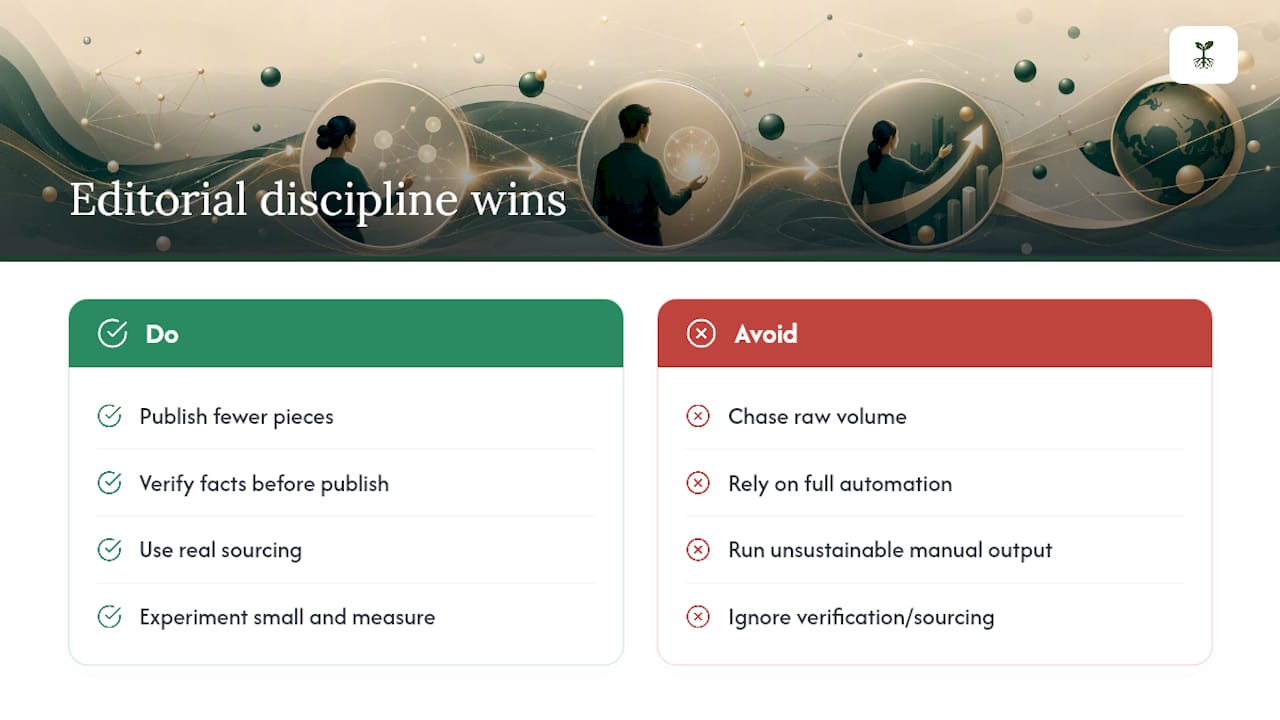
What consistently works, based on the studies tracking this over six and sixteen months, is unglamorous: fewer pieces, more verification, real sourcing. Volume without that discipline just accelerates how fast you find the ceiling.
If you're a solo professional without the bandwidth to run this process yourself, that's a legitimate constraint, not a failure. Pragmatic experimentation, starting small and measuring honestly, beats either extreme: full manual production you can't sustain, or full automation you can't defend.
— Jason
A Managed Path for Professionals Without a Content Team
If you've read this far and realized you don't have three months to spare building an editorial process from scratch, that's the exact gap Rooted Up fills. Rooted Up is the alternative to hiring an in-house content team or juggling freelance writers: one monthly plan that handles the AI drafting, the human editing pass, and the measurement, so you're not choosing between "do it yourself" and "hope a freelancer gets it right."

Monthly plans cover the pieces this article just walked through: monthly SEO blog posts with editorial oversight built in, Google Business Profile management, review and reputation automation, and AI workflow audits that catch the same red flags covered in the risk section above. For professionals weighing a managed route against other AI marketing options, the difference is that Rooted Up builds the editorial gate into the plan itself rather than leaving it as an extra step you have to remember. Check current service plans and pricing to see which package fits your caseload.
Sources
- Google Search Central: Guide to optimizing for generative AI features on Google Search
- Google updates search spam policies to clarify it applies to generative AI responses
- AI vs Human Content: 6-Month SERP Tracking Study 2026
- New ways we’re tackling spammy, low-quality content on Search — Google Blog