
Online reputation management (ORM) is the active practice of monitoring, influencing, and improving how your business appears across every digital channel. The industry term "reputation management" covers everything from Google reviews to social media sentiment to AI-generated search summaries. Businesses that take ORM seriously see measurable results: actively managing reviews drives 18% more revenue growth compared to competitors who ignore feedback. For Nashville business owners competing in a market where word travels fast, your digital reputation is often the first impression you make, and the one that sticks.
How does online reputation management work across digital channels?
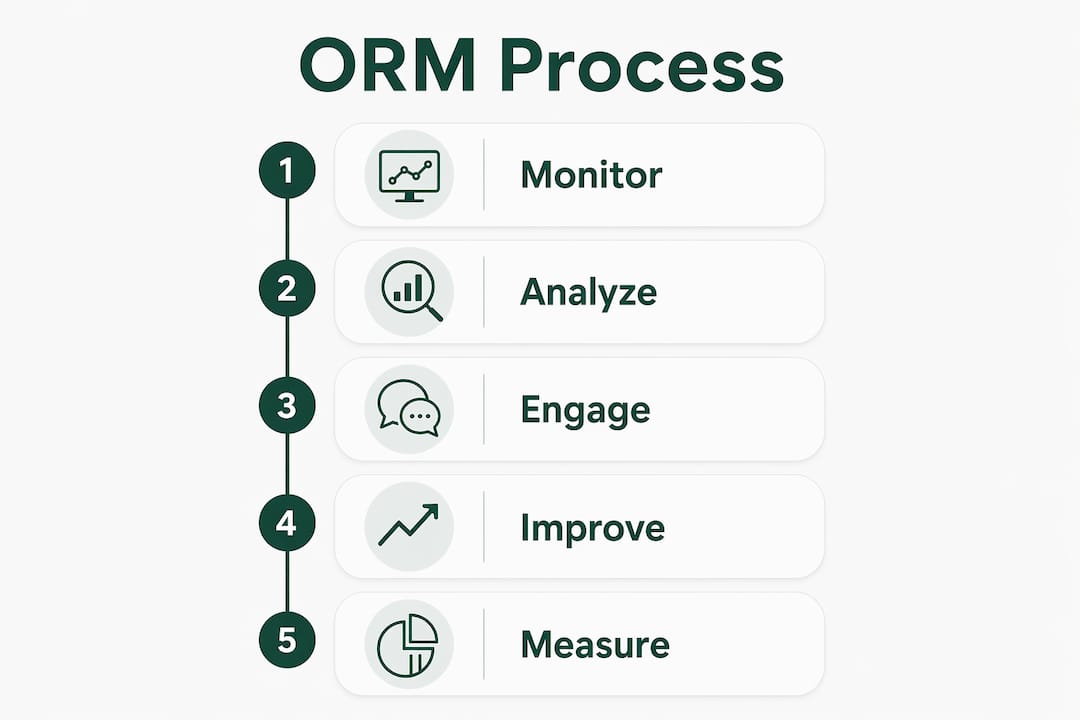
ORM operates as a continuous cycle across multiple platforms, not a one-time fix. The four stages are monitoring, analyzing, acting, and maintaining. Each stage feeds the next, and skipping any one of them creates blind spots that compound over time.
The major channels requiring active attention include Google Search results, Google Business Profile, Yelp, Facebook, industry-specific review platforms, and social media feeds. Each channel carries a different audience and a different type of risk. A negative post on Facebook spreads through shares. A low star rating on Google suppresses your local search ranking. A critical article indexed on page one of Google can follow your brand for years.

Sentiment analysis sits at the center of the analyzing stage. It classifies mentions as positive, negative, or neutral and flags patterns before they become crises. Manual sentiment tracking is slow and inconsistent. AI-powered tools now handle this at scale, which is why the technology section of this guide matters more than ever in 2026.
| Channel | Monitoring focus | Primary management action |
|---|---|---|
| Google Business Profile | Star rating, review volume, Q&A | Respond to all reviews within 24 hours |
| Yelp | Rating trends, flagged reviews | Encourage authentic reviews, report policy violations |
| Comments, shares, brand mentions | Engage publicly, resolve issues via direct message | |
| Social media feeds | Hashtags, tagged posts, sentiment | Monitor daily, respond to complaints within hours |
| News and forums | Brand mentions, Reddit threads | Publish authoritative content to push down negatives |
What are the most effective strategies for managing your online reputation?
The single most effective ORM strategy is generating a steady flow of authentic positive reviews before any crisis occurs. Proactive reputation management costs far less than reactive damage control after a public incident. Building a review pipeline means asking satisfied customers at the right moment, typically right after a successful service delivery, using a direct link to your Google or Yelp profile.
Response speed matters as much as response quality. 89% of consumers prefer businesses that respond actively to feedback. Responding within 24 hours signals that you take customer experience seriously. A delayed or absent response to a one-star review tells every future reader that you do not care.
Negative reviews require two actions, not one. The first is a public, professional response that acknowledges the complaint and offers a resolution. The second is an internal investigation into what caused the problem. Addressing root causes of complaints, whether that is a slow response time, a billing error, or a communication gap, stops the same complaint from appearing again next month.
- Send review request links immediately after service completion, not days later
- Personalize responses to negative reviews rather than using copy-paste templates
- Use AI tools to draft initial responses, then review them before posting
- Monitor your Google Business Profile weekly for new questions and outdated information
- Track your review velocity (new reviews per month) as a leading indicator of reputation health
Pro Tip: A 4.5 to 4.9 star rating builds more trust than a perfect 5.0. Consumers view flawless scores with suspicion. A handful of mixed reviews, handled well, actually signals authenticity.
How do AI and modern technologies impact reputation management in 2026?
AI has changed the speed and scale at which ORM is possible. AI-powered sentiment tools classify feedback with 87%–91% accuracy and generate responses 3.4 times faster than manual review. That speed advantage translates directly into customer satisfaction: AI-assisted response yields a 22% higher satisfaction score and saves roughly 4.7 hours per week for the average small business owner.
The bigger shift is happening in search. Google's AI-generated summaries now appear in as many as 50% of search results, shaping how potential customers perceive your business before they ever click a link. By 2028, those summaries are projected to cover 75% of searches. This means your reputation is being filtered and summarized by an algorithm, not just displayed as raw links. Businesses with consistent, high-quality review content and authoritative web pages feed those summaries with accurate information. Businesses with sparse or negative content get summarized poorly.
The practical implications for Nashville business owners are direct:
- Publish fresh, factual content about your services regularly so AI has accurate material to draw from
- Respond to reviews in natural language that reflects your brand voice, since AI tools index response quality
- Audit your Google Business Profile monthly to correct outdated hours, photos, or service descriptions
- Use AI monitoring tools to catch brand mentions across forums and news sites you would otherwise miss
AI requires human oversight. Automated responses that miss context or tone can escalate a complaint rather than resolve it. The best approach pairs AI speed with human judgment on every public-facing reply.
What common pitfalls should businesses avoid in reputation management?
The most damaging ORM mistake is ignoring negative reviews entirely. Silence reads as indifference to every prospective customer who sees that unanswered one-star rating. Consumers are skeptical of brands that suppress or ignore criticism. Transparency and engagement build more trust than a spotless record.
- Delaying responses. Waiting more than 24 hours to respond to a negative review allows the complaint to define your brand unchallenged. Speed is a signal of professionalism.
- Treating symptoms, not causes. Responding to a complaint about slow service without fixing the scheduling problem guarantees the same review next week. Operational fixes come before review solicitation.
- Over-polishing your profile. Flooding a platform with reviews in a short window looks manufactured. Review platforms flag sudden spikes, and consumers notice when every review sounds identical.
- Monitoring only one channel. A business that watches Google but ignores Facebook or Yelp misses complaints that spread across platforms before they are caught.
- Treating ORM as a crisis tool. Reputation management done only after a bad review is reactive and expensive. Proactive ORM builds lasting trust at a fraction of the cost of damage control.
Pro Tip: Set up Google Alerts for your business name and your owner name. Free, takes two minutes, and catches mentions you would never find manually.
How can you monitor and measure ORM success?
Measurement turns reputation management from a feeling into a function. The key performance indicators (KPIs) that matter most are response rate, average star rating, review velocity, and sentiment trend. Review signals account for an estimated 17% of local SEO rankings, which means these metrics connect directly to how often you appear in Nashville search results.
A unified dashboard that pulls in Google, Yelp, and Facebook reviews into one view is the most efficient monitoring setup. Daily ORM routines of just 5 minutes using a centralized dashboard outperform infrequent long sessions. Consistency beats intensity every time.
| KPI | What it measures | Benchmark to target |
|---|---|---|
| Response rate | Percentage of reviews receiving a reply | 100% across all platforms |
| Average star rating | Overall brand perception | 4.5–4.9 stars |
| Review velocity | New reviews per month | Steady growth, no sudden spikes |
| Sentiment trend | Ratio of positive to negative mentions | Improving month over month |
| Response time | Hours between review posted and reply | Under 24 hours |
Interpreting these KPIs reveals operational patterns, not just reputation scores. A spike in negative sentiment around a specific service line points to a process problem. A drop in review velocity after a staff change suggests the team is no longer asking for reviews. The data tells you where to look.
Key Takeaways
Effective online reputation management requires daily consistency, authentic engagement, and fixing the operational issues that drive complaints before asking for positive reviews.
| Point | Details |
|---|---|
| Proactive beats reactive | Building reviews before a crisis costs far less than recovering from one. |
| Response speed drives trust | Replying to all reviews within 24 hours improves satisfaction and local search rankings. |
| Authenticity over perfection | A 4.5–4.9 star rating earns more consumer trust than a perfect 5.0 score. |
| AI accelerates but needs oversight | AI tools speed up monitoring and responses, but human review prevents tone errors. |
| Measure what matters | Track response rate, review velocity, and sentiment trend as your core ORM KPIs. |
What I've learned from watching businesses ignore their reputation
Most business owners treat reputation management like a smoke alarm. They ignore it until something is burning. That instinct is understandable. Running a business in Nashville is demanding, and monitoring reviews feels like a distraction from the actual work.
The businesses I have seen recover fastest from reputation damage are the ones that already had a system in place. They had a response template they could customize. They had someone checking the dashboard daily. When a bad review hit, they responded within hours, not days. That speed alone changed how other readers perceived the complaint.
The harder truth is that authenticity is the core differentiator in modern ORM, not suppression or spin. Customers can tell when a response is genuine. They can also tell when a brand is managing its image rather than actually listening. The businesses that win long-term are the ones that use negative feedback as an operations meeting, not a PR problem.
Start with the basics before buying into sophisticated analytics platforms. Get your Google Business Profile current. Set up alerts. Respond to every review this week. Those three steps alone put you ahead of most local competitors. Build from there.
— Jason
Rooted Up's reputation management services, built for busy professionals
Nashville business owners rarely have time to monitor five platforms, respond to every review, and track sentiment trends while running their core operations. Rooted Up builds that system for you.

Rooted Up's monthly plans combine review monitoring and response with AI-powered tools that flag mentions, draft replies, and track your rating trends across platforms. The approach is direct: handle the reputation work consistently so you can focus on the work that earns the reviews. Explore Rooted Up's service packages to see which plan fits your business size and goals.
FAQ
What is online reputation management?
Online reputation management is the ongoing process of monitoring, influencing, and improving how a business appears across digital channels including search results, review platforms, and social media.
How long does it take to see results from ORM?
Most businesses see measurable improvement in review volume and response rates within 60–90 days of consistent effort. Rating improvements take longer because they depend on review velocity.
How do I manage online reputation with limited time?
A daily 5-minute routine using a unified dashboard that consolidates Google, Yelp, and Facebook reviews is the most efficient approach for time-limited business owners.
Does responding to reviews actually improve search rankings?
Yes. Review signals account for 17% of local SEO rankings, and businesses that respond within 24 hours gain 33% more engagement and higher local search visibility.
What star rating should my business aim for?
Target a rating between 4.5 and 4.9 stars. Consumers trust that range more than a perfect 5.0, which can appear manufactured rather than earned.