
Marketing automation cost is defined as the total spend required to deploy, run, and maintain software that automates repetitive marketing tasks such as email campaigns, lead scoring, and customer segmentation. Prices range from under $50 per month for basic entry-level plans to over $5,000 monthly for enterprise systems, and that gap reflects real differences in contact volume, feature depth, and operational complexity. Nashville business owners and marketing managers evaluating these platforms often focus on the monthly subscription price alone. That approach consistently leads to budget shortfalls, because the true cost of marketing automation includes implementation, integrations, training, and ongoing operational overhead that can easily double or triple the sticker price.
What factors influence the cost of marketing automation software?
Marketing automation pricing follows several distinct models, and the one your vendor uses determines how predictable your bill will be. The most common structures are per-contact pricing, per-seat licensing, usage-based billing, feature-tier subscriptions, and hybrid combinations of all four. Each model creates different financial exposure depending on how your business grows.
Contact volume is the single biggest cost driver for most small and mid-market businesses. Platforms priced per contact charge more as your list grows, so a business that starts at 5,000 contacts and grows to 25,000 can see its monthly bill multiply several times over without adding a single new feature. User seats add another layer. Platforms that charge per user penalize growing marketing teams, while flat-rate seat models reward them.
The following cost components appear across nearly every platform at every price tier:
- Subscription base fee: The published monthly or annual license price
- Contact or record volume: Charges that scale with your database size
- Message volume: Per-send fees for email, SMS, or push notifications
- User seats: Per-user charges beyond the base license
- Add-on features: AI personalization, advanced reporting, multi-domain support, and multi-channel orchestration sold separately
- Onboarding and setup: One-time fees charged by the vendor or a certified partner
- Integration costs: API connections to your CRM, e-commerce platform, or ad accounts
Usage-based pricing introduces the most financial risk. Monthly bill fluctuations of 30–50% are common with task-based or token-consumption models. That kind of variability makes quarterly budget planning a necessity, not a preference.
Hidden costs catch most buyers off guard. Data cleanup before migration ranges from $500 to $5,000. Standard API integrations cost $500–$2,000 each. Staff training and onboarding runs $300–$2,000 depending on platform complexity. These are one-time implementation costs that rarely appear in vendor sales decks.
Pro Tip: Before signing any contract, ask the vendor for a full list of fees beyond the base subscription. Request a sample invoice from a current customer at your contact volume. That single step surfaces hidden charges faster than any sales call.
How much does marketing automation cost by business size?
Cost ranges vary significantly across business stages, and the gap between entry-level and enterprise pricing is wider than most buyers expect. The table below reflects realistic annual budget ranges, not just published list prices.
| Business stage | Monthly subscription | One-time setup | Realistic year-one total |
|---|---|---|---|
| Solo / micro business | $20–$100 | $500–$2,000 | $2,000–$5,000 |
| Small business (SMB) | $50–$500 | $1,000–$5,000 | $5,000–$15,000 |
| Mid-market | $800–$5,000+ | $5,000–$15,000 | $20,000–$75,000 |
| Enterprise | $5,000–$10,000+ | $15,000–$50,000+ | $75,000–$200,000+ |
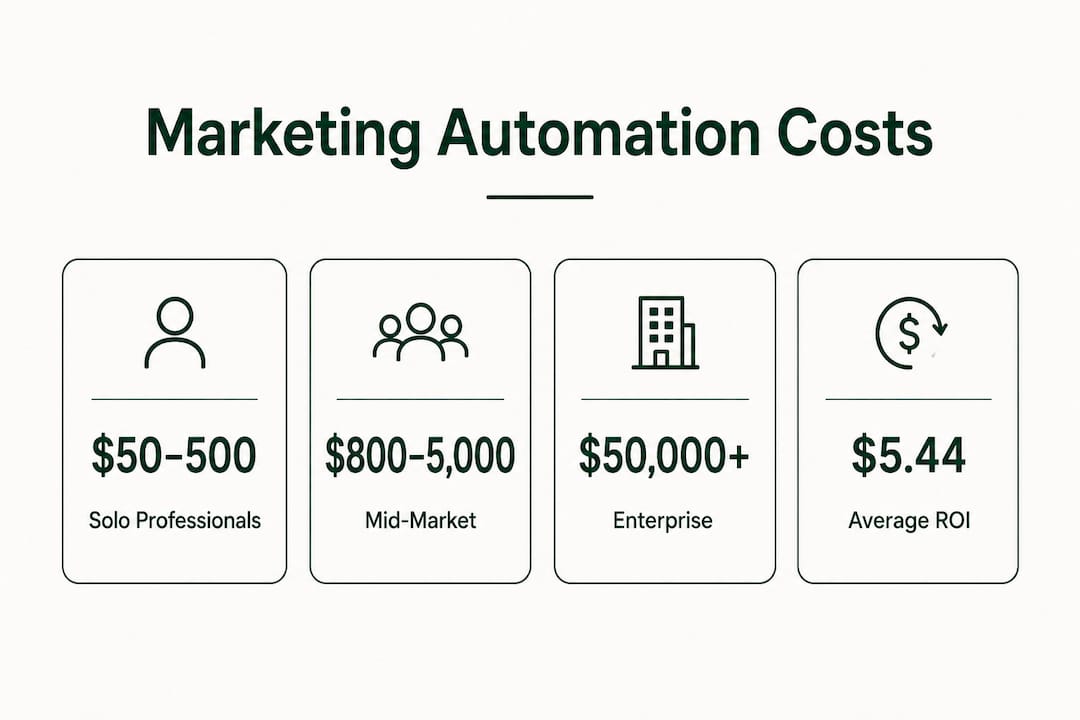
Entry-level SMB tools typically cost $50–$500 per month, but that number rarely captures the full picture. Setup fees, data migration, and the first round of template design push year-one spend well above the monthly rate multiplied by twelve.

Mid-market businesses face a steeper climb. True mid-market costs often run 2x–4x the entry price once you account for contact volume, add-ons, user licenses, and messaging surcharges. A platform advertised at $800 per month can realistically cost $2,500–$3,200 per month once your actual usage is factored in.
Enterprise deployments operate in a different category entirely. Implementation fees alone can exceed $50,000, and that figure does not include the internal staff time required to manage the rollout. For Nashville businesses in growth mode, the most common mistake is buying an enterprise-tier platform before the team has the operational maturity to use it effectively. Starting at the mid-market tier and scaling up is almost always the more cost-efficient path.
Realistic growth planning matters here. A business that expects to double its contact list in 18 months should model costs at the higher contact tier from day one. Repricing surprises mid-contract are avoidable with basic forecasting.
What are the hidden costs that affect total cost of ownership?
Total cost of ownership is the metric that separates informed buyers from surprised ones. Buyers who focus only on vendor sticker prices routinely underestimate their actual expenses by 2x–10x over a three-year period. That is not a rounding error. It is a budget failure.
The costs that most often go unbudgeted fall into these categories:
- Data hygiene: Dirty contact lists inflate your tier and reduce deliverability. Cleaning a list of 25,000 contacts before migration is a real expense, not a technical detail.
- API integrations: Connecting your automation platform to your CRM, ad accounts, or e-commerce system costs $500–$2,000 per integration. Middleware tools like Zapier add monthly fees on top of that.
- Ongoing maintenance: Workflows break. Integrations need updates when vendors push new API versions. Budget for at least a few hours of technical work per month.
- Staff training: A platform your team does not know how to use delivers zero ROI. Training costs $300–$2,000 upfront and requires ongoing time investment as features evolve.
- Add-on features: SMS messaging, AI-driven personalization, and advanced analytics are rarely included in base plans. Each one adds to your monthly bill.
- Workflow management: Someone on your team needs to own the platform. That labor cost is real even if it does not appear on a vendor invoice.
Pro Tip: Pruning your contact list before you migrate pays for itself immediately. Cutting from 25,000 to 10,000 marketed contacts can drop a $900 per month plan to roughly $300 per month. Audit your list before you sign.
One underappreciated risk is the volatility of usage-based billing. If your campaigns run heavier than projected in a given month, your bill spikes with no warning. Building a 20–25% buffer into your monthly automation budget is a practical way to absorb that variability without scrambling.
What ROI can you expect from marketing automation?
The financial case for marketing automation is well-documented. Marketing automation delivers an average ROI of $5.44 for every $1 spent over three years. That figure comes from programs that have reached operational maturity, not from businesses in their first 90 days of deployment.
The timeline matters as much as the number. 77% of companies achieve positive ROI within 12 months of implementation. 44% see positive returns within just six months. Those results require active use of the platform, not just a subscription sitting idle.
Operational benefits compound over time:
- Sales productivity: Mature automation programs boost sales productivity by over 14.5%, freeing your team to focus on closing rather than manual follow-up.
- Marketing overhead reduction: Automation reduces marketing overhead by more than 12%, which directly lowers your cost per acquisition.
- Lead quality: Programs that include lead scoring and multi-channel orchestration report a 451% lift in qualified leads compared to non-automated programs.
ROI is rarely immediate. Early-stage implementations typically automate a single channel, such as email, and see modest returns. The lift accelerates when businesses add lead scoring, behavioral triggers, and cross-channel sequences. That progression takes time and deliberate investment in platform adoption.
The practical implication for your budget is this: do not evaluate marketing automation purely on month-one results. Model your expected ROI at 6, 12, and 36 months. That longer view justifies the full cost of ownership and gives you a realistic benchmark for measuring success.
Key Takeaways
Marketing automation delivers strong ROI, but only when buyers budget for the full cost of ownership, including setup, integrations, training, and ongoing operations, not just the monthly subscription fee.
| Point | Details |
|---|---|
| Subscription is just the start | Year-one costs include setup, data cleanup, integrations, and training on top of monthly fees. |
| Size determines price range | SMBs typically spend $50–$500 per month; mid-market firms often pay 2x–4x that after add-ons. |
| Hidden costs are predictable | Budget for API integrations ($500–$2,000 each), data cleanup ($500–$5,000), and staff training ($300–$2,000). |
| ROI is real but takes time | 77% of companies see positive ROI within 12 months; mature programs average $5.44 per $1 spent. |
| List hygiene cuts costs fast | Pruning your contact list before migration can reduce your monthly plan tier significantly. |
The cost mistake I see Nashville businesses make most often
The most common error I see is treating the vendor's published price as the budget. A business owner in Nashville sees "$299 per month" on a pricing page, multiplies by 12, and calls it a year. Six months later, they are paying $900 per month and wondering what happened.
What happened is contact growth, add-ons, and a mandatory onboarding package they did not read the fine print on. The platform did not deceive them. They just did not ask the right questions before signing.
My honest recommendation is to evaluate every platform on a three-year total cost of ownership, not a monthly rate. That means projecting your contact list growth, identifying every add-on you will realistically need, and pricing out integrations with your existing tools before you commit. A platform that costs more upfront but fits your existing tech ecosystem will almost always be cheaper over three years than a cheaper platform that requires expensive middleware and custom development to connect.
The other mistake I see is overbuying. A solo consultant or a five-person marketing team does not need enterprise-grade automation. Start with a mid-tier plan that covers your core workflows, run it for six months, and then evaluate what features you actually use. Incremental adoption builds ROI steadily. Buying every feature on day one mostly builds a large invoice.
For businesses serious about getting this right, working with a partner who understands both the platform and your operational context shortens the learning curve and reduces the risk of expensive missteps.
— Jason
How Rooted Up helps you get more from your automation budget
Getting the pricing right is only half the challenge. The other half is making sure your automation platform actually performs once it is live.

Rooted Up works with solo professionals and growing businesses to select, deploy, and manage marketing automation in a way that fits their budget and their goals. From platform selection and integration setup to campaign execution and ongoing workflow management, Rooted Up's monthly marketing plans are built to reduce overhead and increase client acquisition without the complexity of managing it all yourself. If you are ready to stop guessing at your automation costs and start seeing measurable returns, Rooted Up is the partner built for that work.
FAQ
What is the average marketing automation cost per month?
Small businesses typically pay $50–$500 per month for entry-level platforms, while mid-market businesses budget $800–$5,000 or more. Enterprise solutions often exceed $10,000 per month before implementation fees.
What hidden costs should I budget for?
Budget for data cleanup ($500–$5,000), API integrations ($500–$2,000 each), staff training ($300–$2,000), and ongoing workflow maintenance. These one-time and recurring costs frequently exceed the subscription fee in year one.
How long does it take to see ROI from marketing automation?
77% of companies achieve positive ROI within 12 months, and 44% see returns within six months. Results depend on how actively the platform is used and how quickly workflows mature.
Does contact list size really affect my monthly bill?
Contact volume is one of the primary pricing drivers on most platforms. Pruning a list from 25,000 to 10,000 marketed contacts can reduce a $900 per month plan to roughly $300 per month on contact-based pricing tiers.
Is affordable marketing automation realistic for small businesses?
Yes. Entry-level plans from established platforms start at $20–$100 per month and cover core email automation and basic segmentation. The key is matching the plan to your actual contact volume and workflow needs rather than buying features you will not use for 12 months.