
AI workflow automation is the integration of artificial intelligence into business processes to automate decisions, data handling, and actions across connected systems. This is distinct from simply using AI tools in isolation. The industry standard term for this practice is AI business process automation, or AI BPA. 72% of SMBs have already adopted AI-driven automation tools, reporting an average 38% reduction in manual labor costs within the first year. That adoption rate signals a shift: AI workflow automation is no longer an enterprise-only advantage. For Nashville business owners managing lean teams and tight margins, understanding how these systems work is now a competitive necessity.
What are the core components of AI workflow automation?
AI workflow automation operates through five distinct architecture layers. Each layer handles a specific job, and together they convert raw inputs into business outcomes without manual intervention.
The five layers are:
- Data ingestion: Collects inputs from emails, forms, CRMs, PDFs, and APIs.
- Semantic parsing: Uses natural language processing and OCR to extract meaning from unstructured data.
- Orchestration: Sequences tasks, manages errors, and routes work between systems or agents.
- Action execution: Triggers real outputs such as sending emails, updating records, or generating invoices.
- Governance: Applies approval gates, audit logs, and confidence thresholds before high-risk actions run.
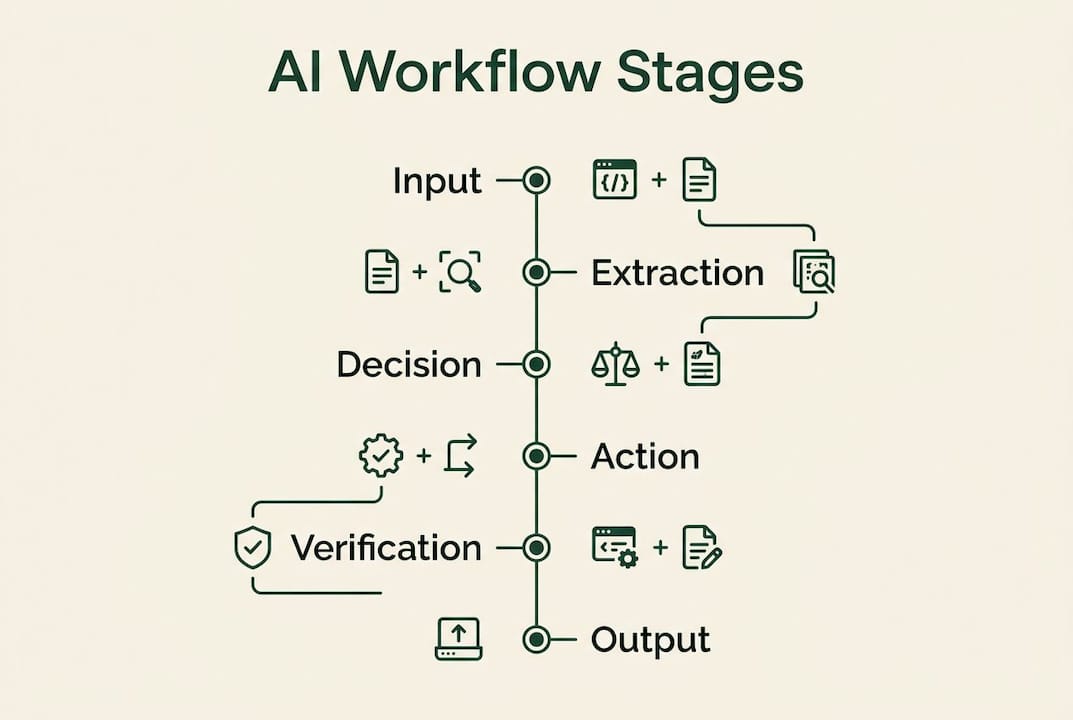
Effective AI BPA implementations separate these five layers to build workflows that scale reliably. Skipping any layer, especially governance, creates brittle systems that fail silently. The structured pipeline approach follows the sequence: Input, Extraction, Decision, Action, Verification, and Output. Each stage hands off a validated result to the next, which is what separates AI BPA from older automation methods.
A practical example: a Nashville consulting firm receives a client intake form by email. The ingestion layer captures it. Semantic parsing extracts the client name, service request, and budget. Orchestration checks the CRM for existing records and routes the lead to the right team member. Action execution creates a follow-up task and sends a confirmation email. Governance logs the entire sequence for review.

Pro Tip: Build your governance layer before you scale. Adding audit trails and approval gates after the fact is significantly harder than designing them in from the start.
| Layer | Primary function |
|---|---|
| Data ingestion | Collects inputs from all connected sources |
| Semantic parsing | Extracts meaning from unstructured text and documents |
| Orchestration | Sequences tasks and manages errors between systems |
| Action execution | Triggers real outputs in connected apps |
| Governance | Enforces approvals, audit logs, and risk controls |
How does AI workflow automation differ from traditional automation?
Traditional workflow automation follows fixed rules. If a condition is true, a specific action fires. This works well for structured, predictable data. Robotic Process Automation, or RPA, extends this by mimicking human clicks and keystrokes inside software interfaces. Both methods break the moment inputs change format or a new exception appears.
AI BPA handles what traditional automation cannot:
- Unstructured inputs: AI reads and interprets emails, contracts, and voice transcripts, not just form fields.
- Decision-making: AI models classify, rank, and recommend rather than just routing based on fixed rules.
- Adaptive handling: When an exception occurs, AI can assess it and escalate rather than failing outright.
- Multi-agent orchestration: Manager-Worker and Sequential agent models distribute complex tasks across specialized AI agents, improving reliability and auditability in ways single-bot RPA cannot match.
Intelligent Process Automation, or IPA, sits between RPA and full AI BPA. IPA adds machine learning to RPA but still relies on structured workflows. AI BPA goes further by embedding large language models, classifiers, and OCR into the orchestration layer itself.
Pro Tip: Do not replace RPA with AI BPA everywhere at once. Keep RPA for high-volume, perfectly structured tasks like data entry into legacy systems. Use AI BPA where inputs vary or decisions are required.
The practical difference for a small business owner: RPA can auto-fill a spreadsheet from a fixed CSV file. AI BPA can read a vendor email, extract the invoice data, match it to a purchase order, flag discrepancies, and request human approval before payment, all without a single rule written for that specific email format.
What ROI can SMBs realistically expect?
The financial case for AI workflow automation is concrete. A portfolio of 8–12 integrated automations generates an average annual labor-equivalent value of $78,000 for SMBs with 5–25 employees. The range runs from $20,000 to $200,000 depending on scale and the complexity of workflows automated. That figure represents time recovered from manual tasks and redirected to revenue-generating work.
Customer-facing workflows show some of the fastest returns. AI triage integration reduces first-response times on customer inquiries by 60–75%. For a service business in Nashville competing on responsiveness, that speed advantage directly affects close rates and client retention.
The highest-value automations for SMBs typically include:
- Lead qualification and follow-up: AI scores inbound leads and triggers personalized outreach within minutes of contact.
- Invoice and billing processing: AI extracts data from vendor documents and routes for approval without manual entry.
- Appointment scheduling: AI handles booking confirmations, reminders, and rescheduling across calendar systems.
- Reputation and review management: Automated workflows monitor, flag, and respond to online reviews, a use case detailed in reputation management workflows.
- Reporting and analytics: AI pulls data from multiple sources and generates weekly summaries without manual compilation.
ROI from AI automation comes from embedding AI outputs directly into business systems, not from using AI as a standalone tool. A business that uses an AI writing assistant but still manually copies outputs into its CRM captures only a fraction of the available value. The full return comes when AI outputs trigger the next step automatically.
What are the best practices for implementing AI workflow automation?
The most common mistake SMBs make is adding AI to a broken process. Automating a flawed workflow produces flawed results faster. Workflow redesign must come before automation. Map the current process, identify the bottlenecks, remove unnecessary steps, and then wire AI into the redesigned version.
Orchestration is the critical factor that separates a collection of AI tools from a working system. Without it, automations become isolated helpers that do not communicate. Orchestration manages sequencing, handles errors, escalates exceptions, and routes tasks to human reviewers when confidence thresholds are not met.
Governance deserves equal attention. Human-in-the-loop checkpoints and approval gates prevent high-risk errors from propagating through connected systems. Action gateways validate AI outputs before executing sensitive tasks such as sending payments or publishing content. Audit logs create a record that builds stakeholder trust and supports compliance.
Practical implementation steps for SMBs:
- Start with one high-impact, well-defined workflow rather than automating everything at once.
- Measure financial outcomes, not just usage metrics. Track time saved, errors reduced, and revenue influenced.
- Treat verification as a trust boundary. Build rollback paths so errors can be reversed quickly.
- Audit data quality before connecting it to AI models. Garbage inputs produce garbage outputs.
- Avoid tool sprawl. Three well-integrated platforms outperform ten loosely connected ones.
Pro Tip: Pick your first automation based on frequency and pain, not complexity. A task done 20 times a day with a clear input and output is a better starting point than a complex approval workflow.
What features matter most in AI workflow automation tools?
Platform selection depends on your team's technical capacity and the complexity of your workflows. No-code and low-code platforms like Zapier AI+ and Make enable non-technical teams to build automations through drag-and-drop interfaces with thousands of SaaS integrations. These platforms suit SMBs that need fast deployment and do not have dedicated developers.
Technical platforms offer more control over model selection, custom logic, and data handling. They require developer resources but support more complex orchestration patterns, including multi-agent workflows.
Key features to evaluate when choosing a platform:
- Integration breadth: Does it connect natively to your CRM, email, calendar, billing, and communication tools?
- AI model support: Can it call large language models, OCR engines, and custom classifiers within the same workflow?
- Orchestration capabilities: Does it handle branching logic, error retries, and human escalation natively?
- Security controls: Look for role-based access control, data encryption, and audit logging as standard features.
- Pricing transparency: Understand how costs scale with usage. Automation platforms that charge per task can become expensive quickly as volume grows.
Deployment timelines vary. Simple no-code automations can go live within days. Complex multi-system workflows with custom AI models typically take four to eight weeks to design, test, and deploy. For SMBs evaluating marketing workflow tools, integration depth with existing systems is often the deciding factor.
Key Takeaways
AI workflow automation delivers measurable ROI only when AI is embedded directly into business systems, not used as a standalone tool alongside manual processes.
| Point | Details |
|---|---|
| Five-layer architecture | Reliable AI BPA requires ingestion, parsing, orchestration, execution, and governance layers working together. |
| Redesign before automating | Automating a flawed process produces faster errors; map and fix workflows before adding AI. |
| Orchestration is non-negotiable | Without orchestration, AI tools operate in isolation and cannot deliver system-level outcomes. |
| SMB ROI benchmarks | SMBs with 8–12 integrated automations average $78,000 in annual labor-equivalent value. |
| Start small and measure | Begin with one high-frequency workflow and track financial outcomes, not just activity metrics. |
AI automation works best when it becomes infrastructure
The businesses I see getting the most from AI workflow automation share one trait: they stopped treating AI as a tool and started treating it as infrastructure. That shift in thinking changes everything about how you design, deploy, and govern your workflows.
Most SMB owners I talk with in Nashville start by asking which AI tool to buy. That is the wrong first question. The right question is: which workflow, if automated end-to-end, would free up the most time or generate the most revenue? Start there. Build one complete workflow with proper orchestration and governance. Measure the financial outcome after 60 days. Then expand.
The governance piece gets skipped more than any other. Teams rush to automate and skip the audit trails, approval gates, and rollback paths. Then one bad output causes a client issue, and confidence in the entire system collapses. Verification as a trust boundary is not optional. It is what makes automation sustainable.
The cultural shift matters too. Your team needs to understand that AI handles the repetitive decisions so they can focus on the ones that require judgment. That framing reduces resistance and accelerates adoption. Automation is not a threat to their jobs. It is the thing that removes the work they dislike most.
— Jason
How Rooted Up helps Nashville SMBs build real automation systems
Running a business in Nashville means competing on speed, service, and local reputation. Rooted Up works directly with small and mid-sized businesses to design and implement AI workflow automation systems that produce measurable results, not just activity reports.
Rooted Up's AI automation services cover workflow redesign, platform integration, orchestration setup, and governance design. Every engagement starts with identifying the workflows that will generate the highest financial return first. Whether you need to automate client intake, billing, follow-up sequences, or reputation management, Rooted Up builds systems that connect your existing tools and deliver outcomes you can track. Reach out to Rooted Up to schedule a workflow assessment and see exactly where automation can recover time and revenue in your operation.
FAQ
What is AI workflow automation?
AI workflow automation is the use of artificial intelligence to automate decisions, data processing, and actions across connected business systems. It goes beyond rule-based automation by handling unstructured inputs and making context-aware decisions.
What are the 4 stages of an AI workflow?
The core stages are Input, Extraction, Decision, and Action, often extended with Verification and Output to form a complete pipeline. Each stage validates its result before passing it to the next.
How much can an SMB save with AI workflow automation?
SMBs with 5–25 employees running 8–12 integrated automations average $78,000 in annual labor-equivalent value, with a range of $20,000 to $200,000 depending on scale and workflow complexity.
What is the difference between RPA and AI BPA?
RPA automates structured, rule-based tasks by mimicking user actions in software. AI BPA handles unstructured inputs, makes decisions using AI models, and manages complex multi-step workflows with orchestration and governance built in.
How long does it take to implement AI workflow automation?
Simple no-code automations can go live within days. Complex multi-system workflows with custom AI models typically require four to eight weeks to design, test, and deploy reliably.